
We read your photo as:
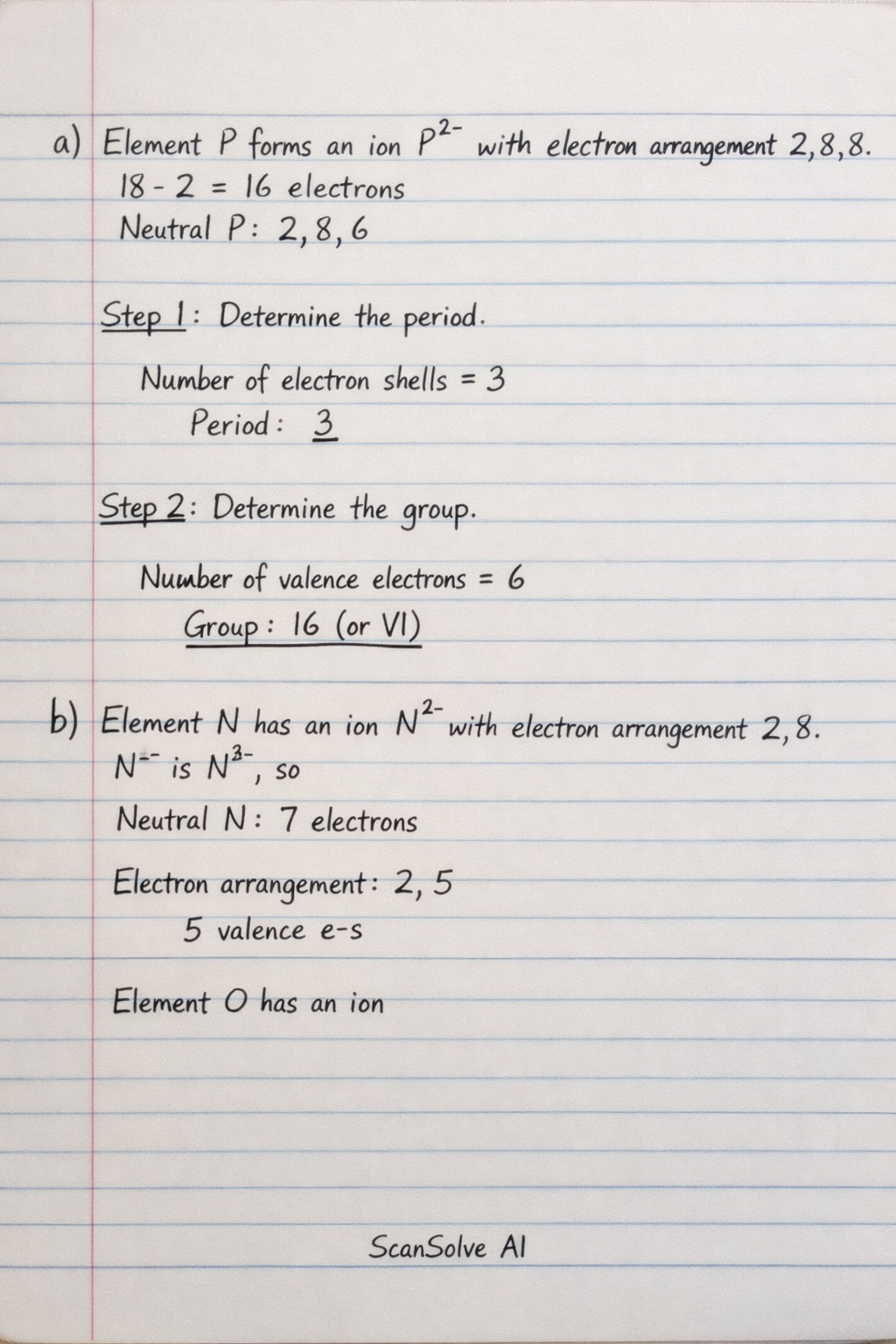
A) Element P forms an ion P²⁻ with electron arrangement 2.8.8.
Physics
ScanSolve AI Answer
Step-by-step solution
2 stepsPart a· 2 steps
Element P forms an ion P²⁻ with electron arrangement 2.8.8.
This means the neutral atom P has 18 - 2 = 16 electrons.
The electron arrangement of neutral P is 2.8.6.
Determine the period.
The number of electron shells is 3.
Period: 3Determine the group.
The number of valence electrons is 6.
Group: 16 (or VI)
Part b
Element N has an ion N' with electron arrangement 2.8. This implies N' is N³⁻, so neutral N has 7 electrons with electron arrangement 2.5 (5 valence electrons).
Element O has an ion
Was this helpful?
Still stuck on this one?
Ask a follow-up, and the answer starts from this question.
Got a different question?Ask your own question
More Physics Questions
QUsing the provided information about element P (forms P³⁺, in Period 3, not actual symbol, atomic…QAn element P forms a stable ion with the formula P³+. P is in period 3 of the periodic table. (P is…Q| Element | No of electrons | Electron arrangement | Diagram showing electron arrangementQDetermine the molecular formula of compound P.QA) Explain why S is not an ion. b) Determine the number of electrons in the neutral atoms of P, Q, R…
Handwritten Step-by-Step Solution
Get this as a handwritten image on WhatsApp — like a tutor wrote it for you.
Try on WhatsApp