
We read your photo as:
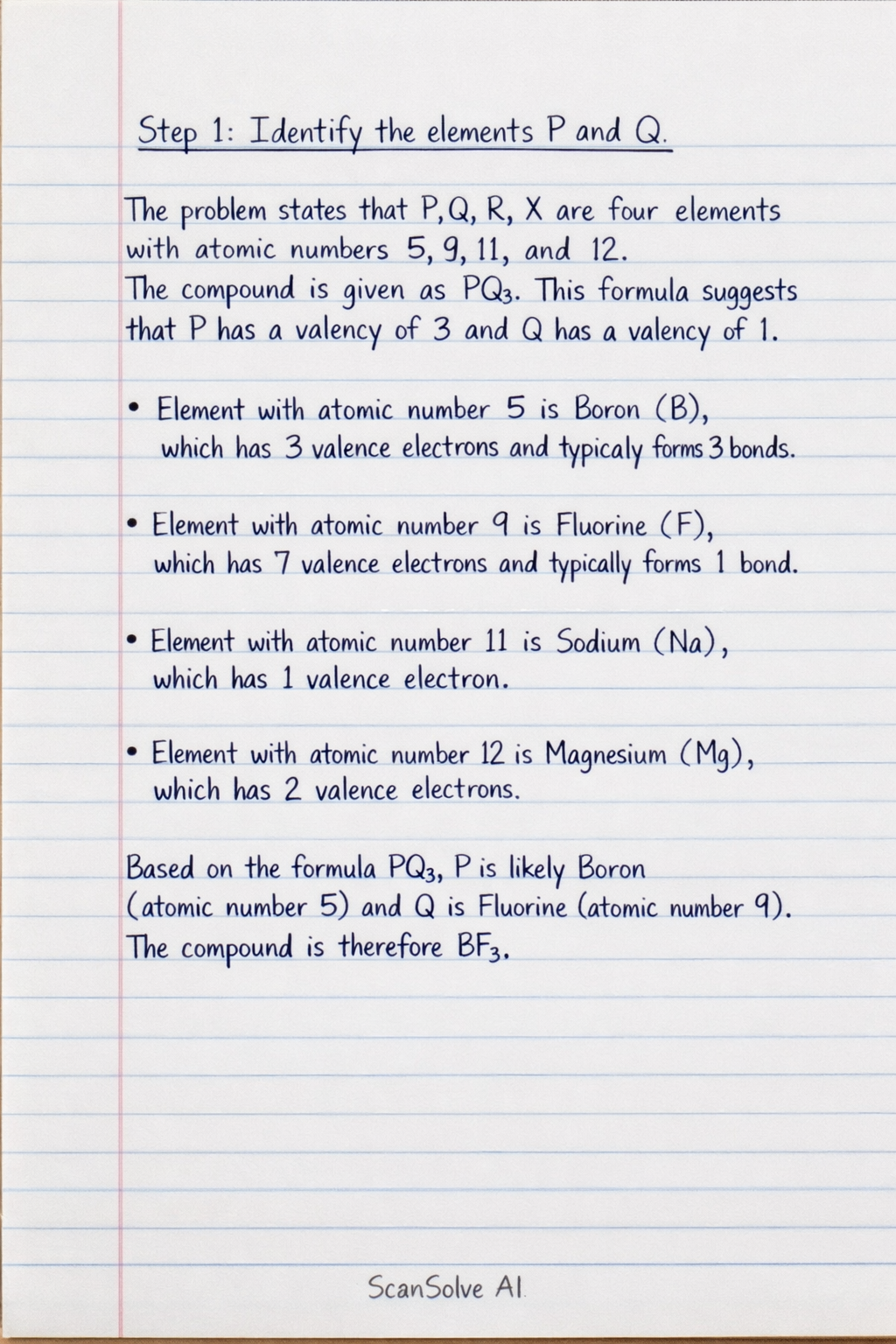
The problem states that P, Q, R, X are four elements with atomic numbers 5, 9, 11, and 12. The compound is given as PQ₃. This formula suggests that P has a valency of 3 and Q has a valency of 1.
ScanSolve AI Answer
Answer
Step-by-step solution
4 stepsIdentify the elements P and Q.
The problem states that P, Q, R, X are four elements with atomic numbers 5, 9, 11, and 12. The compound is given as PQ₃. This formula suggests that P has a valency of 3 and Q has a valency of 1.
- Element with atomic number 5 is Boron (B), which has 3 valence electrons and typically forms 3 bonds.
- Element with atomic number 9 is Fluorine (F), which has 7 valence electrons and typically forms 1 bond.
- Element with atomic number 11 is Sodium (Na), which has 1 valence electron.
- Element with atomic number 12 is Magnesium (Mg), which has 2 valence electrons. Based on the formula PQ₃, P is likely Boron (atomic number 5) and Q is Fluorine (atomic number 9). The compound is therefore BF₃.
Determine the number of lone pairs on the central atom (P).
In BF₃, Boron (P) is the central atom.
Boron has 3 valence electrons.
It forms 3 single bonds with 3 Fluorine atoms.
All 3 valence electrons of Boron are used in bonding.
Number of lone pairs on Boron = .Determine the number of lone pairs on the surrounding atoms (Q).
There are 3 Fluorine (Q) atoms. Each Fluorine atom has 7 valence electrons.
Each Fluorine atom forms 1 single bond with Boron.
Number of electrons used by each Fluorine in bonding = 1.
Number of lone pairs on each Fluorine atom = .Calculate the total number of lone pairs in the PQ₃ molecule.
Total lone pairs = (Lone pairs on P) + (Number of Q atoms Lone pairs on each Q atom)
Total lone pairs = .The total number of lone pairs in the PQ₃ molecule is 9.
The final answer is .
Try one yourself
A new problem that tests the same skill.
Still stuck on this one?
Ask a follow-up, and the answer starts from this question.
More Chemistry Questions
Handwritten Step-by-Step Solution
Get this as a handwritten image on WhatsApp — like a tutor wrote it for you.
Try on WhatsApp