
We read your photo as:
When 50cm³ of 2M HCl was neutralised by an equal volume of 2M NaOH, it initially rose to a minimum of 33.7°C. What is the molar enthalpy of neutralisation of NaOH?
ScanSolve AI Answer
Answer
Step-by-step solution
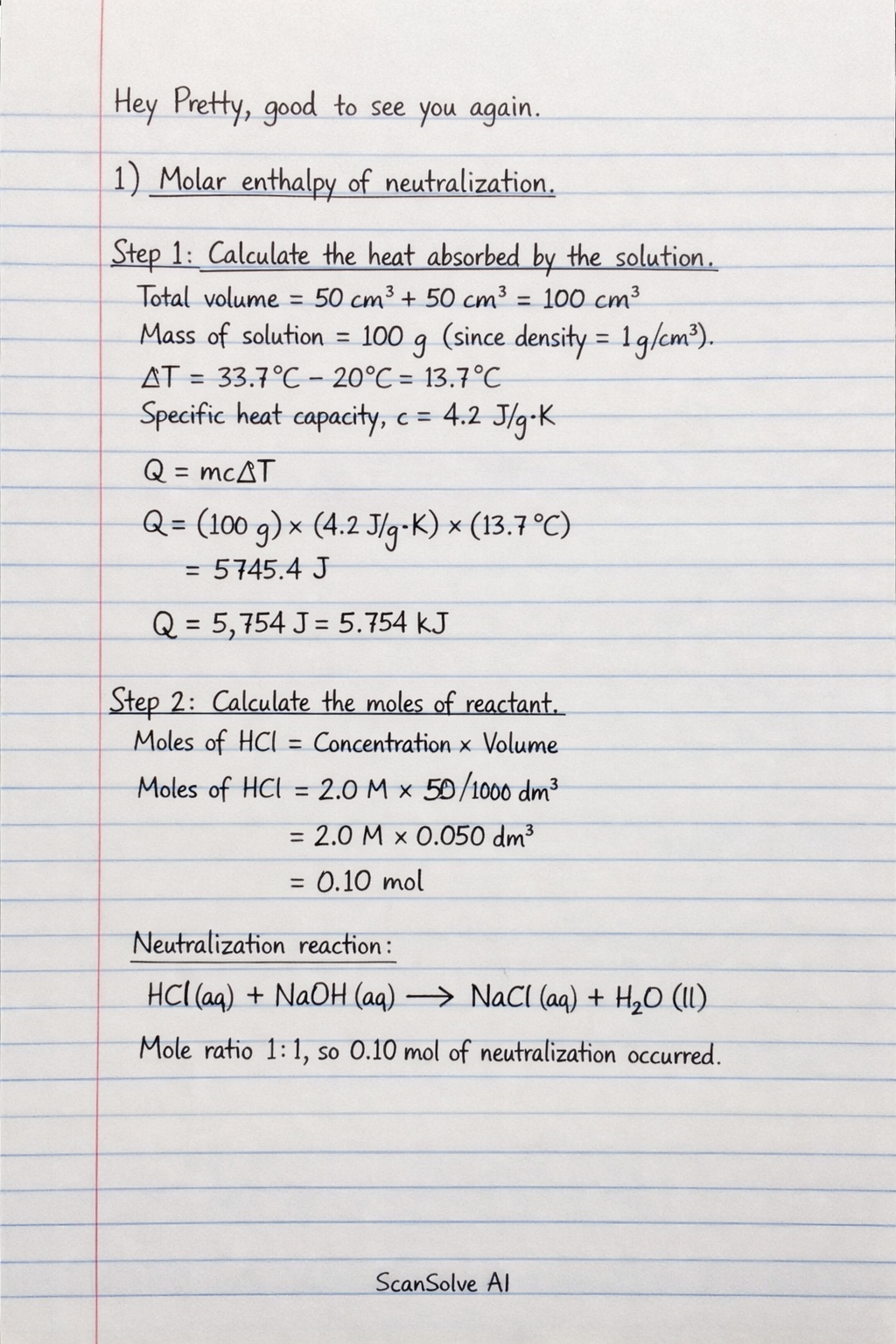
3 steps1) Molar enthalpy of neutralization
Calculate the heat absorbed by the solution.
The total volume of the solution is .
Assuming the density of the solution is , the mass of the solution is .
The change in temperature is .
The specific heat capacity is , which is equivalent to .Calculate the moles of reactant.
Moles of HCl = Concentration Volume (in dm³)
Moles of HCl =
The neutralization reaction is . The mole ratio is 1:1, so of neutralization occurred.Calculate the molar enthalpy of neutralization.
The heat released is . Since the temperature increased, the reaction is exothermic, so the enthalpy change is negative.
The molar enthalpy of neutralization of NaOH is .
2) Draw and name two positional isomers of alkanol C₄H₉OH.
Positional isomers have the same molecular formula and carbon skeleton but differ in the position of the functional group.
-
Isomer 1: The hydroxyl group (-OH) is on the first carbon atom.
Name: Butan-1-ol
-
Isomer 2: The hydroxyl group (-OH) is on the second carbon atom.
Name: Butan-2-ol
3) Explain why metals such as Mg and Al are good conductors of electricity.
Metals like magnesium and aluminum are good conductors of electricity because they contain delocalized electrons. These valence electrons are not fixed to individual atoms but are free to move throughout the entire metallic structure. When an electric potential difference is applied, these mobile electrons can easily flow, carrying electric charge and thus conducting electricity.
4) Give a reason why Al is preferred to Mg for making cooking pans.
Aluminum is preferred over magnesium for making cooking pans primarily due to its superior corrosion resistance. Aluminum forms a thin, tough, and impermeable layer of aluminum oxide (Al₂O₃) on its surface when exposed to air, which protects the underlying metal from further corrosion, especially from acids found in food. Magnesium is more reactive and can corrode more easily, particularly in the presence of water or acids at cooking temperatures.
-
Try one yourself
A new problem that tests the same skill.
Still stuck on this one?
Ask a follow-up, and the answer starts from this question.
More Chemistry Questions
Handwritten Step-by-Step Solution
Get this as a handwritten image on WhatsApp — like a tutor wrote it for you.
Try on WhatsApp