
We read your photo as:
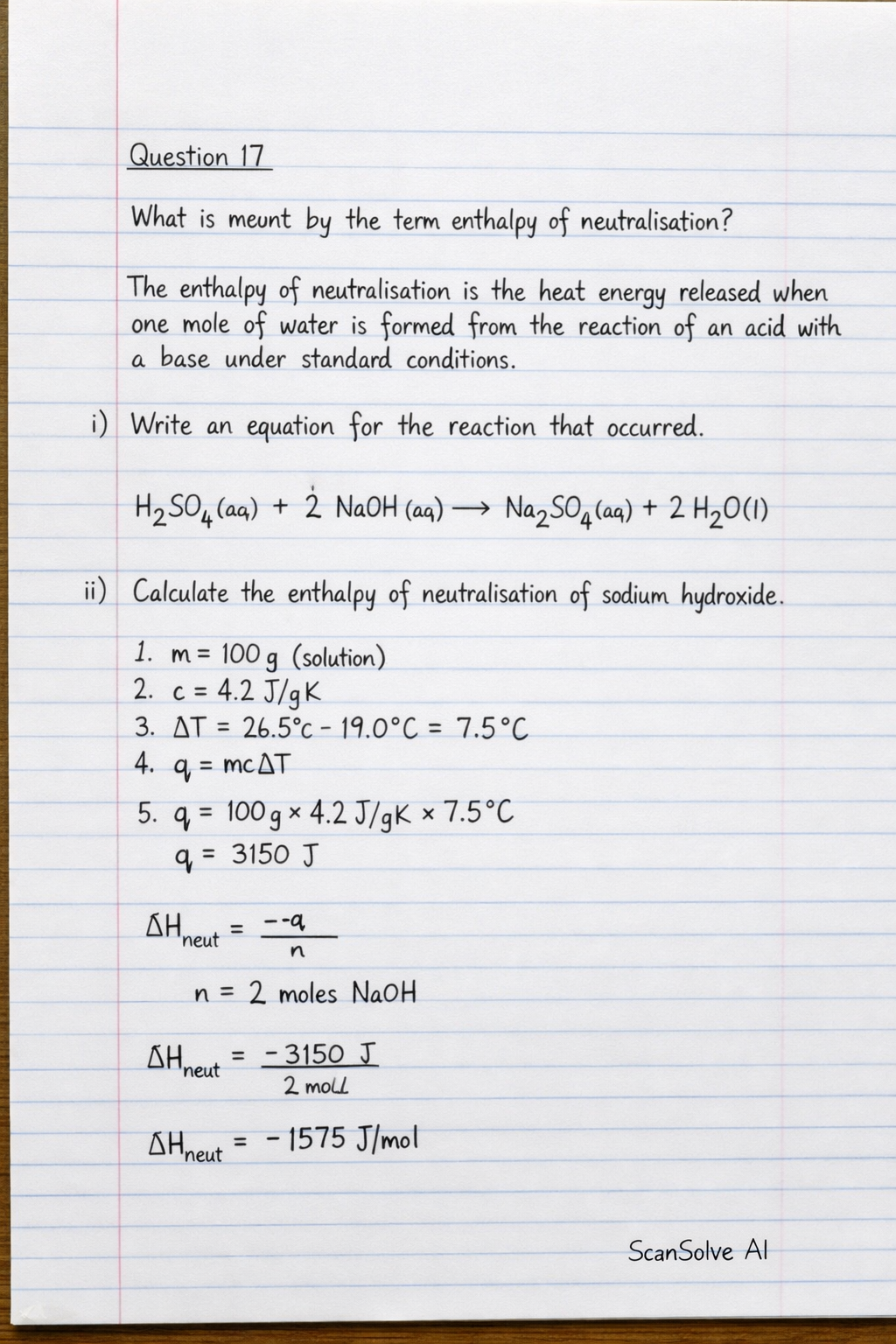
What is meant by the term enthalpy of neutralisation? Write an equation for the reaction that occurred. Calculate the enthalpy of neutralisation.
ScanSolve AI Answer
Step-by-step solution
12 stepslet's tackle these questions, Ignatius.
Question 17
What is meant by the term enthalpy of neutralisation?
The enthalpy of neutralisation is the heat energy released when one mole of water is formed from the reaction of an acid with a base under standard conditions.
i) Write an equation for the reaction that occurred.
The reaction is between sulfuric acid () and sodium hydroxide ().
ii) Calculate the enthalpy of neutralisation of sodium hydroxide (specific heat capacity of solution = , density of water = ).
Calculate the moles of reactants.
Moles of :
Moles of :
Determine the limiting reactant and moles of water formed.
From the balanced equation, reacts with to produce .
If reacts, it would require .
Since we have exactly , both reactants are completely consumed.
The moles of water formed will be .Calculate the total mass of the solution.
Total volume of solution = .
Assuming the density of the solution is :Calculate the heat absorbed by the solution ().
Given (or ) and specific heat capacity () = .
Convert to kilojoules:
Calculate the enthalpy of neutralisation ().
Since heat is released (temperature rose), is negative.
Question 18
i) What does point S represent?
Point S represents the equivalence point (or neutralization point) of the reaction, where the acid and base have completely reacted with each other, and the maximum temperature of the solution is reached.
ii) Why does the temperature rise from R to S?
The temperature rises from R to S because the reaction between (acid) and (base) is an exothermic reaction. As more is added, more heat is released, causing the temperature of the solution to increase until the equivalence point (S) is reached.
iii) Determine the molarity of the acid.
Identify the volume of at point S.
From the graph, point S occurs when of has been added.
Write the balanced chemical equation.
The reaction is between and :
The mole ratio of to is .
Calculate the moles of at the equivalence point.
Given concentration of and volume = .
Calculate the moles of .
Since the mole ratio is , at the equivalence point:
Calculate the molarity of .
Given volume of .
Question 19
a) Give the name of .
The name of is hydrogen gas (or simply hydrogen).
b) Determine the value of .
Apply Hess's Law to the energy cycle.
Hess's Law states that the total enthalpy change for a reaction is independent of the pathway taken.
From the diagram, the direct path from to is .
The indirect path is from to (which is ), and then from to (which is ).
Therefore, according to Hess's Law:Substitute the given values and solve for .
Given and .
Still stuck on this one?
Ask a follow-up, and the answer starts from this question.
More Chemistry Questions
Handwritten Step-by-Step Solution
Get this as a handwritten image on WhatsApp — like a tutor wrote it for you.
Try on WhatsApp