
We read your photo as:
Complete the following reaction: xxviii. CH3CH2OH + CH3COOH → ? + ? (2 marks) xxix. CH3−C=O + H2O → ? + ? (2 marks) CH3 xxx. CH3CHO LiAlH4/ether → ? (2 marks) (c). Using equations only describe how an aldehyde and ketone be prepared from alcohol (6 marks)
ScanSolve AI Answer
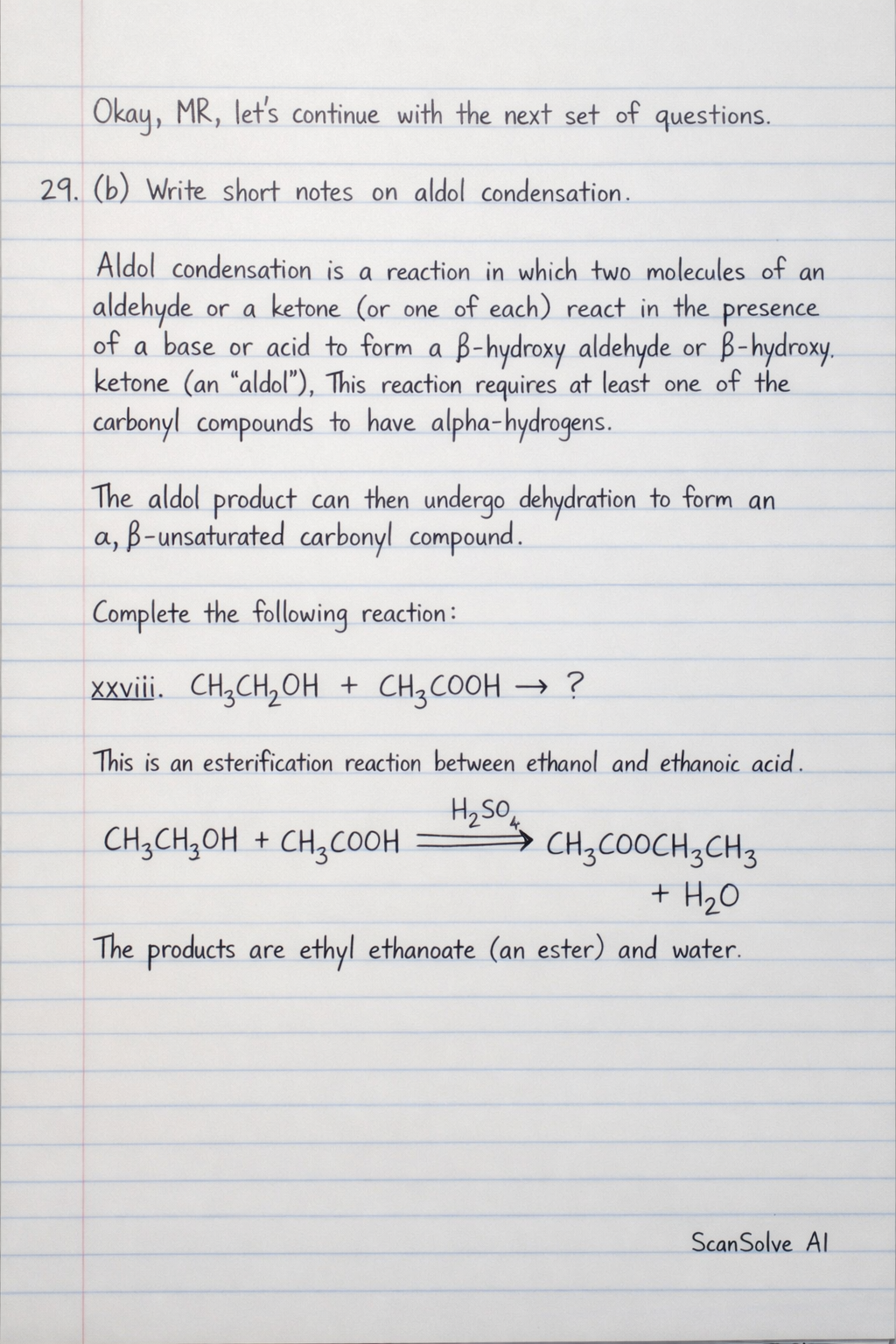
Okay, MR, let's continue with the next set of questions.
29. (b) Write short notes on aldol condensation
Aldol condensation is a reaction in which two molecules of an aldehyde or a ketone (or one of each) react in the presence of a base or acid to form a -hydroxy aldehyde or -hydroxy ketone (an "aldol"). This reaction requires at least one of the carbonyl compounds to have alpha-hydrogens. The aldol product can then undergo dehydration to form an -unsaturated carbonyl compound.
Complete the following reaction:
-
xxviii. This is an esterification reaction between ethanol and ethanoic acid.
The products are ethyl ethanoate (an ester) and water.
-
xxix. This is the hydrolysis of an acid anhydride (ethanoic anhydride).
The product is ethanoic acid.
-
xxx. This is the reduction of an aldehyde (ethanal) using lithium aluminum hydride.
The product is ethanol (a primary alcohol).
29. (c) Using equations only describe how an aldehyde and ketone be prepared from alcohol
-
Preparation of an aldehyde from a primary alcohol: Primary alcohols are oxidized to aldehydes using a mild oxidizing agent like PCC (Pyridinium Chlorochromate).
Example:
-
Preparation of a ketone from a secondary alcohol: Secondary alcohols are oxidized to ketones using oxidizing agents like acidified potassium dichromate ().
Example:
30. (a) Briefly explain the reaction of carboxylic acid involving its:
-
xxviii. Redox properties Carboxylic acids can be reduced to primary alcohols using strong reducing agents like lithium aluminum hydride (). This is a reduction reaction where the carbon atom of the carboxyl group gains electrons.
Example:
-
xxix. Acidic properties Carboxylic acids are acidic due to the highly polarized O-H bond and the resonance stabilization of the resulting carboxylate anion (). They react with bases, active metals, and carbonates/bicarbonates to release a proton ().
Example:
-
xxx. Alcoholic properties (chemical equation is required for all the reactions) Carboxylic acids do not exhibit "alcoholic properties" in the typical sense, as their -OH group is part of a carboxyl group and behaves differently from an alcohol's -OH. However, the -OH group of a carboxylic acid can be replaced in reactions to form derivatives. A key reaction involving the -OH group is esterification, where it reacts with an alcohol to form an ester and water.
Example:
30. (b) i. Aldehydes and ketones upon reduction produce primary alcohols and secondary alcohols respectively.
30. (b) xxxviii. Write the functional group of the following compounds
- (i) Ketone: The functional group is the carbonyl group () where the carbon atom is bonded to two other carbon atoms.
- (ii) Aldehyde: The functional group is the carbonyl group () where the carbon atom is bonded to at least one hydrogen atom and one carbon atom (or two hydrogen atoms in formaldehyde).
30. (b) xxxix. Write any four derivatives of carboxylic acid
- Acid halides (e.g., acyl chlorides, )
- Acid anhydrides (e.g., )
- Esters (e.g., )
- Amides (e.g., )
30. (b) xl. Briefly comment on the difference in boiling point of alcohol and carboxylic acid
Carboxylic acids generally have higher boiling points than alcohols of comparable molecular weight. This is because carboxylic acids can form dimers through two strong hydrogen bonds between two carboxylic acid molecules, creating a more stable and extensive network of intermolecular forces. While alcohols also form hydrogen bonds, they typically form linear chains, which are less extensive than the cyclic dimers of carboxylic acids. More energy is required to overcome these stronger intermolecular forces in carboxylic acids, leading to higher boiling points.
Still stuck on this one?
Ask a follow-up, and the answer starts from this question.
More Chemistry Questions
Handwritten Step-by-Step Solution
Get this as a handwritten image on WhatsApp — like a tutor wrote it for you.
Try on WhatsApp