
We read your photo as:
Spectrometry analysis of a sample shows that it has 2 isotopes. These are 75% chlorine-35 and 25% chlorine-37. Calculate the relative atomic mass of chlorine
Chemistry
ScanSolve AI Answer
Answer
Step-by-step solution
4 stepsTo calculate the relative atomic mass of chlorine, we use the weighted average of the masses of its isotopes, taking into account their natural abundances.
Identify the isotopic masses and their percentage abundances.
- Chlorine-35 has an isotopic mass of 35 and an abundance of 75%.
- Chlorine-37 has an isotopic mass of 37 and an abundance of 25%.
Convert percentage abundances to fractional abundances.
- For Chlorine-35:
- For Chlorine-37:
Apply the formula for relative atomic mass.
The relative atomic mass is calculated as:
Substitute the values and calculate.
The relative atomic mass of chlorine is 35.5.
Was this helpful?
Try one yourself
A new problem that tests the same skill.
Still stuck on this one?
Ask a follow-up, and the answer starts from this question.
Got a different question?Ask your own question
More Chemistry Questions
QCalculate the average atomic mass of Chlorine, given that Chlorine-35 has 75% abundance and…QGiven the average atomic weight of Chlorine is 35.45, and the masses of its isotopes are 34.96 for…QGiven an element with an average atomic mass of 35.5 and isotopes of mass numbers 35 and 37…QA compound consists of 49.0% carbon, 2.72% hydrogen, and 48.3% chlorine, by mass. A lab analysis…QMass spectrometry analysis reveals that a sample has magnesium-23 and magnesium-25.5. Given that the…
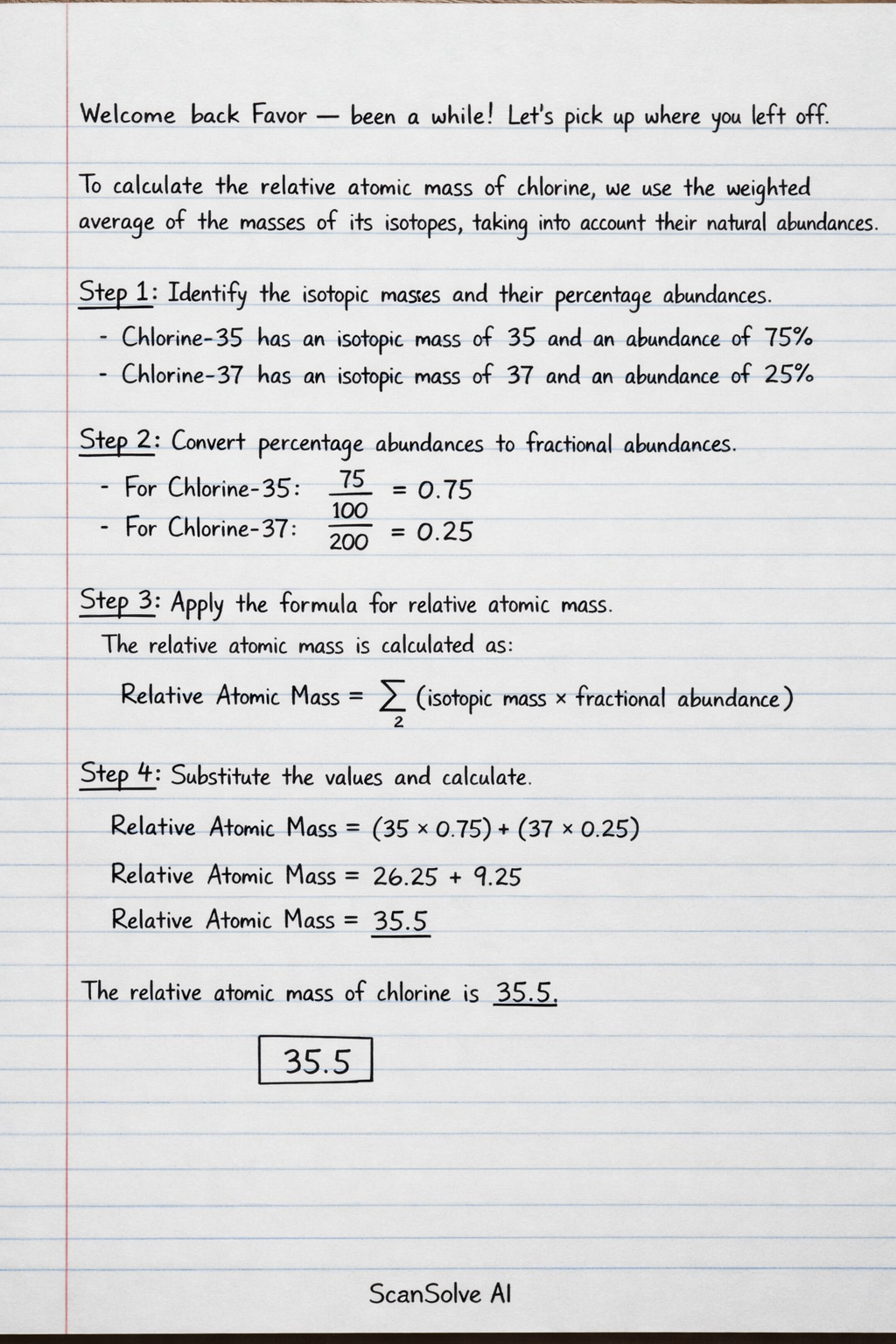
Handwritten Step-by-Step Solution
Get this as a handwritten image on WhatsApp — like a tutor wrote it for you.
Try on WhatsApp