
17, 2. 35, 3. Chlorine, 4. 37 would be it mass number and we would call it ¹⁷Cl²⁰
Chemistry
ScanSolve AI Answer
You're very close! Let's go through them.
-
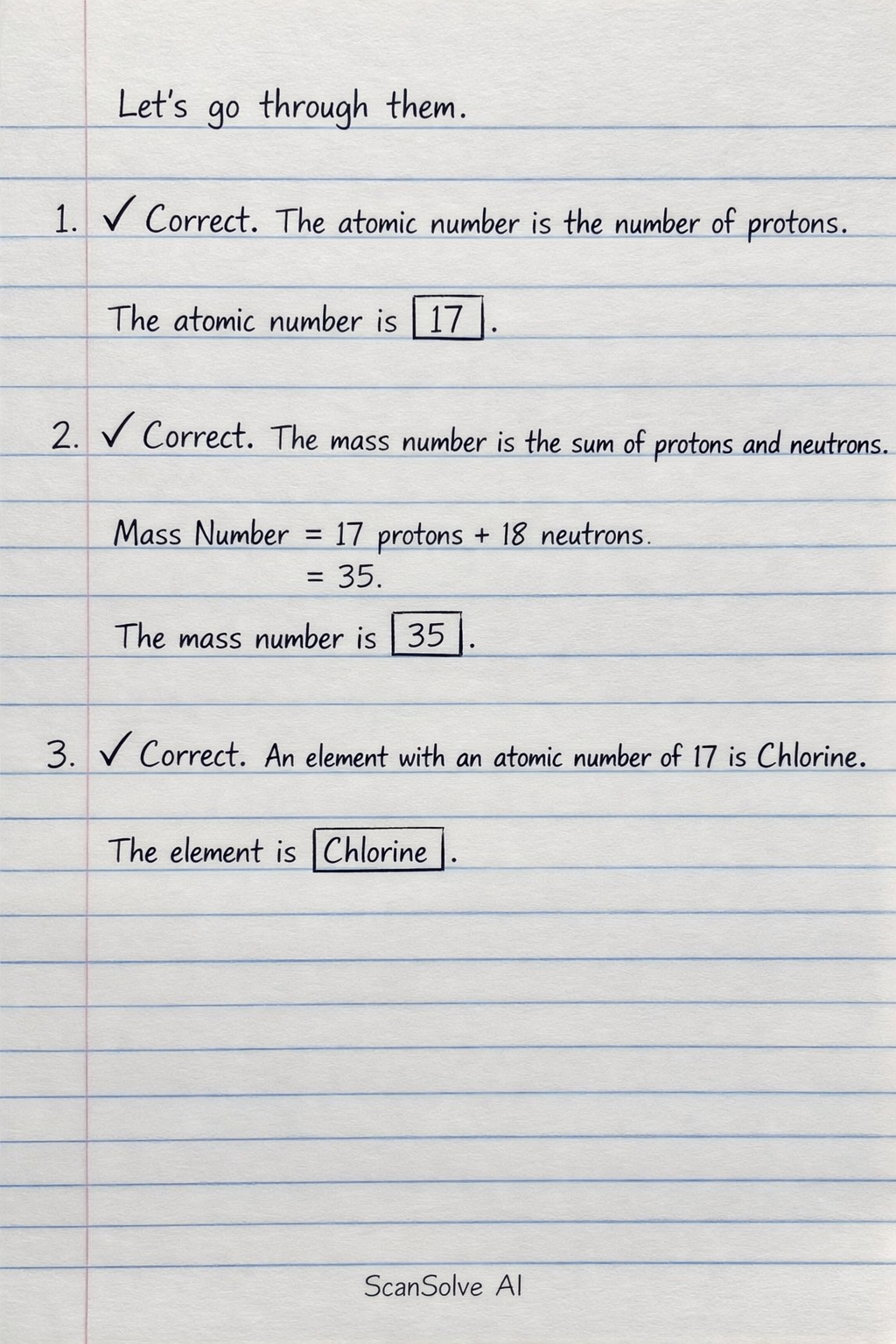
✅ Correct. The atomic number is the number of protons.
- The atomic number is .
-
✅ Correct. The mass number is the sum of protons and neutrons.
- The mass number is .
-
✅ Correct. An element with an atomic number of 17 is Chlorine.
- The element is .
-
Partially correct.
- If the isotope has 20 neutrons, its mass number would be: So, the mass number is .
- The notation for an isotope is typically written as , where A is the mass number, Z is the atomic number, and X is the element symbol. Alternatively, it's written as Element-MassNumber.
- So, this isotope would be called Chlorine-37.
- Your notation is incorrect. The superscript on the left should be the mass number (37), and the subscript on the left should be the atomic number (17). The superscript on the right is not standard for neutrons.
- The correct notation would be .
Was this helpful?
Still stuck on this one?
Ask a follow-up, and the answer starts from this question.
Got a different question?Ask your own question
More Chemistry Questions
QGiven the average atomic weight of Chlorine is 35.45, and the masses of its isotopes are 34.96 for…QGiven that the chlorine atom is 35.5 times as massive as a hydrogen atom, the mass of the chlorine…QSpectrometry analysis of a sample shows that it has 2 isotopes. These are 75% chlorine-35 and 25%…QCl -> Cl+ + e- 17 isQCalculate the average atomic mass of Chlorine, given that Chlorine-35 has 75% abundance and…
Handwritten Step-by-Step Solution
Get this as a handwritten image on WhatsApp — like a tutor wrote it for you.
Try on WhatsApp