
This chemistry question involves key chemical concepts and calculations. The detailed solution below walks through each step, from identifying the reaction type to computing the final answer.
ScanSolve AI Answer
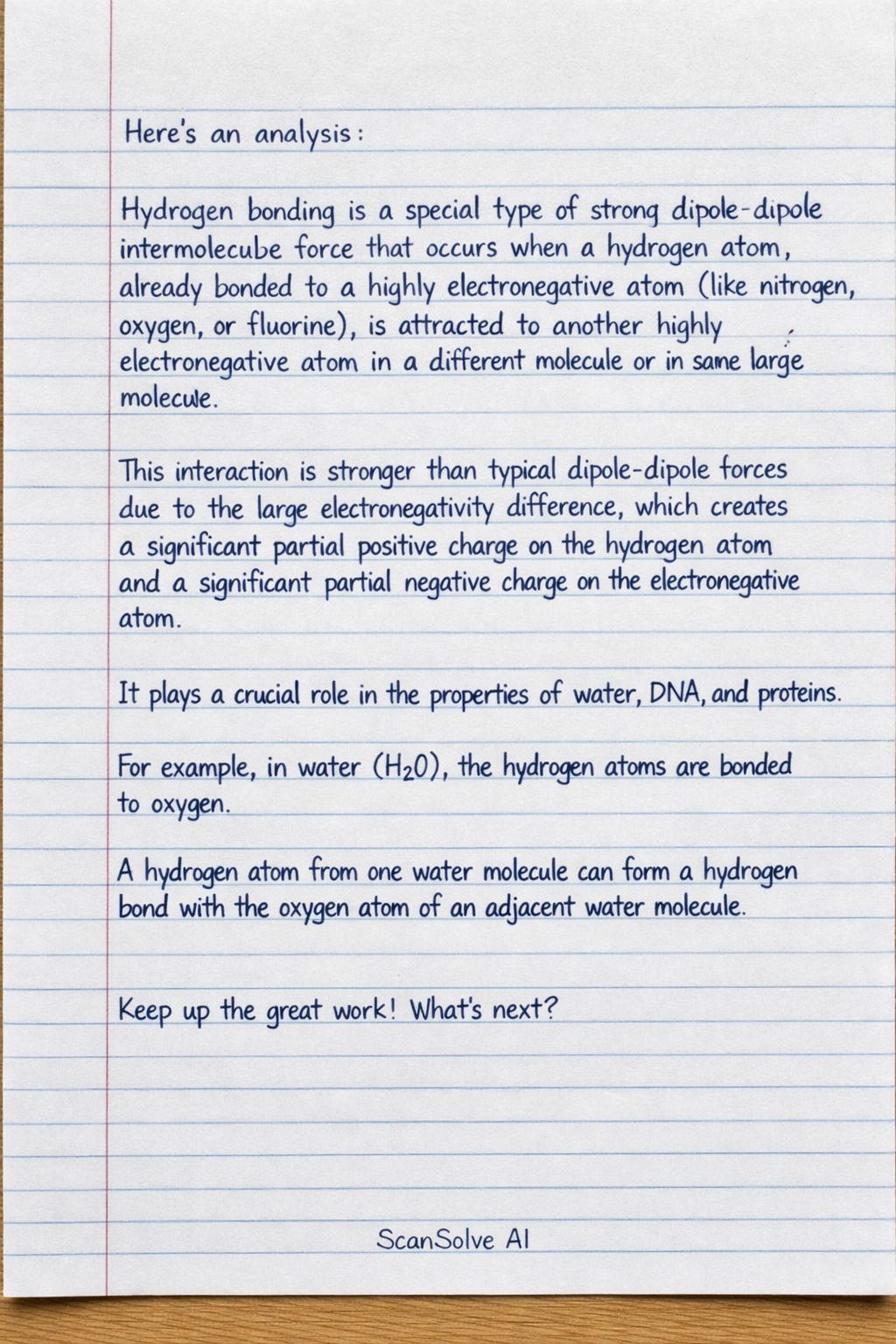
Hydrogen bonding is a special type of strong dipole-dipole intermolecular force that occurs when a hydrogen atom, already bonded to a highly electronegative atom (like nitrogen, oxygen, or fluorine), is attracted to another highly electronegative atom in a different molecule or in the same large molecule. This interaction is stronger than typical dipole-dipole forces due to the large electronegativity difference, which creates a significant partial positive charge on the hydrogen atom and a significant partial negative charge on the electronegative atom. It plays a crucial role in the properties of water, DNA, and proteins. For example, in water (H_2O), the hydrogen atoms are bonded to oxygen. A hydrogen atom from one water molecule can form a hydrogen bond with the oxygen atom of an adjacent water molecule. Keep up the great work! What's next?