
We read your photo as:
Describe an experiment to investigate the effects of temperature on solubility. With the aid of a well labelled diagram describe how to can separate sand from a mixture of sand and water
Chemistry
ScanSolve AI Answer
Here are the descriptions for the experiments you've asked about:
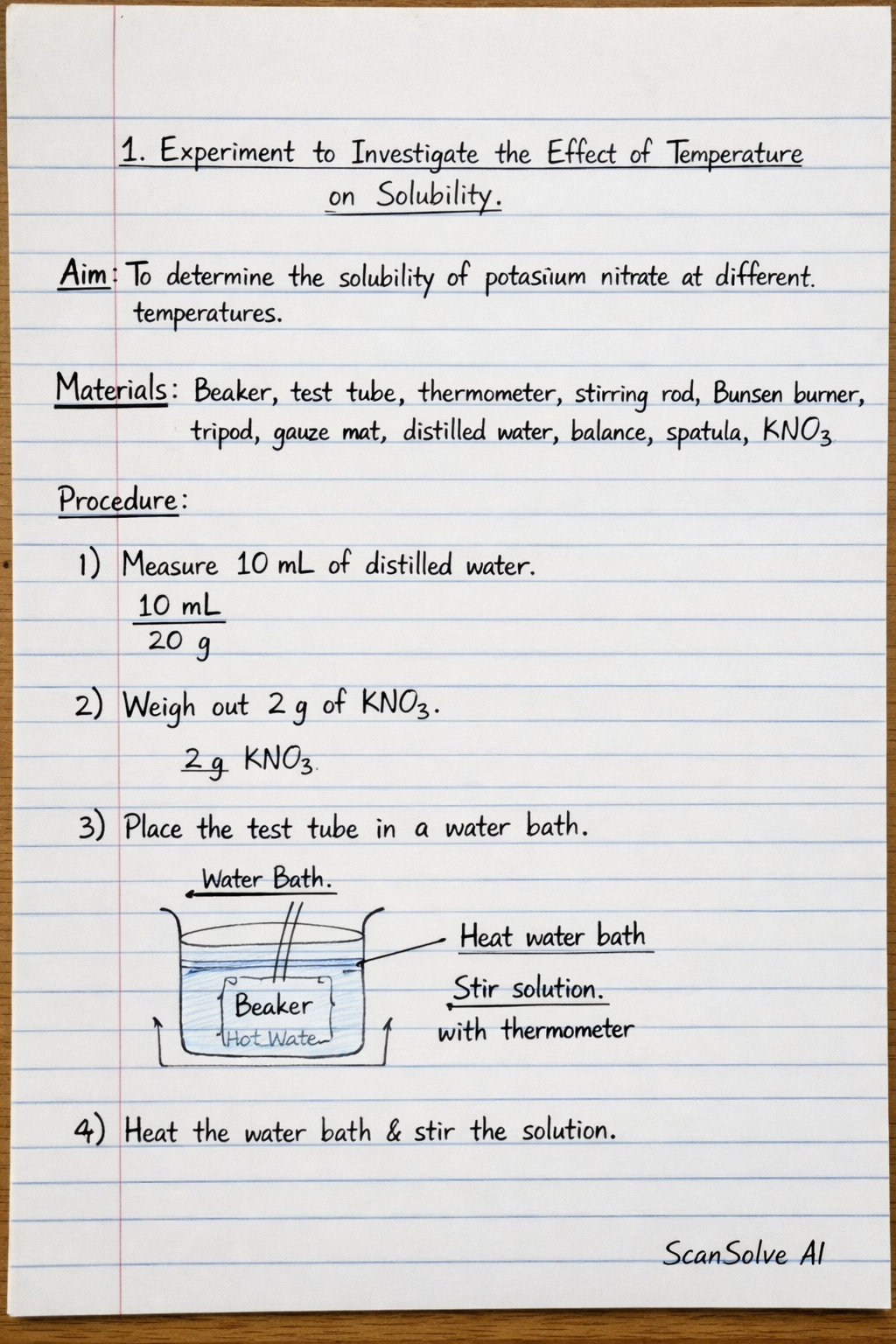
1. Experiment to investigate the effects of temperature on solubility
To investigate how temperature affects the solubility of a solid in a liquid, you can perform the following experiment:
- Aim: To determine the solubility of a given salt (e.g., potassium nitrate) at different temperatures.
- Materials: Beaker, test tube, thermometer, stirring rod, Bunsen burner, tripod stand, gauze mat, distilled water, a soluble salt (e.g., potassium nitrate), balance, spatula.
- Procedure:
- Measure a fixed volume of distilled water (e.g., ) into a test tube.
- Add a small, known mass of the soluble salt (e.g., of potassium nitrate) to the water.
- Place the test tube in a water bath (a larger beaker of water heated by a Bunsen burner).
- Heat the water bath gently while continuously stirring the solution in the test tube with a thermometer.
- Continue adding small, measured amounts of the salt, stirring constantly, until no more salt dissolves and a small amount of undissolved solid remains at a specific temperature. This indicates that a saturated solution has been formed at that temperature.
- Record the temperature at which the solution became saturated and the total mass of salt added.
- Repeat the experiment at different temperatures. You can do this by adding more salt and heating to a higher temperature, then allowing it to cool slowly and noting the temperature at which crystals first appear (the saturation temperature for that amount of solute).
- Expected Observation: For most solid solutes, as the temperature of the solvent increases, the solubility of the solute also increases.
2. Separating sand from a mixture of sand and water
To separate sand from a mixture of sand and water, you can use the process of filtration, as sand is insoluble in water.
-
Procedure:
- Set up a filtration apparatus. This involves placing a filter funnel with filter paper folded into a cone inside it. The filter funnel should be supported by a retort stand or placed in the neck of a clean beaker or conical flask.
- Carefully pour the mixture of sand and water into the filter funnel.
- The sand (which is the residue) will be trapped by the filter paper because its particles are too large to pass through the pores.
- The water (which is the filtrate) will pass through the filter paper and collect in the beaker or conical flask below.
-
Diagram Description: A well-labeled diagram would show:
- A retort stand holding a filter funnel.
- Filter paper inside the filter funnel.
- A beaker containing the mixture of sand and water, being poured into the filter funnel.
- Sand collected on the filter paper, labeled as "Residue: Sand".
- Water dripping into a conical flask or beaker placed below the funnel, labeled as "Filtrate: Water".
Was this helpful?
Still stuck on this one?
Ask a follow-up, and the answer starts from this question.
Got a different question?Ask your own question
More Chemistry Questions
QWith aid of a well lebelled diagram describe how you can separate salt from a mixture of salt and…QIdentify laboratory apparatus and explain the concept of solubility with an experiment procedure.QAn experiment was designed to measure the effect of temperature on solubility. i) What is the…QIdentify laboratory apparatus, explain solubility, and describe an experiment to determine the…QDescribe laboratory apparatus and explain the concept of solubility, including factors affecting it…
Handwritten Step-by-Step Solution
Get this as a handwritten image on WhatsApp — like a tutor wrote it for you.
Try on WhatsApp