
We read your photo as:
In an experiment, 8.0 moles of H2(g) is heated with 5.0 moles of I2(g) in a closed vessel at 298 K. At equilibrium, 9.06 mol of hydrogen iodide are formed. Calculate the equilibrium constants Kc and Kp at that temperature (R = 8.314 J mol-1 or 0.082 atm dm3 K-1 mol-1).
ScanSolve AI Answer
Answer
Step-by-step solution
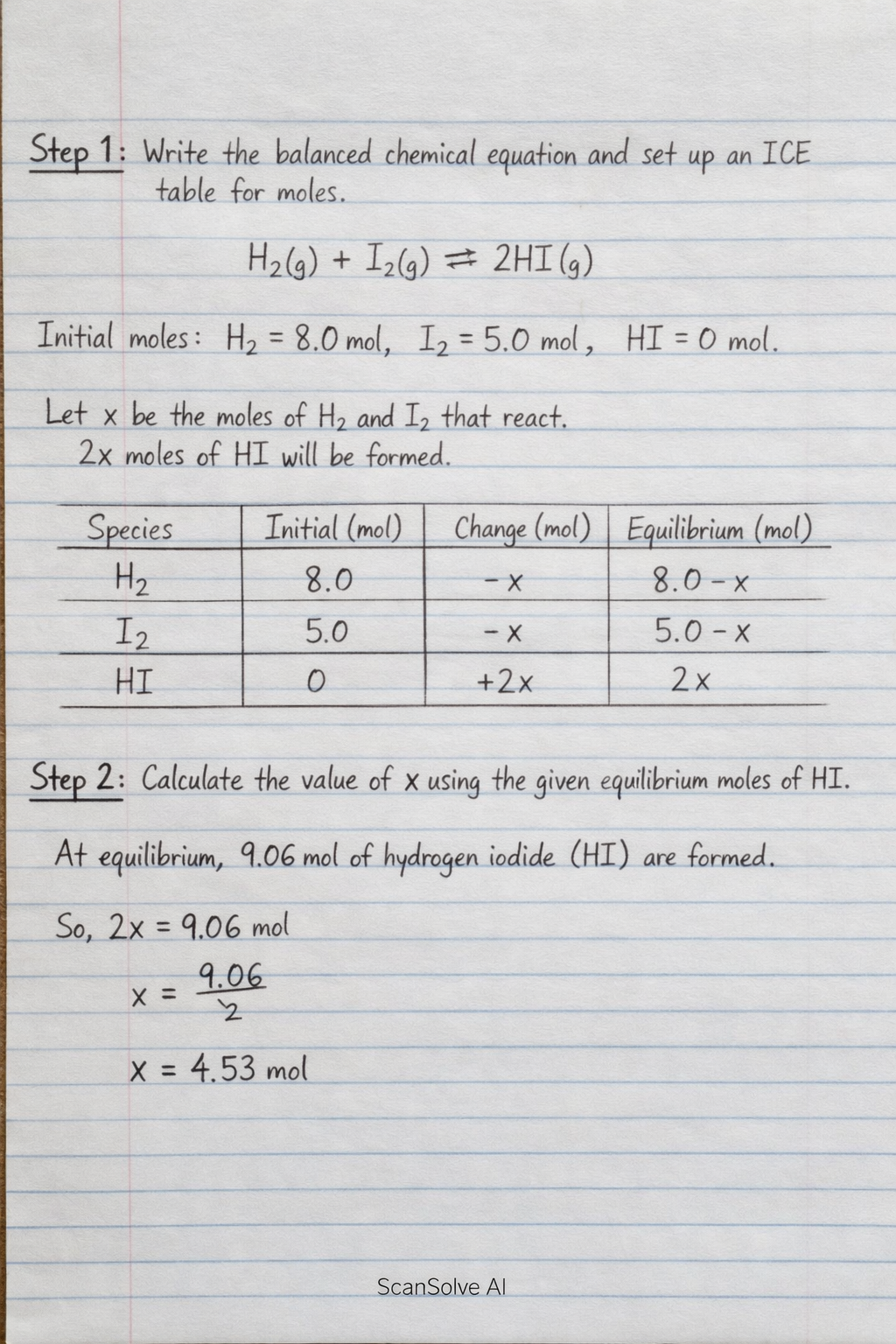
5 stepsWrite the balanced chemical equation and set up an ICE table for moles.
The reaction is between hydrogen gas and iodine gas to form hydrogen iodide gas.
Initial moles: , , .
Let be the moles of and that react. According to the stoichiometry, moles of will be formed.Species Initial (mol) Change (mol) Equilibrium (mol) 8.0 5.0 0 Calculate the value of using the given equilibrium moles of .
At equilibrium, of hydrogen iodide () are formed.
So, .Calculate the equilibrium moles of all species.
Equilibrium moles of
Equilibrium moles of
Equilibrium moles ofCalculate the equilibrium constant .
The expression for is:
Let the volume of the closed vessel be . The concentrations are moles divided by volume.
Substitute these into the expression:
The volume terms cancel out:
Rounding to three significant figures, .
Calculate the equilibrium constant .
The relationship between and is given by .
is the change in the number of moles of gaseous products minus the number of moles of gaseous reactants.
For the reaction :
Moles of gaseous products = 2 (from 2HI)
Moles of gaseous reactants = 1 (from ) + 1 (from ) = 2
So, .
Since , .
Therefore, .Rounding to three significant figures, .
Try one yourself
A new problem that tests the same skill.
Still stuck on this one?
Ask a follow-up, and the answer starts from this question.
More Chemistry Questions
Handwritten Step-by-Step Solution
Get this as a handwritten image on WhatsApp — like a tutor wrote it for you.
Try on WhatsApp