We read your photo as:

A student mixes 50 cm³ of 1.0 mol/dm³ HCl with 50 cm³ of 1.0 mol/dm³ NaOH. The initial temperature of both solutions is 27°C and the final temperature is 34°C. Assuming the density of the solution is

Chemistry

ScanSolve AI Answer

Answers

2 parts
a

2940 J\text{2940 J}

b

-58.8 kJ mol−1\text{-58.8 kJ mol}^{-1}

Step-by-step solution

8 steps

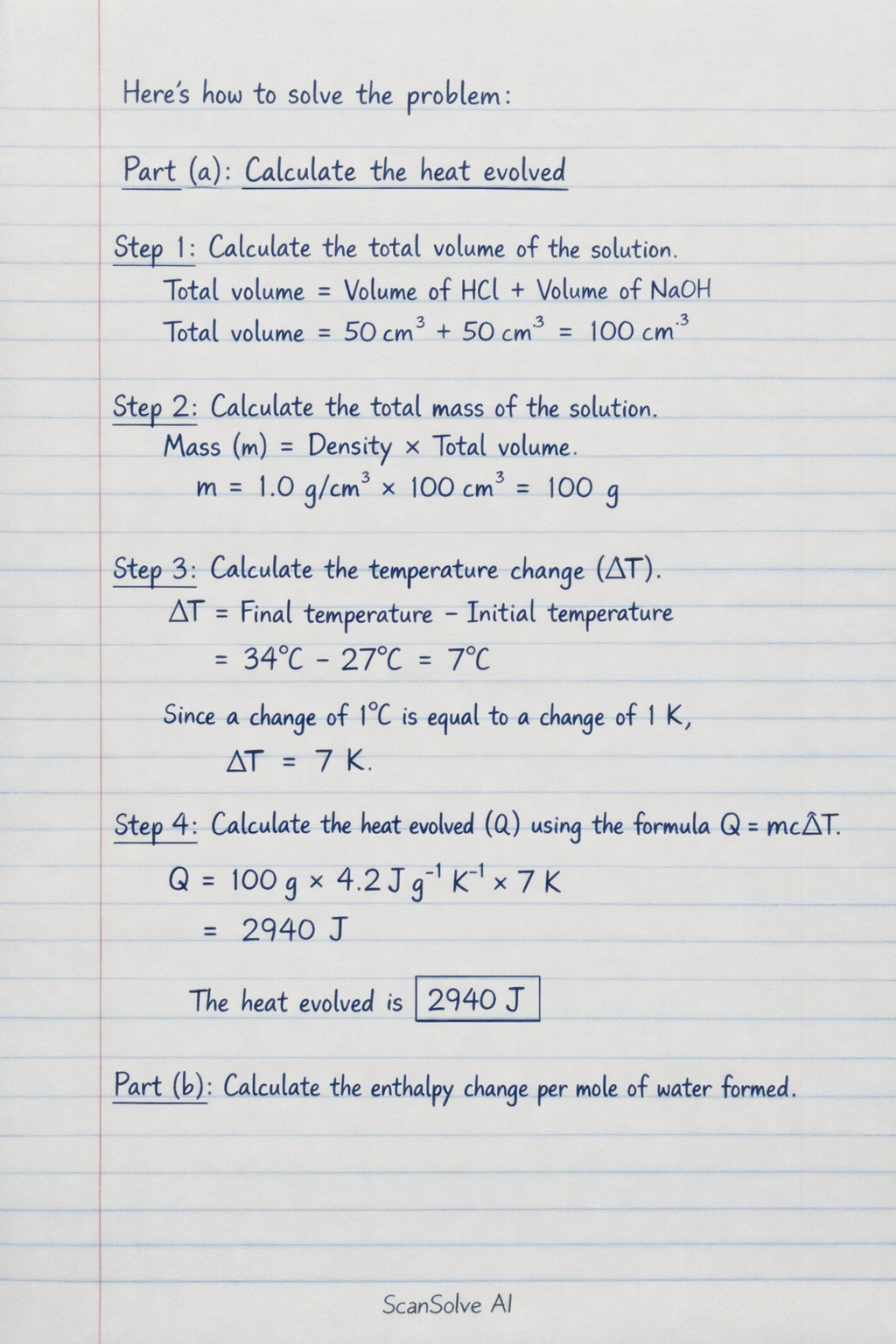
Here's how to solve the problem:

Part a· 4 steps

Calculate the heat evolved

  1. Calculate the total volume of the solution.

    Total volume=Volume of HCl+Volume of NaOH\text{Total volume} = \text{Volume of HCl} + \text{Volume of NaOH} Total volume=50 cm3+50 cm3=100 cm3\text{Total volume} = 50 \text{ cm}^3 + 50 \text{ cm}^3 = 100 \text{ cm}^3
  2. Calculate the total mass of the solution.

    Mass(m)=Density×Total volume\text{Mass} (m) = \text{Density} \times \text{Total volume} m=1.0 g cm−3×100 cm3=100 gm = 1.0 \text{ g cm}^{-3} \times 100 \text{ cm}^3 = 100 \text{ g}
  3. Calculate the temperature change (ΔT\Delta T).

    ΔT=Final temperature−Initial temperature\Delta T = \text{Final temperature} - \text{Initial temperature} ΔT=34∘C−27∘C=7∘C\Delta T = 34^\circ\text{C} - 27^\circ\text{C} = 7^\circ\text{C}

    Since a change of 1∘C1^\circ\text{C} is equal to a change of 1 K1 \text{ K}, ΔT=7 K\Delta T = 7 \text{ K}.

  4. Calculate the heat evolved (QQ) using the formula Q=mcΔTQ = mc\Delta T.

    Q=100 g×4.2 J g−1 K−1×7 KQ = 100 \text{ g} \times 4.2 \text{ J g}^{-1} \text{ K}^{-1} \times 7 \text{ K} Q=2940 JQ = 2940 \text{ J}

    The heat evolved is 2940 J\boxed{\text{2940 J}}.

Part b

-58.8 kJ mol−1\text{-58.8 kJ mol}^{-1}

Calculate the enthalpy change per mole of water formed

  1. Write the balanced chemical equation for the neutralization reaction.

    HCl(aq)+NaOH(aq)→NaCl(aq)+H2O(l)\text{HCl(aq)} + \text{NaOH(aq)} \to \text{NaCl(aq)} + \text{H}_2\text{O(l)}

    From the equation, 1 mole of HCl reacts with 1 mole of NaOH to produce 1 mole of H2O\text{H}_2\text{O}.

  2. Calculate the moles of reactants.

    Volume of HCl = 50 cm3=0.050 dm350 \text{ cm}^3 = 0.050 \text{ dm}^3
    Moles of HCl = Concentration ×\times Volume

    Moles of HCl=1.0 mol dm−3×0.050 dm3=0.050 mol\text{Moles of HCl} = 1.0 \text{ mol dm}^{-3} \times 0.050 \text{ dm}^3 = 0.050 \text{ mol}

    Volume of NaOH = 50 cm3=0.050 dm350 \text{ cm}^3 = 0.050 \text{ dm}^3
    Moles of NaOH = Concentration ×\times Volume

    Moles of NaOH=1.0 mol dm−3×0.050 dm3=0.050 mol\text{Moles of NaOH} = 1.0 \text{ mol dm}^{-3} \times 0.050 \text{ dm}^3 = 0.050 \text{ mol}

    Since the moles of HCl and NaOH are equal and react in a 1:1 ratio, 0.050 mol0.050 \text{ mol} of water is formed.

  3. Calculate the enthalpy change per mole of water formed (ΔHneut\Delta H_{neut}).

    The heat evolved (QQ) is 2940 J2940 \text{ J}. Since heat is evolved, the enthalpy change is negative.

    ΔHneut=−QMoles of water formed\Delta H_{neut} = -\frac{Q}{\text{Moles of water formed}} ΔHneut=−2940 J0.050 mol\Delta H_{neut} = -\frac{2940 \text{ J}}{0.050 \text{ mol}} ΔHneut=−58800 J mol−1\Delta H_{neut} = -58800 \text{ J mol}^{-1}
  4. Convert the enthalpy change to kilojoules per mole.

    ΔHneut=−58800 J mol−1×1 kJ1000 J\Delta H_{neut} = -58800 \text{ J mol}^{-1} \times \frac{1 \text{ kJ}}{1000 \text{ J}} ΔHneut=−58.8 kJ mol−1\Delta H_{neut} = -58.8 \text{ kJ mol}^{-1}

    The enthalpy change per mole of water formed is -58.8 kJ mol−1\boxed{\text{-58.8 kJ mol}^{-1}}.

Was this helpful?

Try one yourself

A new problem that tests the same skill.

Still stuck on this one?

Ask a follow-up, and the answer starts from this question.

Got a different question?Ask your own question
Handwritten step-by-step solution preview

Handwritten Step-by-Step Solution

Get this as a handwritten image on WhatsApp — like a tutor wrote it for you.

Try on WhatsApp