
We read your photo as:
A student is performing a titration. Solution D is 0.100 mol/dm³ NaOH and Solution E is dilute HCl of unknown concentration. 25.0 cm³ of Solution D is titrated against Solution E using methyl orange i
ScanSolve AI Answer
This answer stops before the end.
It was cut off when it was first written. Ask ScanSolve this question again for the full working.
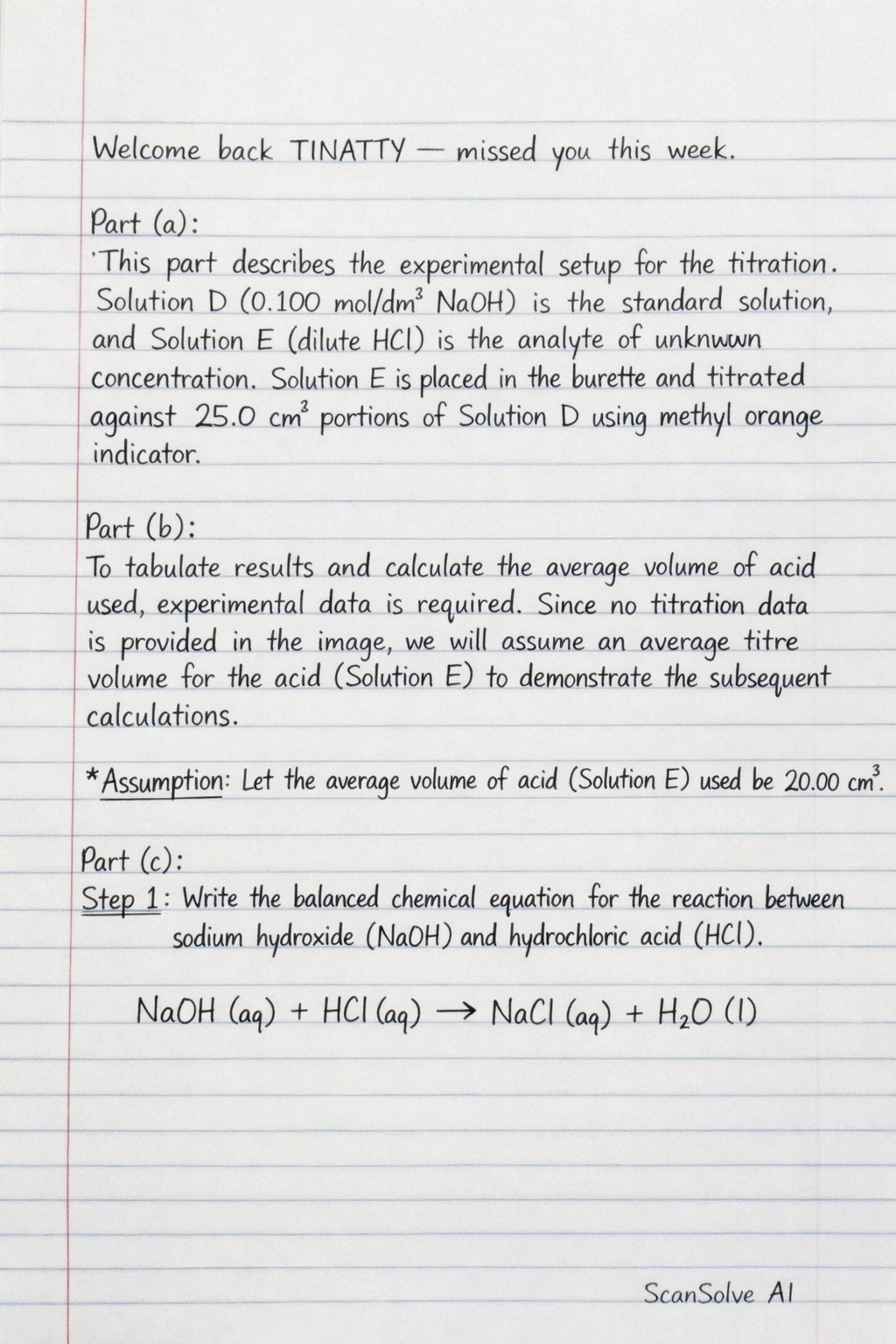
Part (a): This part describes the experimental setup for the titration. Solution D () is the standard solution, and Solution E (dilute ) is the analyte of unknown concentration. Solution E is placed in the burette and titrated against portions of Solution D using methyl orange indicator.
Part (b):
To tabulate results and calculate the average volume of acid used, experimental data is required. Since no titration data is provided in the image, we will assume an average titre volume for the acid (Solution E) to demonstrate the subsequent calculations.
- Assumption: Let the average volume of acid (Solution E) used be .
Part (c):
Step 1: Write the balanced chemical equation for the reaction between sodium hydroxide () and hydrochloric acid ().
Part (d):
Step 1: Identify the known values and the assumed average titre.
Concentration of base,
Volume of base,
Volume of acid, (assumed from part b)
From the balanced equation, the mole ratio of acid to base is .
Step 2: Use the titration formula to calculate the concentration of the acid ().
The concentration of E in is .
Step 3: Calculate the molar mass of .
Molar mass of
Molar mass of
Molar mass of
Step 4: Convert the concentration from to .
Concentration in
Concentration in
Concentration in \text{g/dm}^3 = 4.557625 \text{ g/dm}^3$$
The concentration of E in \text{g/dm}^3\boxed{\text{4.56 g/dm}^3}$ (to 3 significant figures).
Part (e):
Step 1: Determine the mass of pure in of solution E.
From part (d), the concentration of pure is .
So, in of solution, the mass of pure is .
Step 2: Calculate the percentage purity.
Given that the impure acid used to prepare the solution was of in .
This result (over 100%) indicates that the assumed average titre volume or the given mass of impure HCl might be inconsistent with a real-world scenario where purity cannot exceed 100%. However, based on the numbers provided and calculated, this is the mathematical result.
The percentage purity of the acid is (to 1 decimal place).
Part (f):
- (i) Dilution factor
Step 1: Identify the initial and final volumes.
Initial volume,
Final volume,
Step 2: Calculate the dilution factor.
The dilution factor is .
- (ii) Concentration of the new solution in
Step 1: Use the dilution formula .
Initial concentration, (from part d)
Initial volume,
Final volume,
Final concentration,
Step 2: Calculate the new concentration ().
The concentration of the new solution is .
Still stuck on this one?
Ask a follow-up, and the answer starts from this question.
More Chemistry Questions
Handwritten Step-by-Step Solution
Get this as a handwritten image on WhatsApp — like a tutor wrote it for you.
Try on WhatsApp