
We read your photo as:
3: The law of conservation of linear momentum states that in an isolated system, the total linear momentum remains constant. This means that the total momentum before a collision or interaction is e
ScanSolve AI Answer
Step-by-step solution
7 stepsHere are the solutions to your questions:
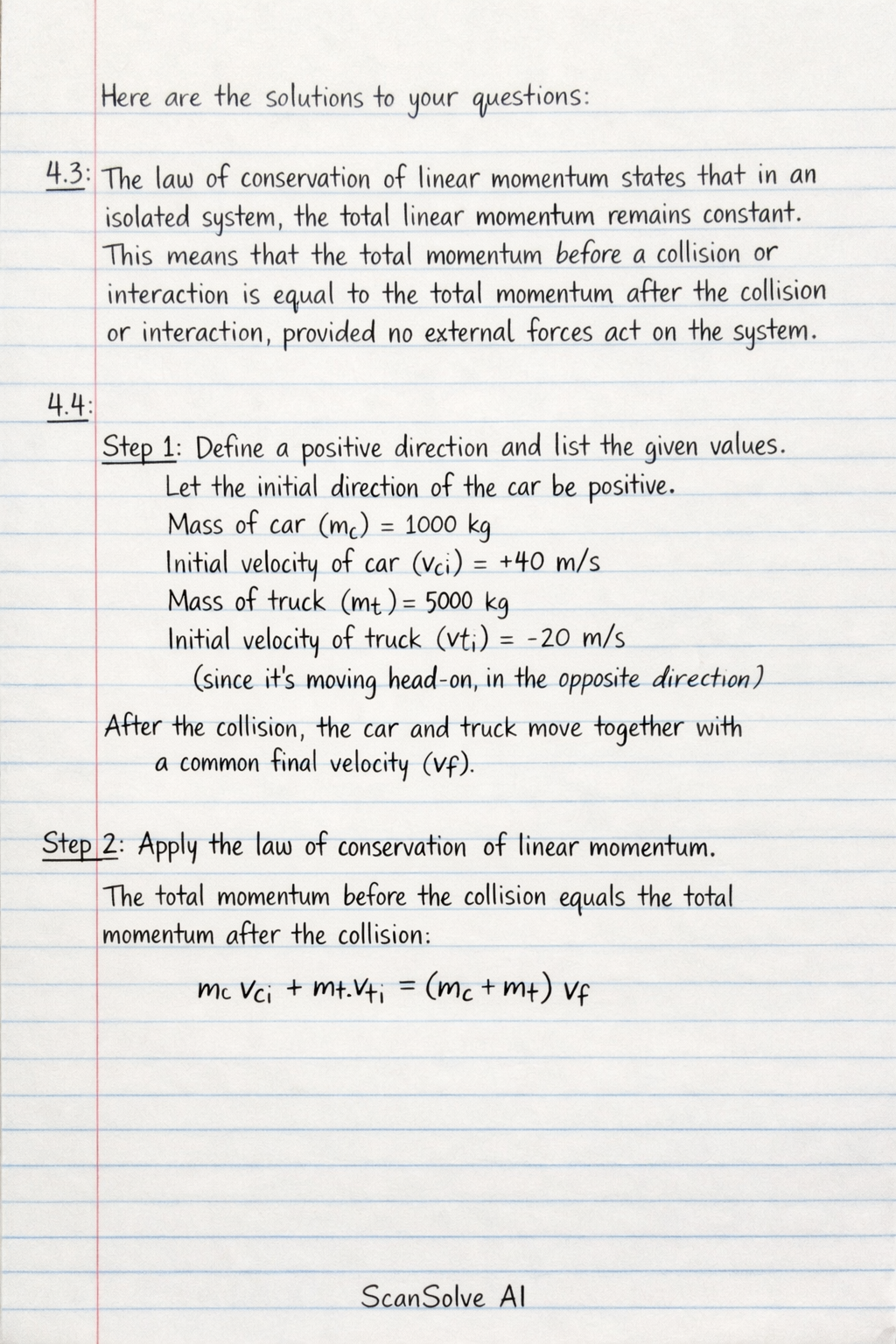
4.3: The law of conservation of linear momentum states that in an isolated system, the total linear momentum remains constant. This means that the total momentum before a collision or interaction is equal to the total momentum after the collision or interaction, provided no external forces act on the system.
4.4:
Define a positive direction and list the given values.
Let the initial direction of the car be positive.
Mass of car () =
Initial velocity of car () =
Mass of truck () =
Initial velocity of truck () = (since it's moving head-on, in the opposite direction)
After the collision, the car and truck move together with a common final velocity ().Apply the law of conservation of linear momentum.
The total momentum before the collision equals the total momentum after the collision:
Substitute the values into the equation.
Solve for the final velocity ().
The negative sign indicates that the final velocity is in the opposite direction to the car's initial motion (i.e., in the direction the truck was initially moving).
The velocity of the thief's car immediately after the collision is .
4.5:
Calculate the impulse experienced by the car.
Impulse () is the change in momentum (). We will calculate the impulse on the car.
Using the values from 4.4:
Calculate the average force exerted during the collision.
The average force () is equal to the impulse divided by the time interval ().
The collision lasts .The magnitude of the average force is .
Compare the calculated average force with the fatal injury threshold.
The research states that forces greater than may cause fatal injuries.
Our calculated average force magnitude is .
Since , the collision could result in a fatal injury.The collision could result in a fatal injury because the calculated average force of is greater than the threshold of .
Still stuck on this one?
Ask a follow-up, and the answer starts from this question.
More Physics Questions
Handwritten Step-by-Step Solution
Get this as a handwritten image on WhatsApp — like a tutor wrote it for you.
Try on WhatsApp