
We read your photo as:
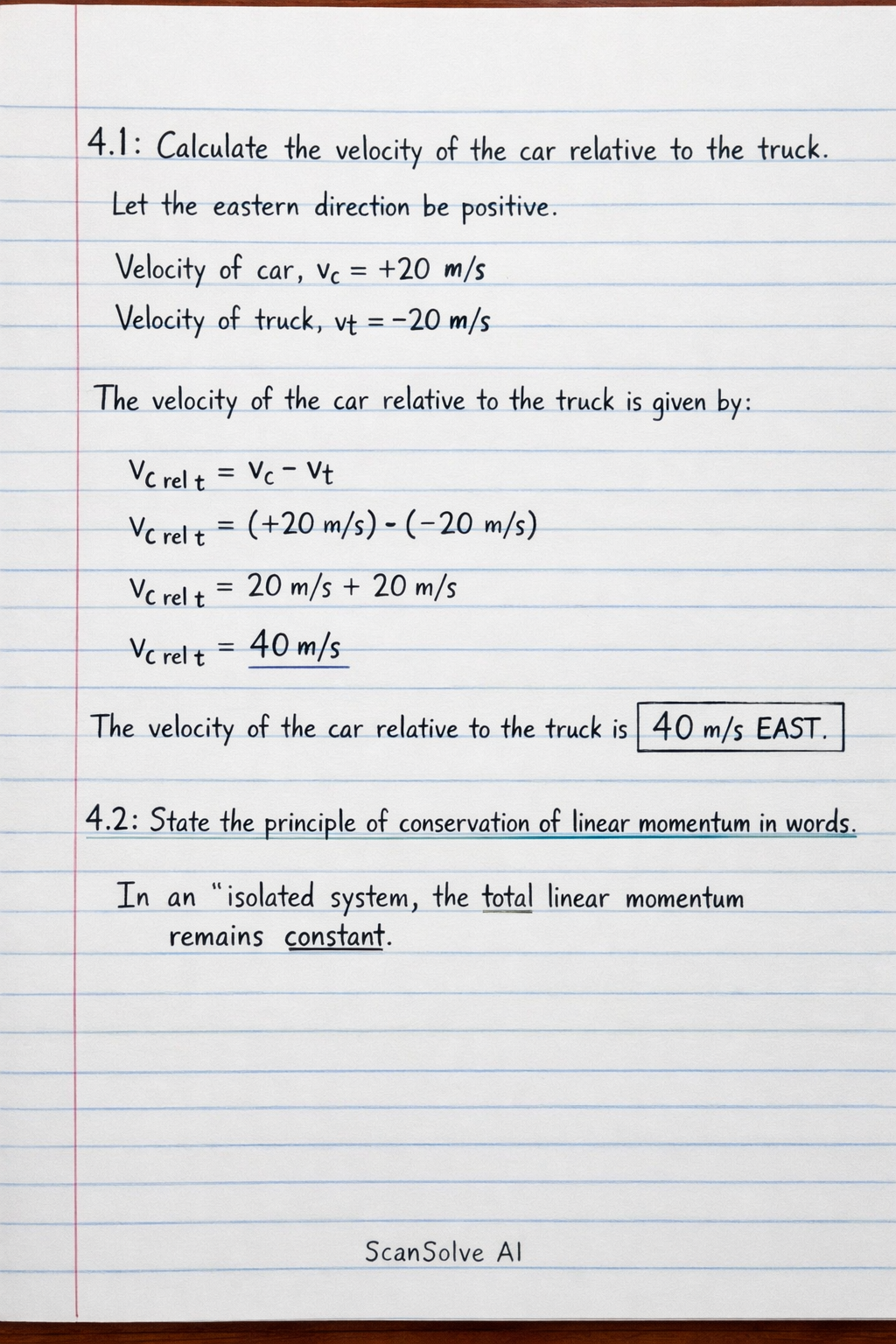
4.1: Calculate the velocity of the car relative to the truck.
ScanSolve AI Answer
Answer
F
4.1: Calculate the velocity of the car relative to the truck.
Let the eastern direction be positive.
Velocity of car,
Velocity of truck,
The velocity of the car relative to the truck is given by:
The velocity of the car relative to the truck is .
4.2: State the principle of conservation of linear momentum in words.
In an isolated system, the total linear momentum remains constant.
4.3: Calculate the velocity of the truck-car system immediately after the collision.
Let the eastern direction be positive.
Mass of car,
Initial velocity of car,
Mass of truck,
Initial velocity of truck,
Since the vehicles stick together, their final velocity will be the same, .
According to the principle of conservation of linear momentum:
Substitute the given values:
Divide both sides by :
The negative sign indicates the direction is WEST.
The velocity of the truck-car system immediately after the collision is .
4.4.1: Determine, in terms of , the magnitude of the force that the truck exerts on the car on impact. Give a reason for the answer.
The magnitude of the force that the truck exerts on the car is .
Reason: According to Newton's Third Law, for every action, there is an equal and opposite reaction. The force exerted by the car on the truck is an action force, and the force exerted by the truck on the car is the reaction force. These forces are equal in magnitude and opposite in direction.
Try one yourself
A new problem that tests the same skill.
Still stuck on this one?
Ask a follow-up, and the answer starts from this question.
More Physics Questions
Handwritten Step-by-Step Solution
Get this as a handwritten image on WhatsApp — like a tutor wrote it for you.
Try on WhatsApp