
We read your photo as:
A 40 kg box is at rest 5 m from the end of a truck bed. The coefficient of friction between the box and the truck bed is 0.15. If the truck accelerates at 2 m/s2, how long will it take for the box to
ScanSolve AI Answer
Answer
Step-by-step solution
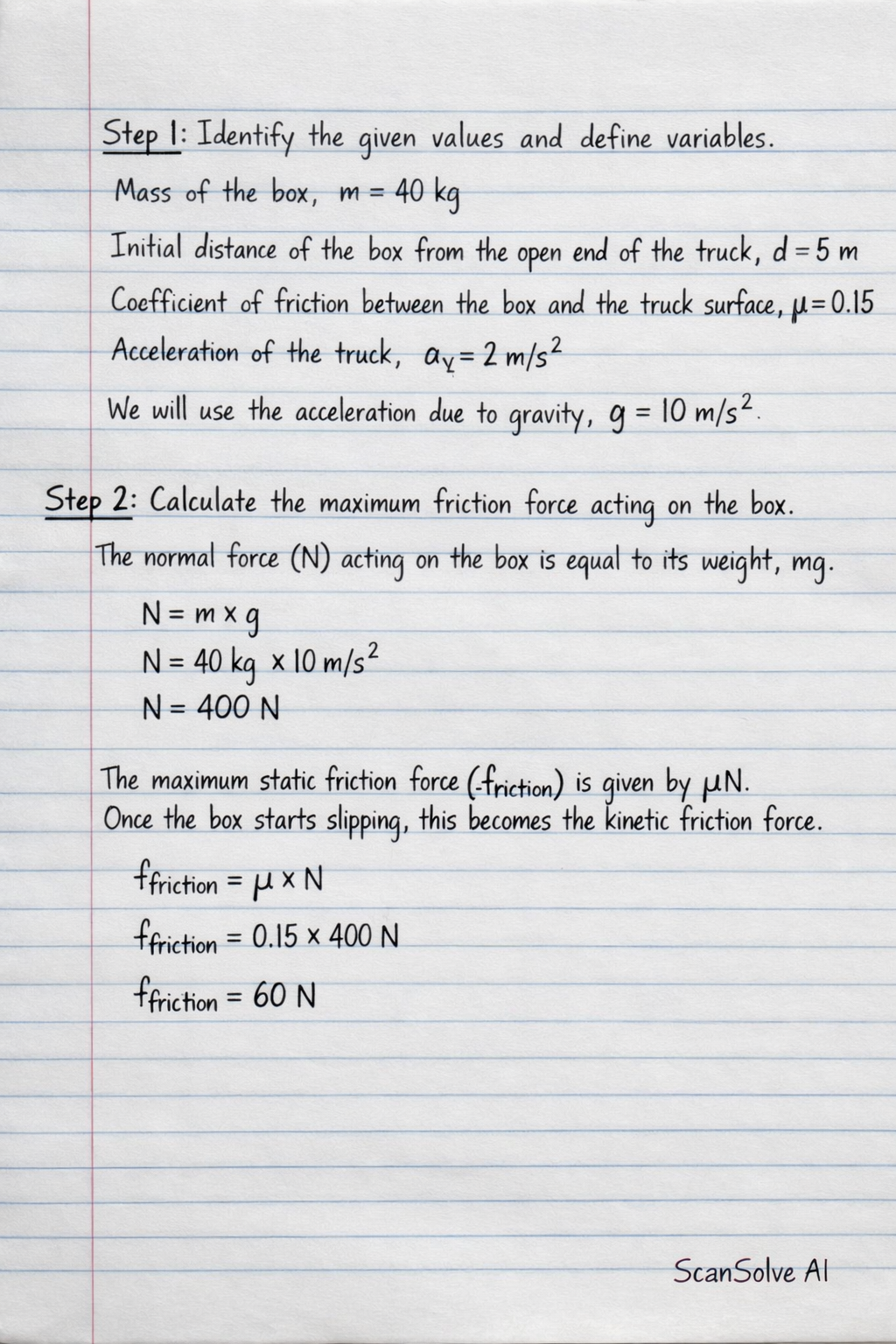
6 stepsIdentify the given values and define variables.
Mass of the box,
Initial distance of the box from the open end of the truck,
Coefficient of friction between the box and the truck surface,
Acceleration of the truck,
We will use the acceleration due to gravity, .Calculate the maximum friction force acting on the box.
The normal force () acting on the box is equal to its weight, .
The maximum static friction force () is given by . Once the box starts slipping, this becomes the kinetic friction force.
Calculate the acceleration of the box.
The friction force is the only horizontal force acting on the box. Using Newton's second law (), the acceleration of the box () is:
Determine the relative acceleration between the truck and the box.
The truck accelerates at , and the box accelerates at . Since , the truck moves forward faster than the box, causing the box to slip backward relative to the truck.
The relative acceleration () of the truck with respect to the box (or the box slipping backward relative to the truck) is:Calculate the time it takes for the box to fall off the truck.
The box falls off when it has moved a relative distance of with respect to the truck. Both the truck and the box start from rest, so the initial relative velocity is 0.
Using the kinematic equation :Calculate the distance traveled by the truck from the starting point.
The question asks for the distance from the starting point where the box falls off. This is the distance traveled by the truck during the time .
Using the kinematic equation for the truck: .
Since the truck starts from rest, .The distance from the starting point where the box falls off the truck is 20 meters. This corresponds to option (a).
The final answer is .
Try one yourself
A new problem that tests the same skill.
Still stuck on this one?
Ask a follow-up, and the answer starts from this question.
More Physics Questions
Handwritten Step-by-Step Solution
Get this as a handwritten image on WhatsApp — like a tutor wrote it for you.
Try on WhatsApp