
We read your photo as:
A 5m plank of weight 50N is supported by two strings A and B. A block of weight 100N is suspended 2.5m from the left end. Rope A is attached 2m from the left end and Rope B is attached 1.5m from the r
ScanSolve AI Answer
Step-by-step solution
5 stepsHere are the solutions to the questions:
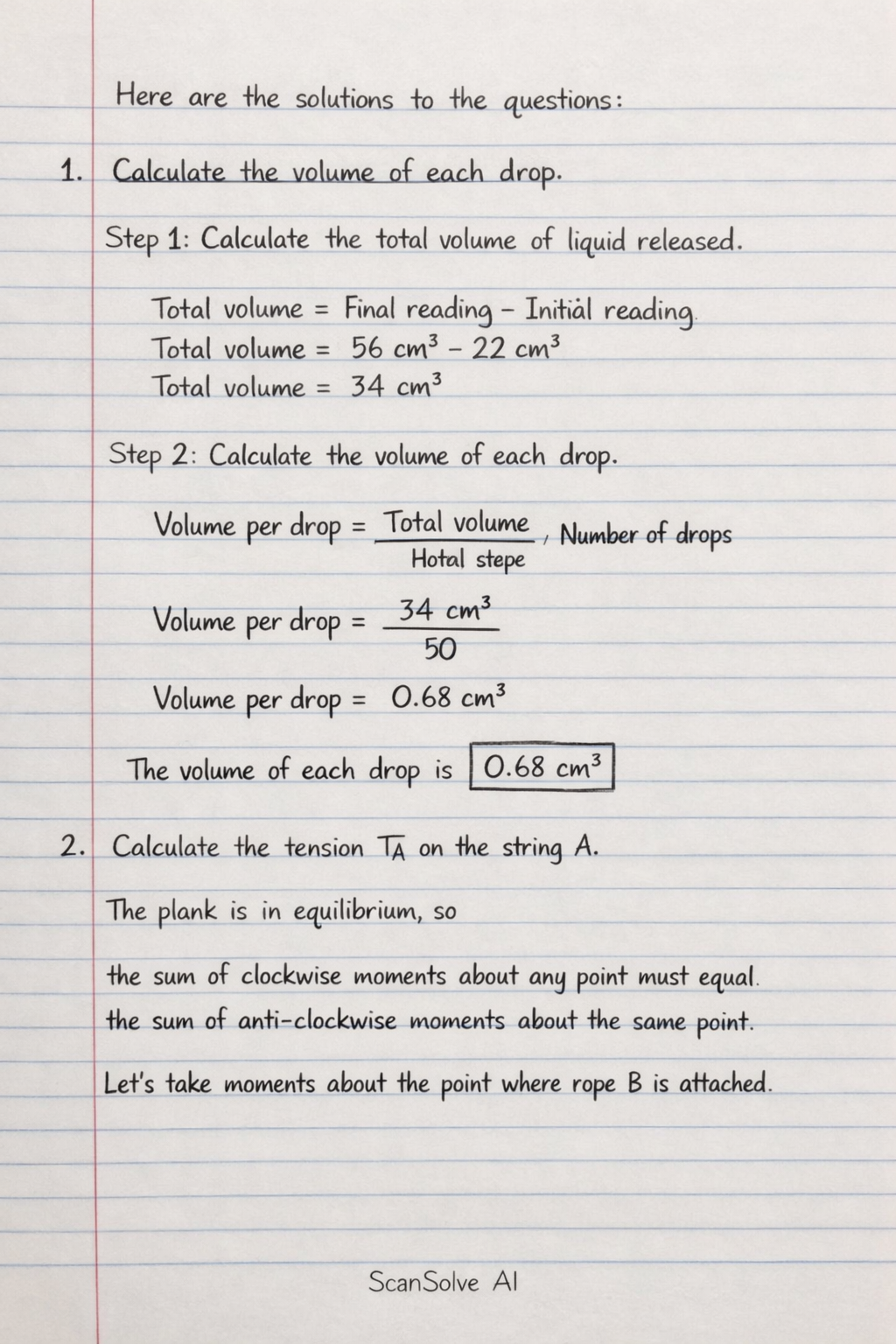
- Calculate the volume of each drop.
Calculate the total volume of liquid released.
$$ \text{Total volume} = \text{Final reading} - \text{Initial reading} $$ $$ \text{Total volume} = 56 \text{ cm}^3 - 22 \text{ cm}^3 = 34 \text{ cm}^3 $$Calculate the volume of each drop.
$$ \text{Volume per drop} = \frac{\text{Total volume}}{\text{Number of drops}} $$ $$ \text{Volume per drop} = \frac{34 \text{ cm}^3}{50} $$ $$ \text{Volume per drop} = 0.68 \text{ cm}^3 $$ The volume of each drop is $\boxed{\text{0.68 cm}^3}$.2. Calculate the tension on the string A. The plank is in equilibrium, so the sum of clockwise moments about any point must equal the sum of anti-clockwise moments about the same point. Let's take moments about the point where rope B is attached.
* **Plank details:** * Length of plank = $5 \text{ m}$ * Weight of plank ($W_p$) = $50 \text{ N}$ (acts at the center of the plank, $2.5 \text{ m}$ from either end). * Block weight ($W_b$) = $100 \text{ N}$ (suspended from the center of the plank, $2.5 \text{ m}$ from either end). * **Positions from the left end:** * Rope A: $2 \text{ m}$ * Center of plank (where $W_p$ and $W_b$ act): $2.5 \text{ m}$ * Rope B: $5 \text{ m} - 1.5 \text{ m} = 3.5 \text{ m}$Identify forces and their distances from the pivot (Rope B).
* Tension $T_A$ (upwards): Distance from B = $3.5 \text{ m} - 2 \text{ m} = 1.5 \text{ m}$. This creates an anti-clockwise moment. * Weight of plank $W_p = 50 \text{ N}$ (downwards): Distance from B = $3.5 \text{ m} - 2.5 \text{ m} = 1.0 \text{ m}$. This creates a clockwise moment. * Weight of block $W_b = 100 \text{ N}$ (downwards): Distance from B = $3.5 \text{ m} - 2.5 \text{ m} = 1.0 \text{ m}$. This creates a clockwise moment.Apply the principle of moments (Sum of anti-clockwise moments = Sum of clockwise moments).
$$ T_A \times 1.5 \text{ m} = (W_p \times 1.0 \text{ m}) + (W_b \times 1.0 \text{ m}) $$ $$ T_A \times 1.5 = (50 \text{ N} \times 1.0 \text{ m}) + (100 \text{ N} \times 1.0 \text{ m}) $$ $$ 1.5 T_A = 50 + 100 $$ $$ 1.5 T_A = 150 $$Solve for .
$$ T_A = \frac{150}{1.5} $$ $$ T_A = 100 \text{ N} $$ The tension $T_A$ on the string A is $\boxed{\text{100 N}}$.3. Explain this observation. The observation that the water level in pipe X is lower than in pipe Y can be explained by applying the principles of continuity and Bernoulli's principle. - Continuity Equation: As air flows through the horizontal tube from right to left, it encounters a narrower section at X and a wider section at Y. According to the principle of continuity, for an incompressible fluid, the fluid speed is inversely proportional to the cross-sectional area. Therefore, the speed of air in the narrower section X is higher than in the wider section Y. - Bernoulli's Principle: Bernoulli's principle states that for a horizontal flow of a fluid, an increase in fluid speed is accompanied by a decrease in pressure. Since the air speed in section X is higher, the pressure in section X is lower than the pressure in section Y. - Result: The lower pressure in section X exerts less downward force on the water surface in the vertical pipe X, allowing the external atmospheric pressure to push the water less high into pipe X. Conversely, the higher pressure in section Y results in the water level in Y being higher than in X.
Still stuck on this one?
Ask a follow-up, and the answer starts from this question.
More Physics Questions
Handwritten Step-by-Step Solution
Get this as a handwritten image on WhatsApp — like a tutor wrote it for you.
Try on WhatsApp