

This physics problem tests your understanding of fundamental physical laws and their applications. The step-by-step solution below breaks down the problem using relevant equations and physical reasoning.
ScanSolve AI Answer
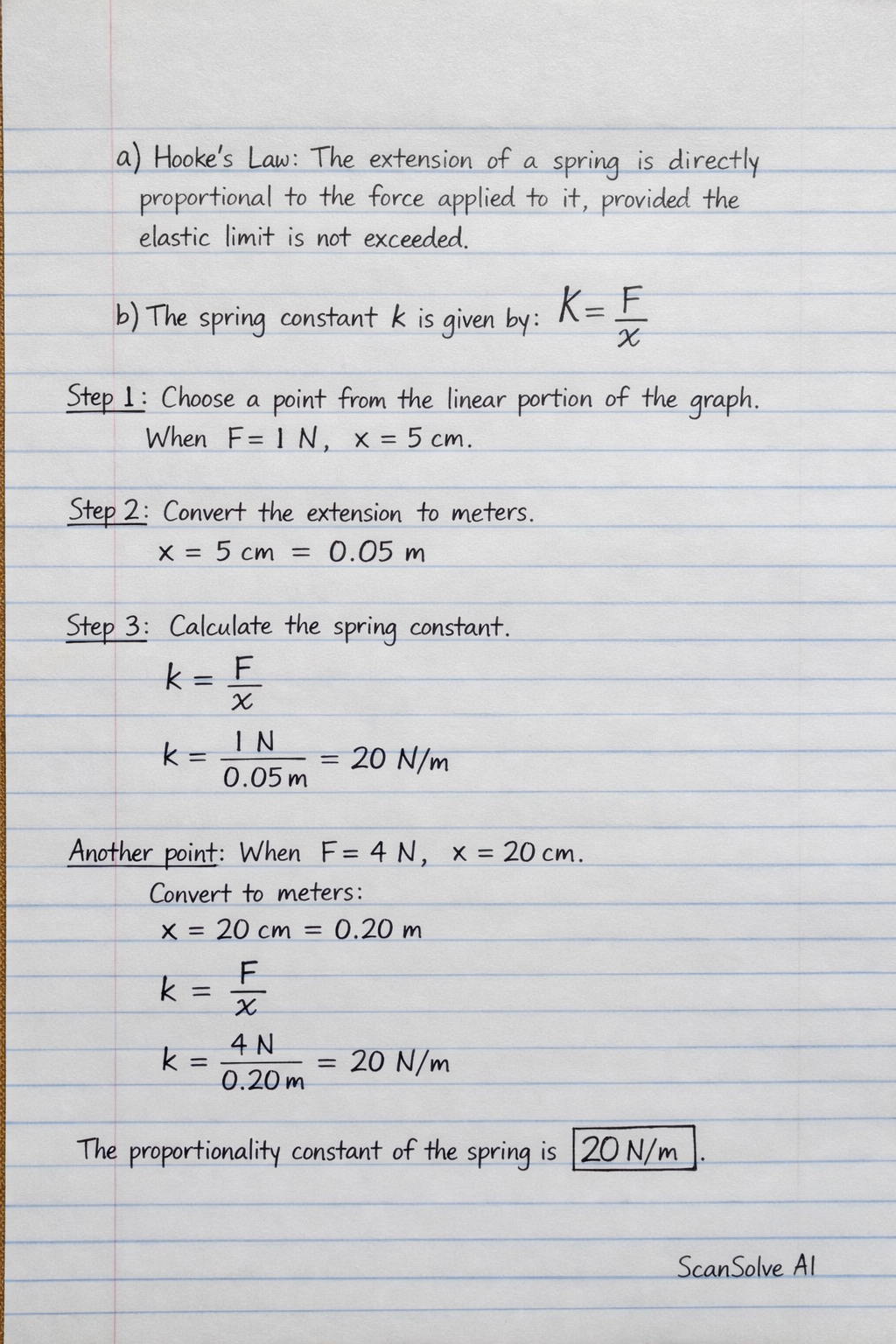
a) Hooke's Law states that the extension of a spring is directly proportional to the force applied to it, provided the elastic limit is not exceeded. b) The proportionality constant of the spring, also known as the spring constant (k), is given by the ratio of the applied load (force, F) to the extension (x). k = (F)/(x) Step 1: Choose a point from the linear portion of the graph. From the graph, when the Load (F) is 1 N, the Extension (x) is 5 cm. Step 2: Convert the extension from centimeters to meters to use SI units for the spring constant. x = 5 cm = 0.05 m Step 3: Calculate the spring constant k. k = 1 N0.05 m = 20 N/m Using another point, for example, when Load (F) is 4 N, Extension (x) is 20 cm. x = 20 cm = 0.20 m k = 4 N0.20 m = 20 N/m The proportionality constant of the spring is 20 N/m. c) Two factors that affect the proportionality constant of a vertical spring are: • The material of the spring (e.g., steel, copper). • The diameter of the wire used to make the spring. d) i) Given that the L_v is the specific latent heat of vaporization of steam. ii) The latent heat of vaporization (Q) is the total energy required to change the state of a mass m of a substance at its boiling point without a change in temperature. Given L_v is the specific latent heat of vaporization (energy per unit mass), the expression for the total latent heat of vaporization is: Q = mL_v where m is the mass of the steam and L_v is the specific latent heat of vaporization. The expression for the latent heat of vaporization of steam is Q = mL_v.