
We read your photo as:
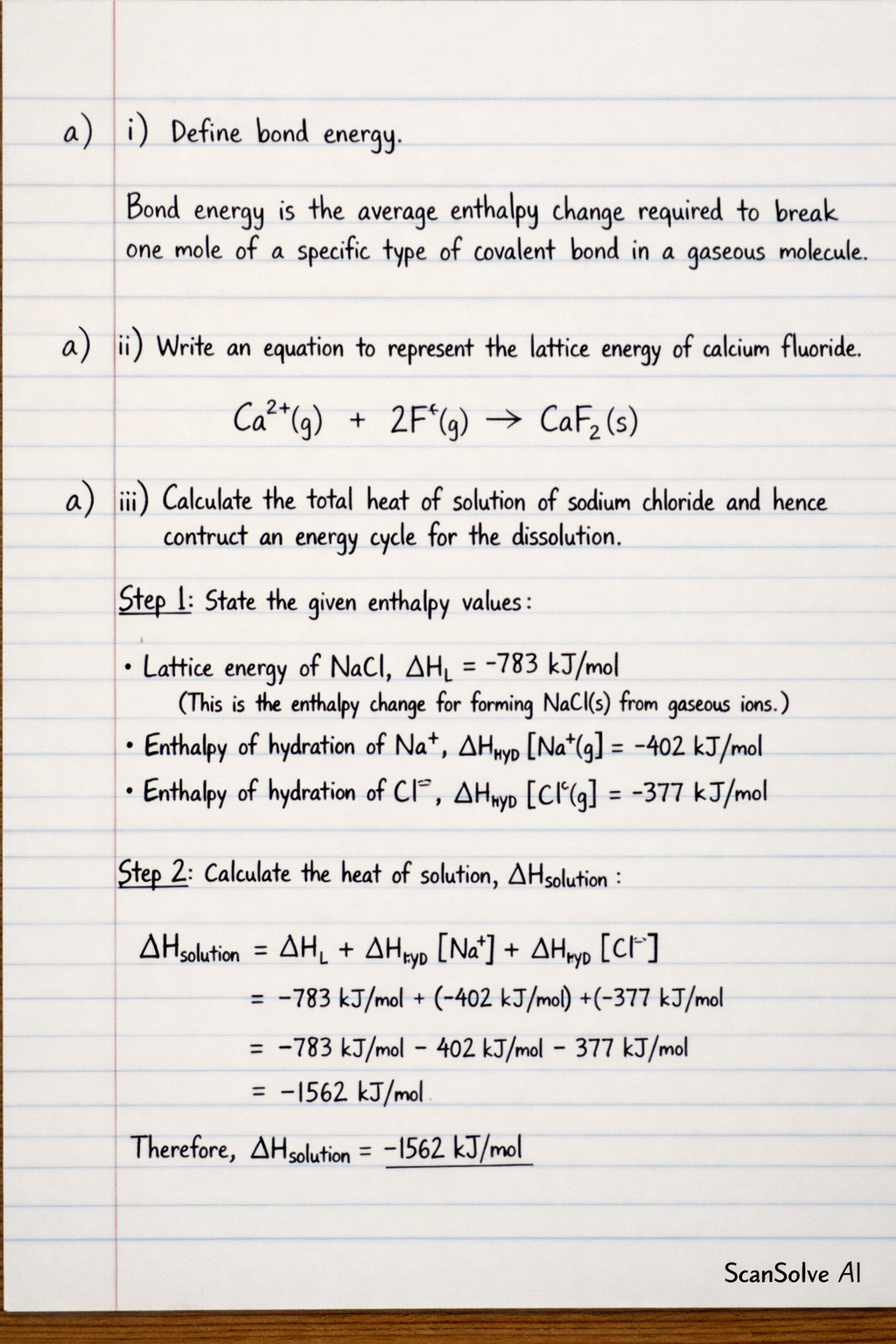
A) i) Define bond energy.
Physics
ScanSolve AI Answer
Step-by-step solution
2 stepsa) i) Define bond energy.
Bond energy is the average enthalpy change required to break one mole of a specific type of covalent bond in a gaseous molecule.
a) ii) Write an equation to represent the lattice energy of calcium fluoride.
a) iii) Calculate the total heat of solution of sodium chloride and hence construct an energy cycle for the dissolution.
State the given enthalpy values.
- Lattice energy of NaCl, (This is the enthalpy change for forming NaCl(s) from gaseous ions).
- Enthalpy of hydration of Na,
- Enthalpy of hydration of Cl,
Apply Hess's Law to calculate the enthalpy of solution ().
The dissolution process is:
This can be broken down into two steps:- Breaking the lattice into gaseous ions: . The enthalpy change for this step is the negative of the lattice energy, .
- Hydrating the gaseous ions: $\text{Na}^{+}(g) + \text
Was this helpful?
Still stuck on this one?
Ask a follow-up, and the answer starts from this question.
Got a different question?Ask your own question
More Physics Questions
QUnderstand the concept of Binding Energy.QTo determine the enthalpy change for the reaction using bond energies, we use the formula:Qc) i. State the type of bond that exists in:QI) A chemical bond is a strong force of attraction that holds atoms or ions together in a molecule…QCalculate for the total energy required when the old bonds are broken. Show full working out
Handwritten Step-by-Step Solution
Get this as a handwritten image on WhatsApp — like a tutor wrote it for you.
Try on WhatsApp