
A mass of oxygen occurps 7.0 millimetres under the pressure of 740 torr deretimen the same volume of Mass of gas and standard pressure and the temperature remaining constant
ScanSolve AI Answer
Answer
Step-by-step solution
5 stepsThis problem involves a gas undergoing a change in pressure while its temperature remains constant. This scenario is described by Boyle's Law, which states that for a fixed mass of gas at constant temperature, the pressure () and volume () are inversely proportional. Mathematically, this is expressed as:
Where:
- is the initial pressure
- is the initial volume
- is the final pressure
- is the final volume
Identify the given values and make necessary assumptions.
- Initial pressure,
- Initial volume, (Assuming "7.0 millimetres" is a typo for "7.0 milliliters", as millimeters is a unit of length, not volume, in this context.)
- Final pressure, (Standard pressure is commonly taken as 1 atmosphere, which is equal to 760 torr.)
- Temperature remains constant.
- We need to find the final volume, .
Rearrange Boyle's Law to solve for .
Substitute the known values into the equation.
Calculate the final volume.
Round the answer to an appropriate number of significant figures.
Since the initial volume (7.0 mL) has two significant figures, we round our answer to two significant figures.
The volume of the oxygen gas at standard pressure (760 torr) and constant temperature is approximately .
Try one yourself
A new problem that tests the same skill.
Still stuck on this one?
Ask a follow-up, and the answer starts from this question.
More Physics Questions
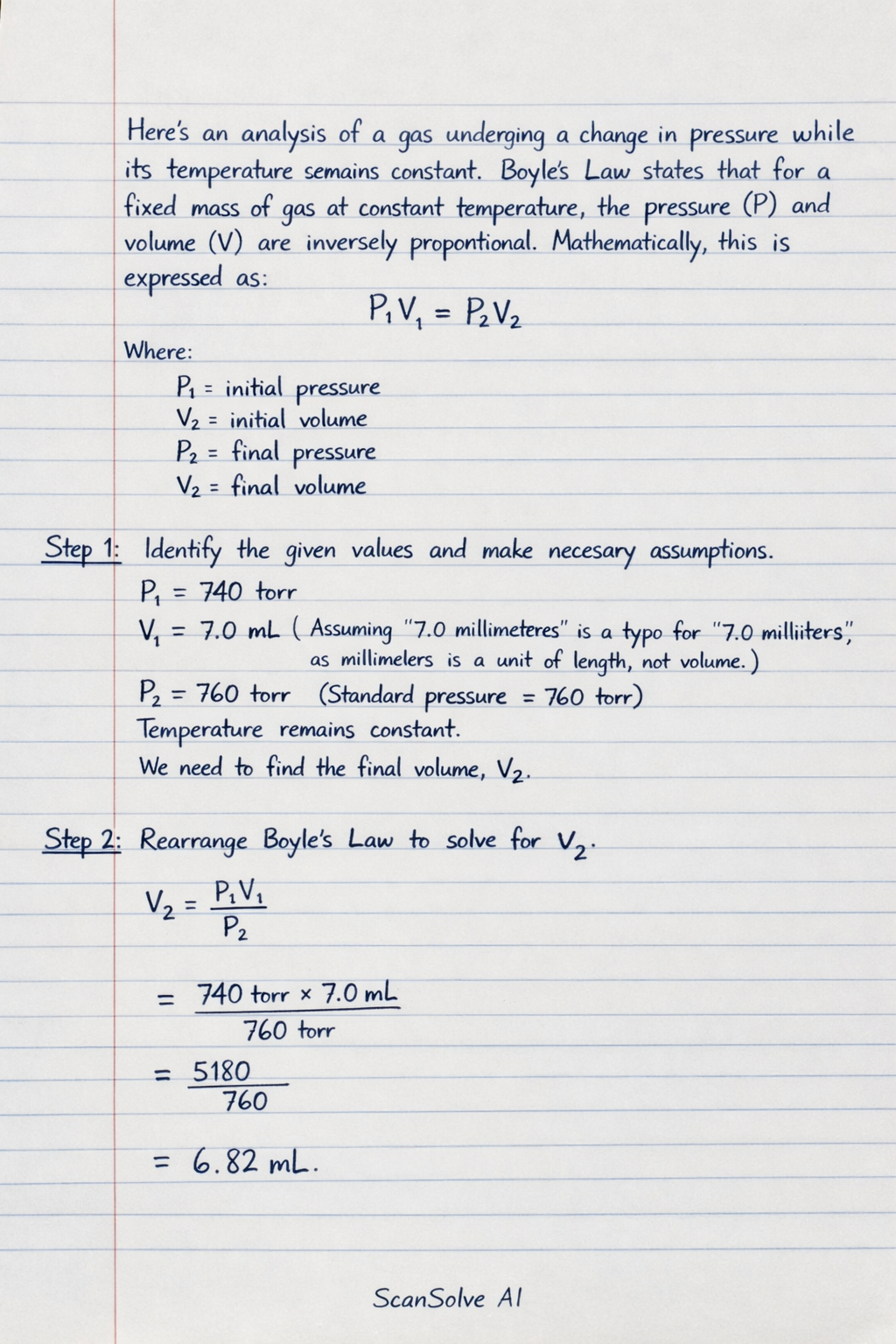
Handwritten Step-by-Step Solution
Get this as a handwritten image on WhatsApp — like a tutor wrote it for you.
Try on WhatsApp