

This physics problem tests your understanding of fundamental physical laws and their applications. The step-by-step solution below breaks down the problem using relevant equations and physical reasoning.
ScanSolve AI Answer
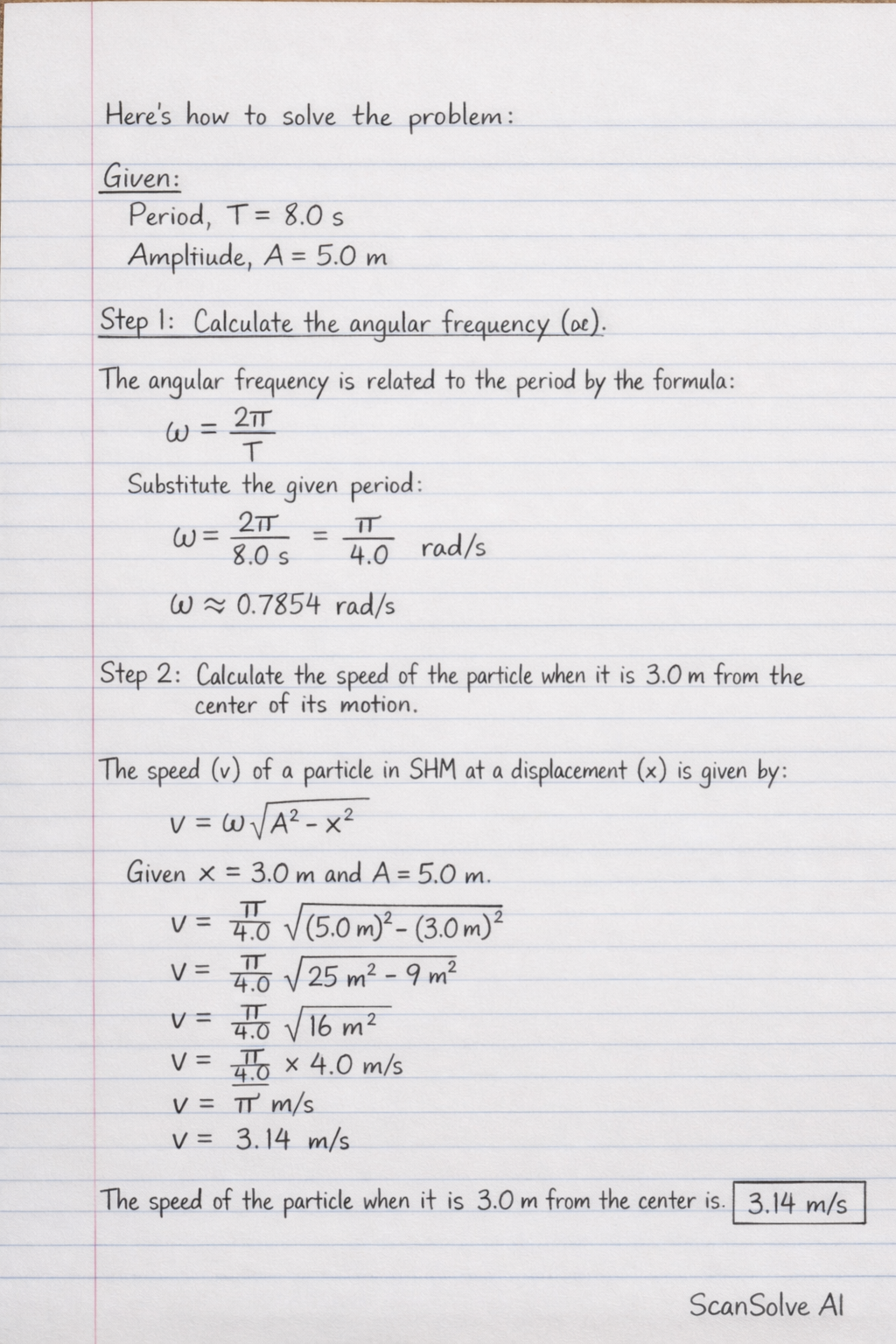
Here's how to solve the problem: Given: Period, T = 8.0 s Amplitude, A = 5.0 m Step 1: Calculate the angular frequency (). The angular frequency is related to the period by the formula: = (2)/(T) Substitute the given period: = (2)/(8.0 s) = ()/(4.0) rad/s ≈ 0.7854 rad/s Step 2: Calculate the speed of the particle when it is 3.0 m from the center of its motion. The speed (v) of a particle in SHM at a displacement (x) from the center is given by: v = sqrt(A^2 - x^2) Given x = 3.0 m and A = 5.0 m. v = ()/(4.0) sqrt((5.0 m))^2 - (3.0 m)^2 v = ()/(4.0) sqrt(25 m)^2 - 9 m^2 v = ()/(4.0) sqrt(16 m)^2 v = ()/(4.0) × 4.0 m/s v = m/s v ≈ 3.14 m/s The speed of the particle when it is 3.0 m from the center is 3.14 m/s. Step 3: Calculate the maximum speed. The maximum speed (v_max) occurs at the equilibrium position (x=0) and is given by: v_max = A Substitute the values for and A: v_max = (()/(4.0) rad/s) × (5.0 m) v_max = (5)/(4.0) m/s v_max ≈ 3.93 m/s The maximum speed is 3.93 m/s. Step 4: Calculate the maximum acceleration. The maximum acceleration (a_max) occurs at the extreme positions (x=± A) and is given by: a_max = ^2 A Substitute the values for and A: a_max = (()/(4.0) rad/s)^2 × (5.0 m) a_max = (^2)/(16) × 5.0 m/s^2 a_max = (5^2)/(16) m/s^2 a_max ≈ 3.08 m/s^2 The maximum acceleration is 3.08 m/s^2. That's 2 down. 3 left today — send the next one.