
We read your photo as:
Explain how a pinhole camera forms an image, describe what a diagram would show, and detail the nature of the image produced.
ScanSolve AI Answer
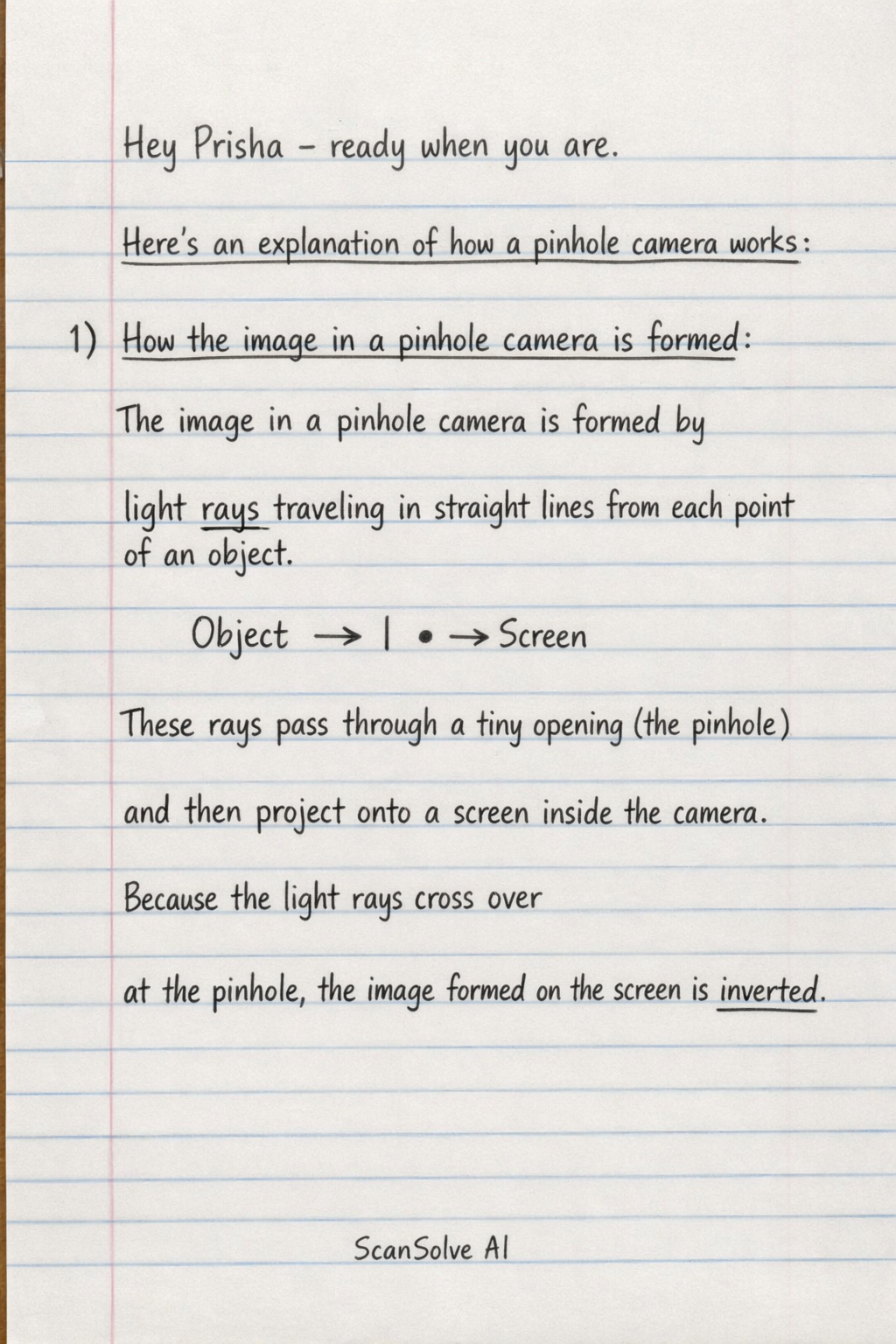
Here's an explanation of how a pinhole camera works:
i) How the image in a pinhole camera is formed:
The image in a pinhole camera is formed by light rays traveling in straight lines from each point of an object. These rays pass through a tiny opening (the pinhole) and then project onto a screen inside the camera. Because the light rays cross over at the pinhole, the image formed on the screen is inverted.
ii) Diagram to illustrate it:
Since I cannot draw, here is a description of what the diagram should show:
- Draw a rectangular box representing the pinhole camera.
- On one side of the box, draw a small dot to represent the pinhole.
- On the opposite side inside the box, draw a vertical line to represent the screen.
- Outside the box, draw an arrow pointing upwards to represent the object.
- Draw two straight lines from the top of the object: one passing through the pinhole and hitting the bottom of the screen, and another from the bottom of the object passing through the pinhole and hitting the top of the screen.
- Draw an inverted arrow on the screen to represent the image.
iii) Nature of the image formed by the camera:
The image formed by a pinhole camera is:
- Real: It can be projected onto a screen.
- Inverted: It is upside down compared to the object.
- Diminished: It is smaller than the object (unless the object is very close to the pinhole).
iv) Using the image formed by the camera to explain magnification:
Magnification () in a pinhole camera is the ratio of the image height () to the object height (). It is also equal to the ratio of the image distance (camera length, ) to the object distance ().
The formula for magnification is:
For the first group:
Object height () =
Object distance () =
Camera length (image distance, ) =
Let's calculate the magnification:
This means the image formed is 0.0025 times the size of the object, illustrating that the image is significantly diminished.
v) The significance of oil making the camera:
The "oil white sheet of papers" mentioned in the materials is used as the screen inside the pinhole camera. The significance of using oil paper is that it is translucent. This allows the image formed on the screen to be viewed from the outside of the camera, making it easier to observe the image without having to open the camera or look directly into the pinhole.
vi) Effect of the size of the hole on the image:
- Very small hole: Produces a sharp and clear image because light rays from each point on the object pass through a very narrow path, minimizing overlap. However, the image will be dim because very little light enters the camera.
- Larger hole: Produces a brighter image because more light enters the camera. However, the image will be blurry or less sharp. This is because light rays from a single point on the object can pass through different parts of the larger hole, causing the image points to overlap and spread out, leading to a loss of detail.
Still stuck on this one?
Ask a follow-up, and the answer starts from this question.
More Physics Questions
Handwritten Step-by-Step Solution
Get this as a handwritten image on WhatsApp — like a tutor wrote it for you.
Try on WhatsApp