
We read your photo as:
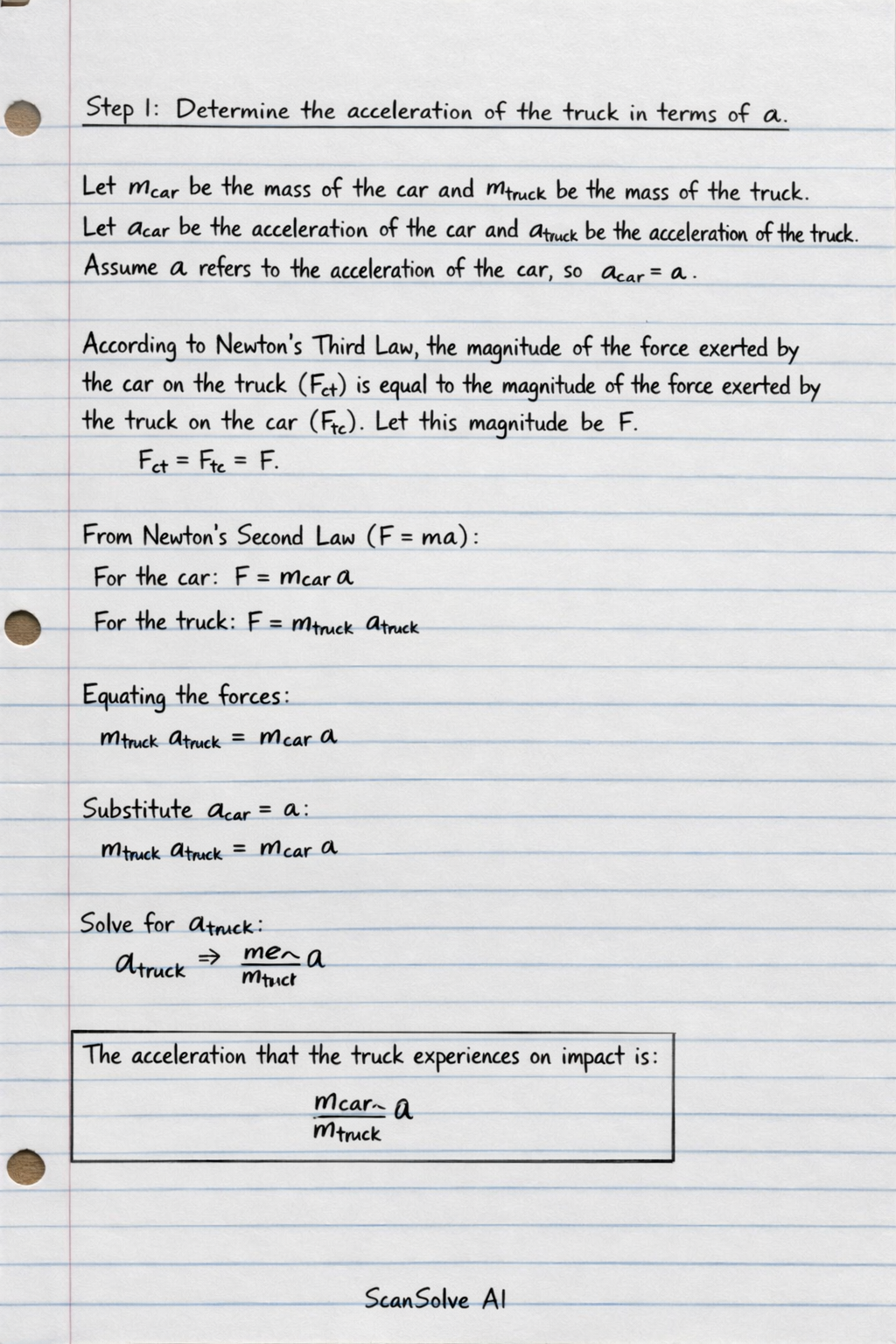
Determine the acceleration of the truck in terms of a.
ScanSolve AI Answer
Answer
Step-by-step solution
2 stepsDetermine the acceleration of the truck in terms of .
Let be the mass of the car and be the mass of the truck.
Let be the acceleration of the car and be the acceleration of the truck.
Assume refers to the acceleration of the car, so .According to Newton's Third Law, the magnitude of the force exerted by the car on the truck () is equal to the magnitude of the force exerted by the truck on the car (). Let this magnitude be .
From Newton's Second Law ():
For the car:
For the truck:
Equating the forces:Substitute :
Solve for :
The acceleration that the truck experiences on impact is
Reason: According to Newton's Third Law, the force exerted by the car on the truck is equal in magnitude to the force exerted by the truck on the car. Since the truck typically has a much larger mass than the car (), for the same force, the truck's acceleration will be smaller than the car's acceleration.
Determine which driver is likely to be more severely injured and explain why.
The is likely to be more severely injured on impact.
Explanation:
During the collision, the less massive car experiences a greater change in velocity () compared to the more massive truck, for the same impulse. Since the time of impact () is the same for both vehicles, the car undergoes a significantly larger deceleration (). This greater deceleration means a larger force is exerted on the car driver by the seatbelt, leading to more severe injuries.
Try one yourself
A new problem that tests the same skill.
Still stuck on this one?
Ask a follow-up, and the answer starts from this question.
More Physics Questions
Handwritten Step-by-Step Solution
Get this as a handwritten image on WhatsApp — like a tutor wrote it for you.
Try on WhatsApp