
We read your photo as:
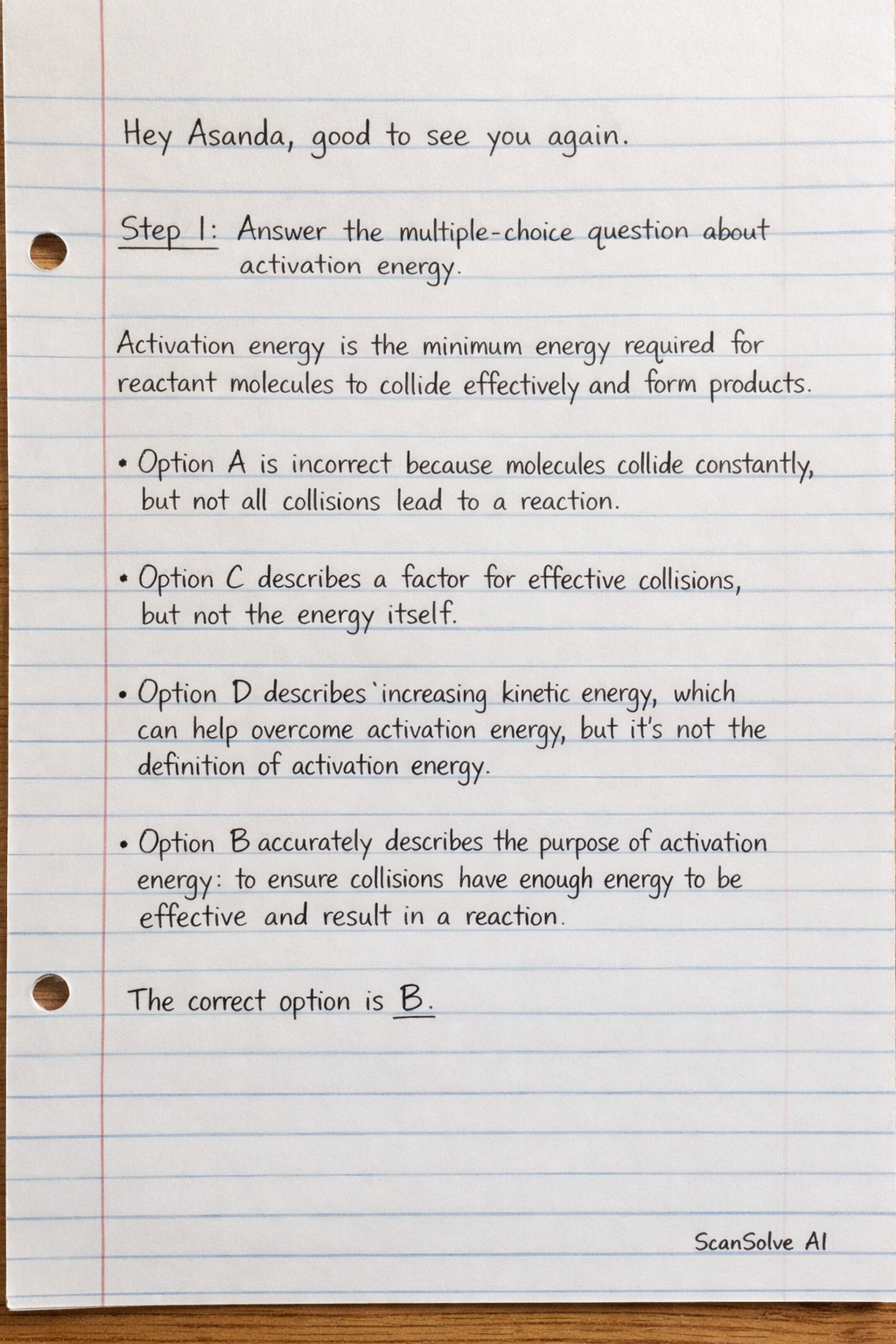
Answer the multiple-choice question about activation energy.
ScanSolve AI Answer
Answer
Step-by-step solution
3 stepsAnswer the multiple-choice question about activation energy.
Activation energy is the minimum energy required for reactant molecules to collide effectively and form products.
- Option A is incorrect because molecules collide constantly, but not all collisions lead to a reaction.
- Option C describes a factor for effective collisions, but not the energy itself.
- Option D describes increasing kinetic energy, which can help overcome activation energy, but it's not the definition of activation energy.
- Option B accurately describes the purpose of activation energy: to ensure collisions have enough energy to be effective and result in a reaction.
The correct option is B.
Analyze the given information for the graph.
Curve I represents the reaction of powdered magnesium with 1 mol·dm⁻³ HCl at 25 °C.
Curve II shows a faster reaction rate (steeper slope) but reaches the same final volume of hydrogen gas as Curve I.
The same volume of hydrochloric acid solution was used for both curves, meaning the initial moles of HCl were the same, which explains why the final volume of H₂ produced is the same.Evaluate the conditions for Curve II based on the table.
We need conditions that lead to a faster rate than Curve I (Powdered Mg, 1 mol·dm⁻³ HCl, 25 °C) while producing the same total amount of product.
- Option A: Ribbon Mg (smaller surface area, slower rate) and 0.5 mol·dm⁻³ acid (lower concentration, slower rate). Also, lower concentration means less product. This is incorrect.
- Option B: Ribbon Mg (smaller surface area, slower rate) but 2 mol·dm⁻³ acid (higher concentration, faster rate). However, higher concentration with the same volume means more moles of HCl, which would produce a larger final volume of hydrogen gas. This is incorrect.
- Option C: Powdered Mg (same surface area) and 1 mol·dm⁻³ acid (same concentration) but 20 °C (lower temperature, slower rate). This is incorrect.
- Option D: Powdered Mg (same surface area) and 1 mol·dm⁻³ acid (same concentration) but 30 °C (higher temperature, faster rate). This matches the observation that Curve II has a faster rate and produces the same final volume of hydrogen gas as Curve I.
The correct option for the conditions used to obtain curve II is D.
Final Answer:
1.1: B
1.2: D
Try one yourself
A new problem that tests the same skill.
Still stuck on this one?
Ask a follow-up, and the answer starts from this question.
More Physics Questions
Handwritten Step-by-Step Solution
Get this as a handwritten image on WhatsApp — like a tutor wrote it for you.
Try on WhatsApp