
We read your photo as:
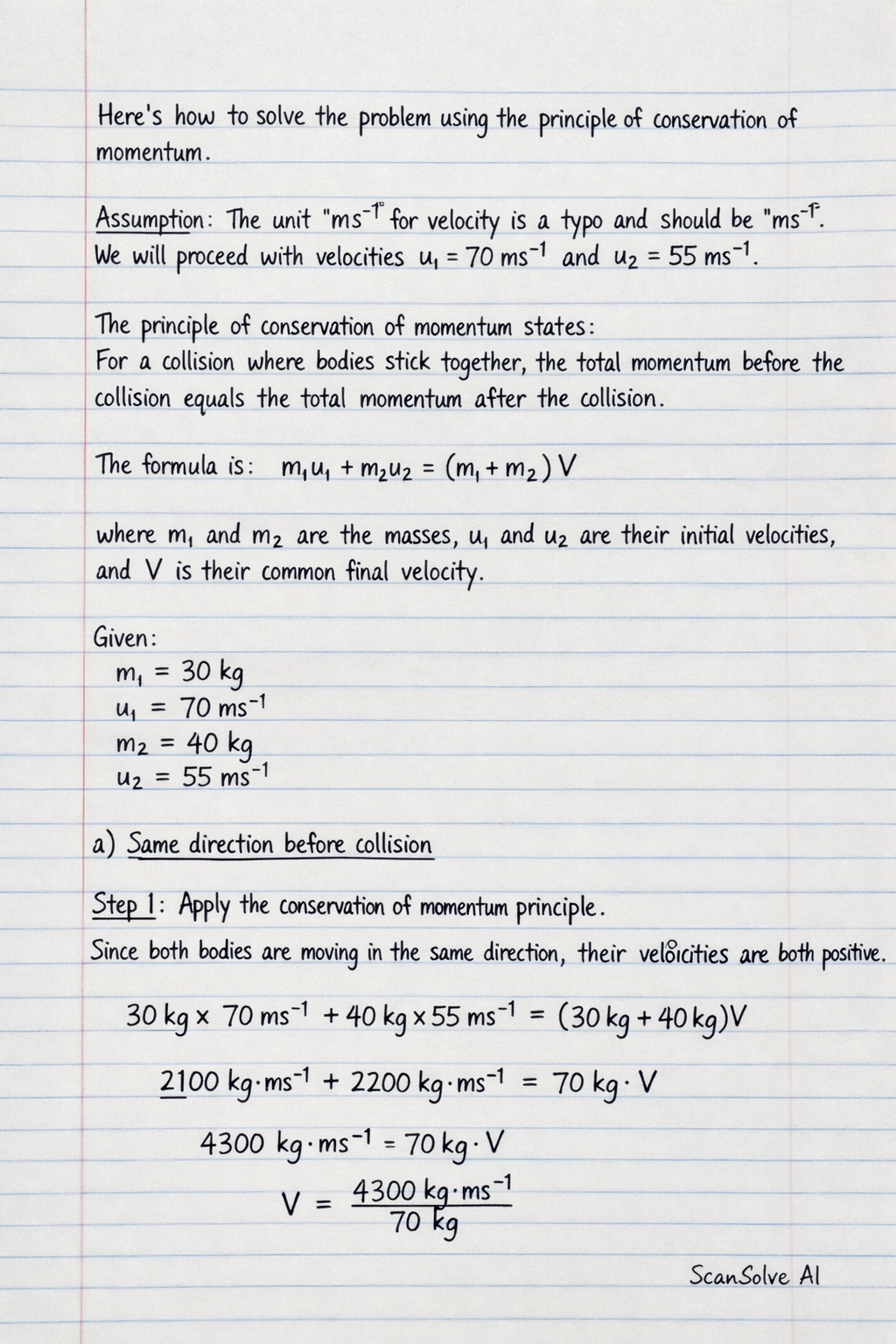
Assumption: The unit "ms⁻²" for velocity is a typo and should be "ms⁻¹". We will proceed with velocities u1 = 70 ms⁻¹ and u2 = 55 ms⁻¹.
ScanSolve AI Answer
Answers
2 partsStep-by-step solution
6 stepsHere's how to solve the problem using the principle of conservation of momentum.
Assumption: The unit "ms⁻²" for velocity is a typo and should be "ms⁻¹". We will proceed with velocities and .
The principle of conservation of momentum states that for a collision where bodies stick together, the total momentum before the collision equals the total momentum after the collision.
The formula is:
where and are the masses, and are their initial velocities, and is their common final velocity.
Given:
Part a· 3 steps
Same direction before collision
Apply the conservation of momentum principle.
Since both bodies are moving in the same direction, their velocities are both positive.
Calculate the total initial momentum.
Solve for the common final velocity .
Rounding to one decimal place:
Part b
Opposite direction, before collision
Apply the conservation of momentum principle.
If the bodies move in opposite directions, one velocity must be negative. Let's assume is positive and is negative.
Calculate the total initial momentum.
Solve for the common final velocity .
Rounding to one decimal place:
The negative sign indicates that the combined mass moves in the direction of the initially heavier body (40 kg mass).
Try one yourself
A new problem that tests the same skill.
Still stuck on this one?
Ask a follow-up, and the answer starts from this question.
More Physics Questions
Handwritten Step-by-Step Solution
Get this as a handwritten image on WhatsApp — like a tutor wrote it for you.
Try on WhatsApp