
We read your photo as:
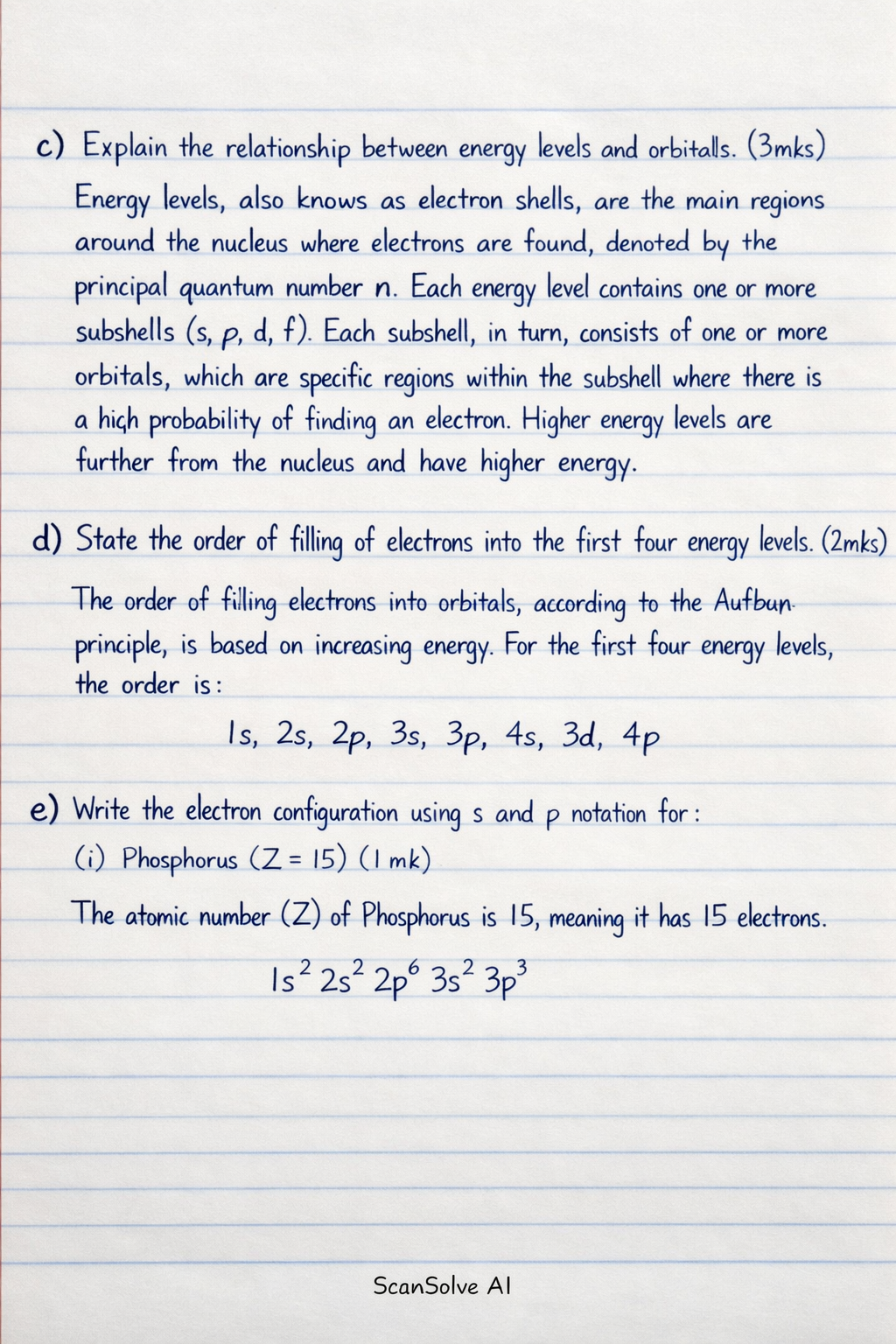
c) Explain the relationship between energy levels and orbitals. (3mks)
ScanSolve AI Answer
Here are the solutions to the questions:
c) Explain the relationship between energy levels and orbitals. (3mks)
Energy levels, also known as electron shells, are the main regions around the nucleus where electrons are found, denoted by the principal quantum number . Each energy level contains one or more subshells (s, p, d, f). Each subshell, in turn, consists of one or more orbitals, which are specific regions within the subshell where there is a high probability of finding an electron. Higher energy levels are further from the nucleus and have higher energy.
d) State the order of filling of electrons into the first four energy levels. (2mks)
The order of filling electrons into orbitals, according to the Aufbau principle, is based on increasing energy. For the first four energy levels, the order is:
e) Write the electron configuration using s and p notation for:
(i) Phosphorus (Z = 15) (1mk)
The atomic number (Z) of Phosphorus is 15, meaning it has 15 electrons.
(ii) Neon (Z = 10) (1mk)
The atomic number (Z) of Neon is 10, meaning it has 10 electrons.
15. A career guidance teacher organizes a talk on chemistry-related professions.
a) List four branches of chemistry. (4mks)
- Organic Chemistry
- Inorganic Chemistry
- Physical Chemistry
- Analytical Chemistry
b) Write a career to the correct branch of chemistry: (4mks)
(i) Pharmacist: Biochemistry
(ii) Petroleum engineer: Organic Chemistry
(iii) Food technologist: Biochemistry
(iv) Forensic scientist: Analytical Chemistry
Still stuck on this one?
Ask a follow-up, and the answer starts from this question.
More Physics Questions
Handwritten Step-by-Step Solution
Get this as a handwritten image on WhatsApp — like a tutor wrote it for you.
Try on WhatsApp