This physics problem tests your understanding of fundamental physical laws and their applications. The step-by-step solution below breaks down the problem using relevant equations and physical reasoning.
List the following materials: Ceramic, Rubber, Glass.
Physics

ScanSolve AI Answer
1.
-
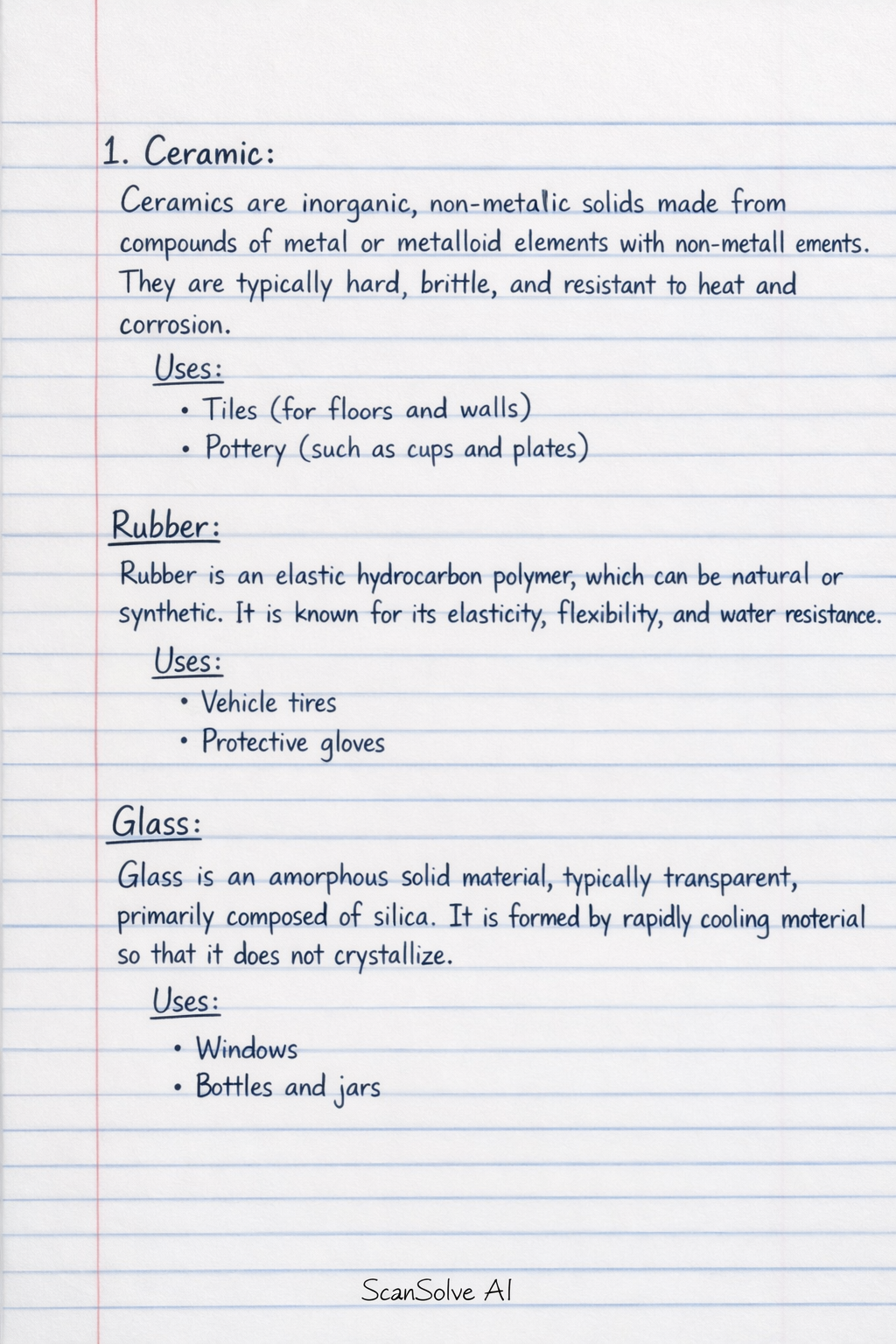
Ceramic: Ceramics are inorganic, non-metallic solids made from compounds of metal or metalloid elements with non-metallic elements. They are typically hard, brittle, and resistant to heat and corrosion.
- Uses:
- Tiles (for floors and walls)
- Pottery (such as cups and plates)
- Uses:
-
Rubber: Rubber is an elastic hydrocarbon polymer, which can be natural or synthetic. It is known for its elasticity, flexibility, and water resistance.
- Uses:
- Vehicle tires
- Protective gloves
- Uses:
-
Glass: Glass is an amorphous solid material, typically transparent, primarily composed of silica. It is formed by rapidly cooling molten material so that it does not crystallize.
- Uses:
- Windows
- Bottles and jars
- Uses:
Was this helpful?
Need help with your own homework?
Get instant step-by-step solutions to any question. Free to start.
Ask Your Question
Handwritten Step-by-Step Solution
Get this as a handwritten image on WhatsApp — like a tutor wrote it for you.
Try on WhatsAppMore Physics Questions
Still have questions?
Quick Answer
- Ceramic: Ceramics are inorganic, non-metallic solids made from compounds of metal or metalloid elements with non-metallic elements.
- They are typically hard, brittle, and resistant to heat and corrosion.
- It is known for its elasticity, flexibility, and water resistance.
- Uses: Vehicle tires Protective gloves Glass: Glass is an amorphous solid material, typically transparent, primarily composed of silica.
ScanSolve AI Answer
1. Ceramic: Ceramics are inorganic, non-metallic solids made from compounds of metal or metalloid elements with non-metallic elements. They are typically hard, brittle, and resistant to heat and corrosion. Uses: Tiles (for floors and walls) Pottery (such as cups and plates) Rubber: Rubber is an elastic hydrocarbon polymer, which can be natural or synthetic. It is known for its elasticity, flexibility, and water resistance. Uses: Vehicle tires Protective gloves Glass: Glass is an amorphous solid material, typically transparent, primarily composed of silica. It is formed by rapidly cooling molten material so that it does not crystallize. Uses: Windows Bottles and jars