
We read your photo as:
Chapter 1: matter In our surroundings
Physics
ScanSolve AI Answer
Your notes on "Matter In Our Surroundings" are largely accurate and cover the fundamental concepts well. Here's a review:
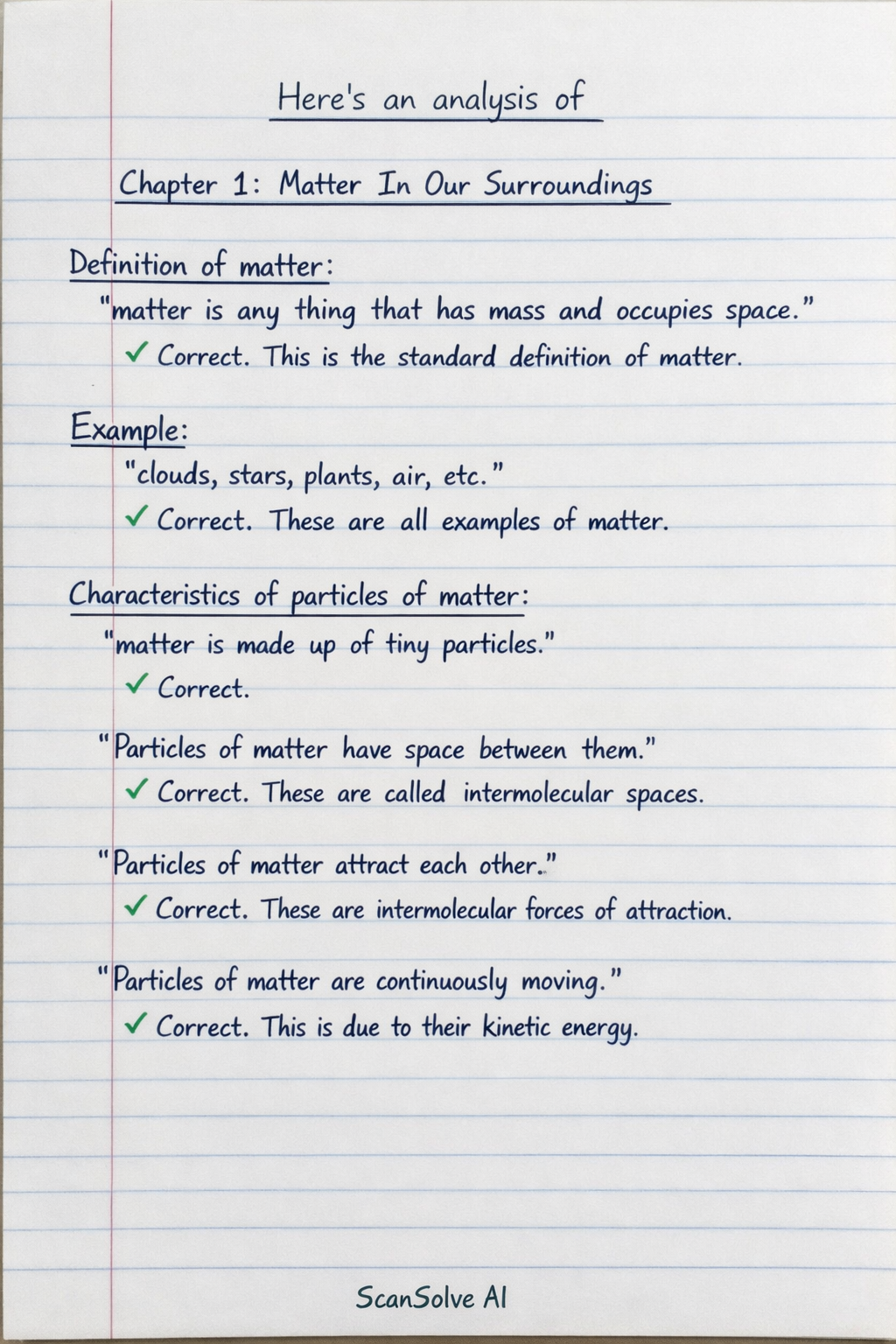
Chapter 1: Matter In Our Surroundings
- Definition of matter: "matter is any thing that has mass and occupies space."
- ✅ Correct. This is the standard definition of matter.
- Example: "clouds, stars, plants, air, etc."
- ✅ Correct. These are all examples of matter.
Characteristics of particles of matter:
- "matter is made up of tiny particles."
- ✅ Correct.
- "Particles of matter have space between them."
- ✅ Correct. These are called intermolecular spaces.
- "Particles of matter attract each other."
- ✅ Correct. These are intermolecular forces of attraction.
- "Particles of matter are continuously moving."
- ✅ Correct. This is due to their kinetic energy.
States of Matter (Comparison table):
- Solids:
-
- "Strong inter mole cular force."
- ✅ Correct.
-
- "very less intermole cular space."
- ✅ Correct.
-
- "have definite shape and definite volume."
- ✅ Correct.
-
- Liquid:
-
- "weak intermole cular force."
- ✅ Correct. Weaker than solids, stronger than gases.
-
- "Large intermole cular space."
- ✅ Correct. Larger than solids, smaller than gases.
-
- "no definite shape but definite volume."
- ✅ Correct.
-
- Gas:
-
- "Very weak molecular force."
- ✅ Correct. Negligible intermolecular forces.
-
- "Very Large mole cular space."
- ✅ Correct. Particles are far apart.
-
- "No definite shape and no definite volume."
- ✅ Correct.
-
Your notes are well-structured and scientifically sound. Keep up the great work!
Was this helpful?
Still stuck on this one?
Ask a follow-up, and the answer starts from this question.
Got a different question?Ask your own question
More Physics Questions
Handwritten Step-by-Step Solution
Get this as a handwritten image on WhatsApp — like a tutor wrote it for you.
Try on WhatsApp