
Which characteristic of blood refers to the concentration of solutes? A. salinity B. pH C. osmolality D. viscosity What constitutes blood plasma? A. whole blood without the formed elements. B. blood without the red blood cells. C. whole blood without blood cells and clotting factors. D. blood minus blood cells and proteins. Which of the following statements concerning intracellular and extracellular fluids is FALSE? A. The concentration of sodium is higher in extracellular fluid than in intracellular fluid. B. The concentration of potassium is lower in extracellular fluid than in intracellular fluid. C. Blood plasma is an example of intracellular fluid. D. The volume of intracellular fluid is greater than that of extracellular fluid. Which of the following statements about platelets is INCORRECT? They: A. adhere to collagen fibres of damaged tissue B. release phospholipids which combine with “clotting factors” to produce prothrombin activator. C. are cell fragments derived from megakayoblasts D. are part of the “extrinsic pathway” for the formation of prothrombin activator. The colloid osmotic pressure of blood is due to which of the following? A. proteins in the blood B. proteins in the interstitial fluid C. sodium and chloride ions dissolved in blood D. the water component of the blood
ScanSolve AI Answer
Answer
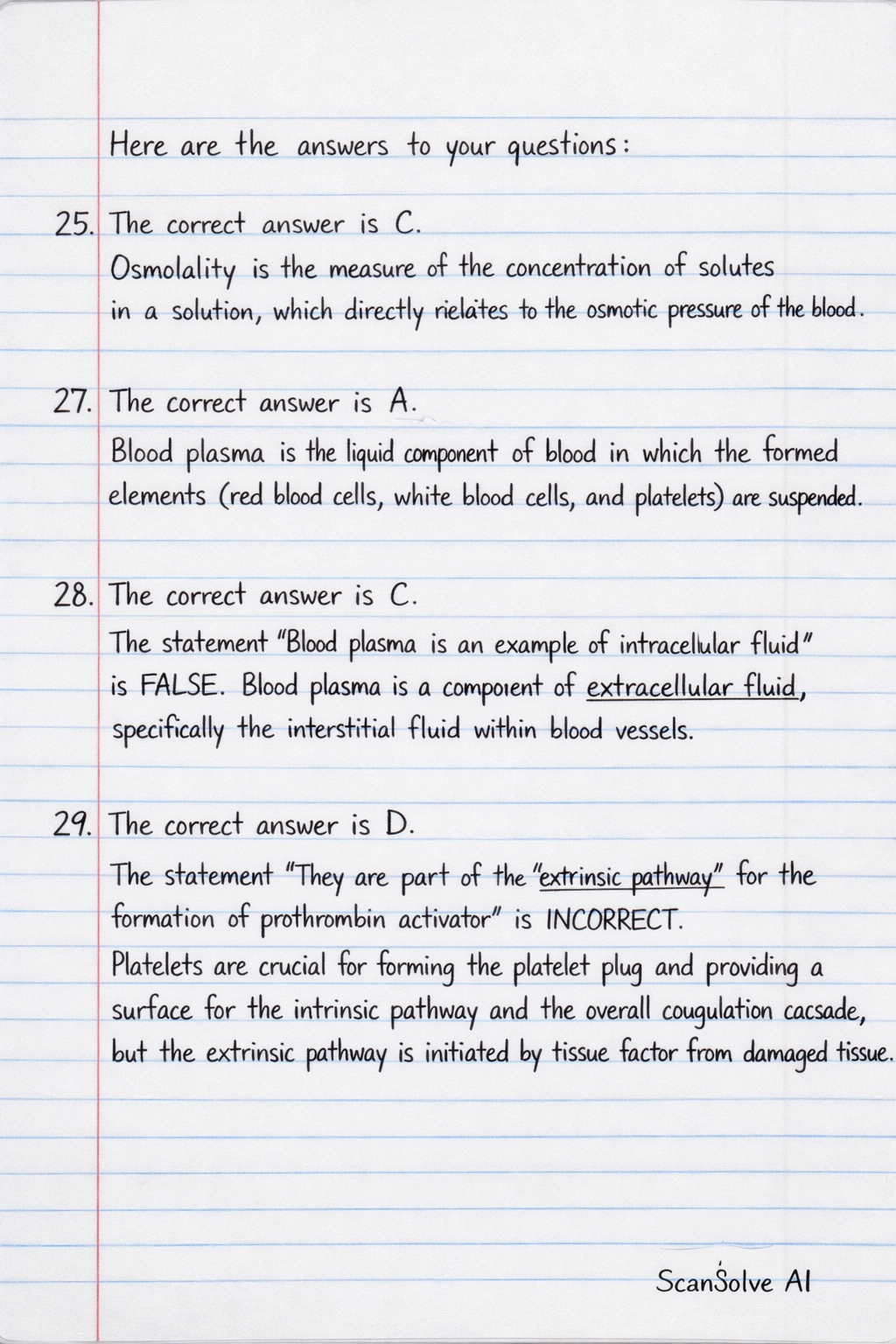
Here are the answers to your questions:
-
The correct answer is C. Osmolality is the measure of the concentration of solutes in a solution, which directly relates to the osmotic pressure of the blood.
-
The correct answer is A. Blood plasma is the liquid component of blood in which the formed elements (red blood cells, white blood cells, and platelets) are suspended.
-
The correct answer is C. The statement "Blood plasma is an example of intracellular fluid" is FALSE. Blood plasma is a component of extracellular fluid, specifically the interstitial fluid within blood vessels.
-
The correct answer is D. The statement "They are part of the 'extrinsic pathway' for the formation of prothrombin activator" is INCORRECT. Platelets are crucial for forming the platelet plug and providing a surface for the intrinsic pathway and the overall coagulation cascade, but the extrinsic pathway is initiated by tissue factor from damaged tissue.
-
The correct answer is A. The colloid osmotic pressure (also known as oncotic pressure) of blood is primarily caused by the presence of large, non-diffusible proteins in the blood, mainly albumin, which exert an osmotic pull on water.
Try one yourself
A new problem that tests the same skill.
Still stuck on this one?
Ask a follow-up, and the answer starts from this question.
More Physics Questions
Handwritten Step-by-Step Solution
Get this as a handwritten image on WhatsApp — like a tutor wrote it for you.
Try on WhatsApp