

This physics problem tests your understanding of fundamental physical laws and their applications. The step-by-step solution below breaks down the problem using relevant equations and physical reasoning.
ScanSolve AI Answer
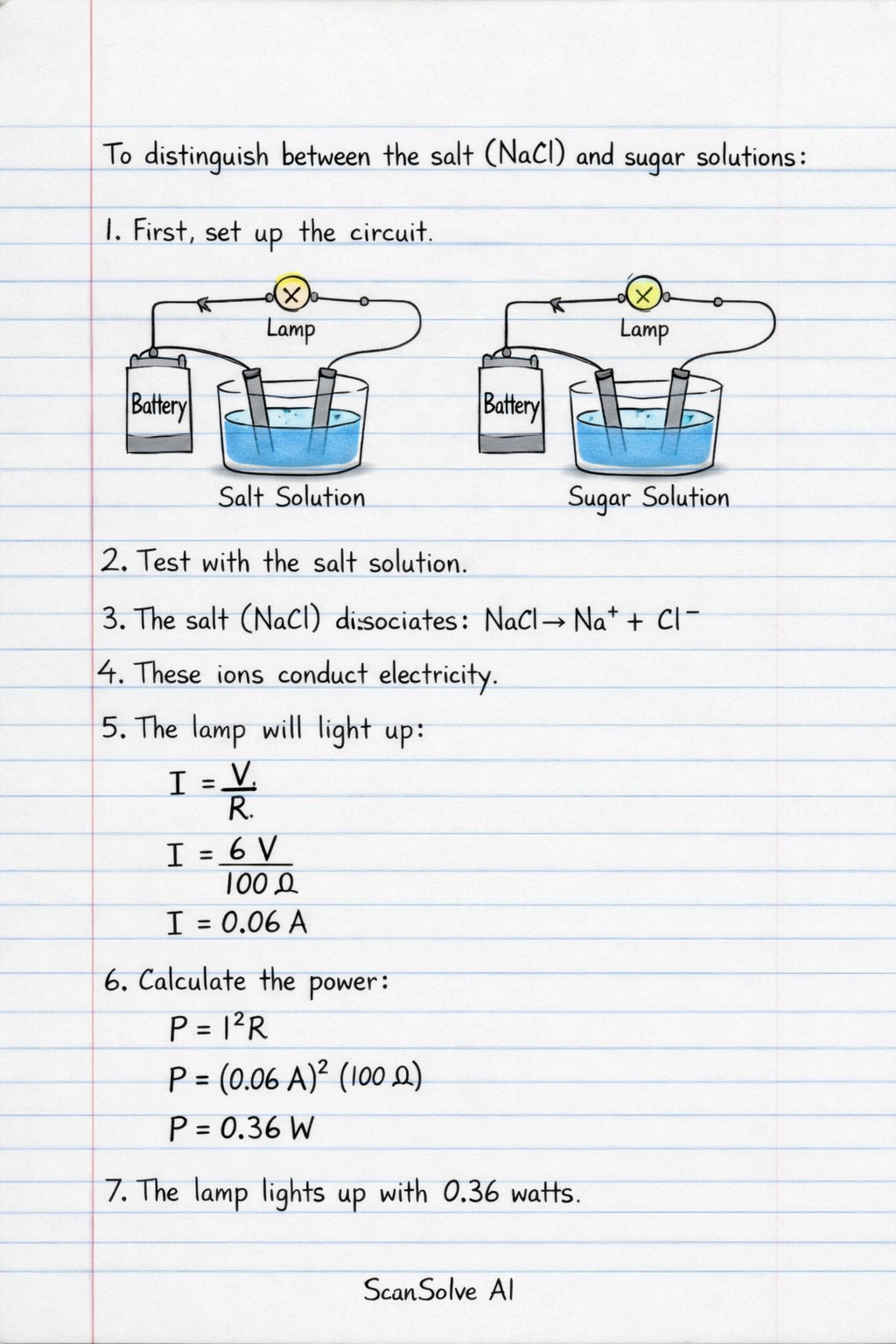
Here's how to distinguish between the salt (NaCl) and sugar solutions using the provided apparatus: Circuit diagrams: [ battery/.style= thick, draw, fill=white, rectangle, minimum width=0.8cm, minimum height=1.2cm, label=[font=]above:Battery , lamp/.style= thick, draw, circle, minimum size=0.8cm, label=[font=]above:Lamp , nail/.style= thick, draw, line width=1.5pt, line cap=round, shorten >=1mm, shorten <=1mm , cup/.style= draw, thick, rounded corners=2mm, minimum width=2cm, minimum height=2.5cm, label=[font=]below:Plastic Cup , solution/.style= fill=blue!10, draw=blue!50, line width=0.5mm , wire/.style=thick, draw ] % Setup for Solution P (battery1) at (0,3) [battery, l_=2 cells] ; (lamp1) at (2,3) [lamp, label=[font=]above:1.5V Lamp] ; (cup1) at (1,0) [cup, label=[font=]below:Solution P] ; [solution] (0,0.5) rectangle (2,1.5); (battery1.east) -- (lamp1.west); (lamp1.east) -- (3,3) -- (3,1.5); (battery1.west) -- (-1,3) -- (-1,1.5); % Nails in Solution P [nail] (-0.5,1.5) -- (-0.5,0.5); [nail] (2.5,1.5) -- (2.5,0.5); [wire] (-1,1.5) -- (-0.5,1.5); [wire] (3,1.5) -- (2.5,1.5); % Labels for Solution P at (1,1) [font=] Solution P; at (1, -1.5) a) Testing Solution P; % Setup for Solution Q (battery2) at (6,3) [battery, l_=2 cells] ; (lamp2) at (8,3) [lamp, label=[font=]above:1.5V Lamp] ; (cup2) at (7,0) [cup, label=[font=]below:Solution Q] ; [solution] (6,0.5) rectangle (8,1.5); (battery2.east) -- (lamp2.west); (lamp2.east) -- (9,3) -- (9,1.5); (battery2.west) -- (5,3) -- (5,1.5); % Nails in Solution Q [nail] (5.5,1.5) -- (5.5,0.5); [nail] (8.5,1.5) -- (8.5,0.5); [wire] (5,1.5) -- (5.5,1.5); [wire] (9,1.5) -- (8.5,1.5); % Labels for Solution Q at (7,1) [font=] Solution Q; at (7, -1.5) b) Testing Solution Q; The diagram shows a simple circuit for testing electrical conductivity. It consists of a battery, a filament lamp, and two nails (electrodes) immersed in the solution being tested. Procedure: 1. Set up the circuit as shown in the diagram, ensuring all connections are secure. 2. Pour solution P into one of the plastic cups. 3. Immerse the two nails (electrodes) into solution P, ensuring they do not touch each other. 4. Observe the filament lamp. Record whether it lights up or not. 5. Remove the nails from solution P, rinse them thoroughly with distilled water, and dry them. 6. Pour solution Q into the second plastic cup. 7. Immerse the cleaned nails into solution Q, ensuring they do not touch each other. 8. Observe the filament lamp. Record whether it lights up or not. Observations: When the nails are immersed in Solution P, the filament lamp lights up brightly*. When the nails are immersed in Solution Q, the filament lamp does not light up* (or glows very dimly, indicating negligible conductivity). Inference: Solution P conducts electricity, indicating it contains mobile ions. Solution Q does not conduct electricity (or conducts very poorly), indicating it consists of neutral molecules and lacks mobile ions. Conclusion: Solution P is the common salt (NaCl) solution* because ionic compounds dissociate into ions in water, making the solution an electrolyte that conducts electricity. Solution Q is the sugar solution* because sugar is a covalent compound that dissolves in water as molecules, not ions, making the solution a non-electrolyte that does not conduct electricity. Precaution(s): Do not* touch solutions P and Q with bare hands or taste them, as stated in the instructions (P is poisonous). Ensure the nails (electrodes) are thoroughly cleaned with distilled water and dried* between testing solution P and solution Q to prevent cross-contamination. Make sure the nails do not touch each other* when immersed in the solutions to avoid a short circuit. Ensure all electrical connections are tight and secure* for accurate results. 3 done, 2 left today. You're making progress.