

This physics problem tests your understanding of fundamental physical laws and their applications. The step-by-step solution below breaks down the problem using relevant equations and physical reasoning.
ScanSolve AI Answer
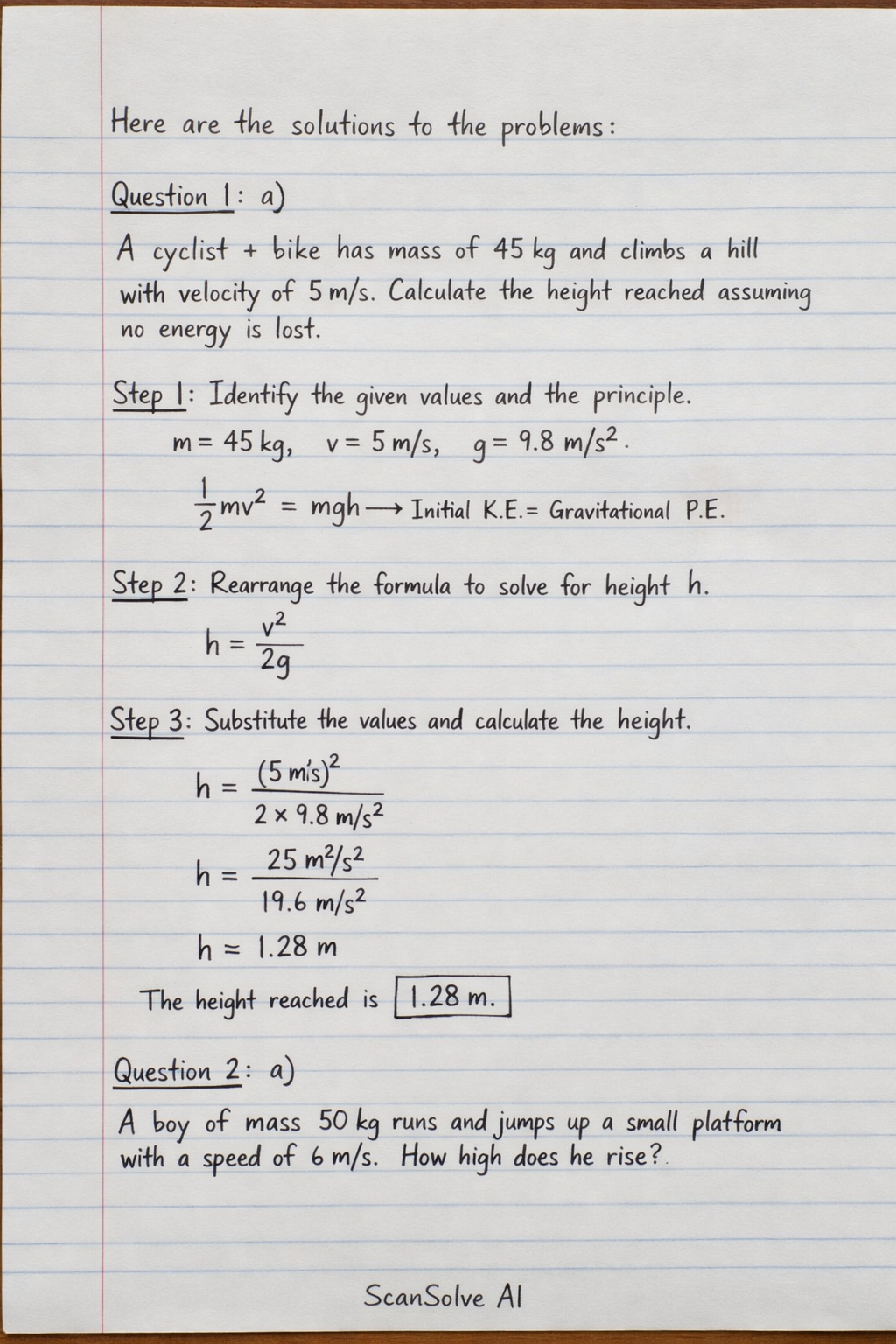
Here are the solutions to the problems: Question 1: a) A cyclist together with his bike has a mass of 45 kg and climbs a hill with a velocity of 5 m/s. Calculate the height reached assuming no energy is lost. Step 1: Identify the given values and the principle. Given mass m = 45 kg, initial velocity v = 5 m/s. We assume acceleration due to gravity g = 9.8 m/s^2. According to the principle of conservation of mechanical energy, the initial kinetic energy is converted into gravitational potential energy at the maximum height. (1)/(2)mv^2 = mgh Step 2: Rearrange the formula to solve for height h. h = (v^2)/(2g) Step 3: Substitute the values and calculate the height. h = (5 m/s)^22 × 9.8 m/s^2 h = 25 m^2/s^219.6 m/s^2 h ≈ 1.28 m The height reached is 1.28 m. Question 2: a) A boy of mass 50 kg runs and jumps up a small platform with a speed of 6 m/s. How high does he rise? Step 1: Identify the given values and the principle. Given mass m = 50 kg, initial velocity v = 6 m/s. We assume acceleration due to gravity g = 9.8 m/s^2. Using the principle of conservation of mechanical energy: (1)/(2)mv^2 = mgh Step 2: Rearrange the formula to solve for height h. h = (v^2)/(2g) Step 3: Substitute the values and calculate the height. h = (6 m/s)^22 × 9.8 m/s^2 h = 36 m^2/s^219.6 m/s^2 h ≈ 1.84 m The height he rises is 1.84 m. Question 3: a) A car of mass 800 kg moves up a slope with a speed of 10 m/s. Find the maximum height it can reach. Step 1: Identify the given values and the principle. Given mass m = 800 kg, initial velocity v = 10 m/s. We assume acceleration due to gravity g = 9.8 m/s^2. Using the principle of conservation of mechanical energy: (1)/(2)mv^2 = mgh Step 2: Rearrange the formula to solve for height h. h = (v^2)/(2g) Step 3: Substitute the values and calculate the height. h = (10 m/s)^22 × 9.8 m/s^2 h = 100 m^2/s^219.6 m/s^2 h ≈ 5.10 m The maximum height the car can reach is 5.10 m. Question 4: a) A footballer kicks a ball vertically upward with a speed of 12 m/s. Determine the height reached by the ball. Step 1: Identify the given values and the principle. Given initial velocity u = 12 m/s. We assume acceleration due to gravity g = 9.8 m/s^2. Using the principle of conservation of mechanical energy, the initial kinetic energy is converted into gravitational potential energy at the maximum height. (1)/(2)mu^2 = mgh Step 2: Rearrange the formula to solve for height h. h = (u^2)/(2g) Step 3: Substitute the values and calculate the height. h = (12 m/s)^22 × 9.8 m/s^2 h = 144 m^2/s^219.6 m/s^2 h ≈ 7.35 m The height reached by the ball is 7.35 m. Send me the next one 📸