
We read your photo as:
Explain the coefficient of kinetic friction, the work-energy theorem, and draw a free-body diagram for an object being pulled by a force at an angle.
ScanSolve AI Answer
This answer stops before the end.
It was cut off when it was first written. Ask ScanSolve this question again for the full working.
Question 5
5.1:
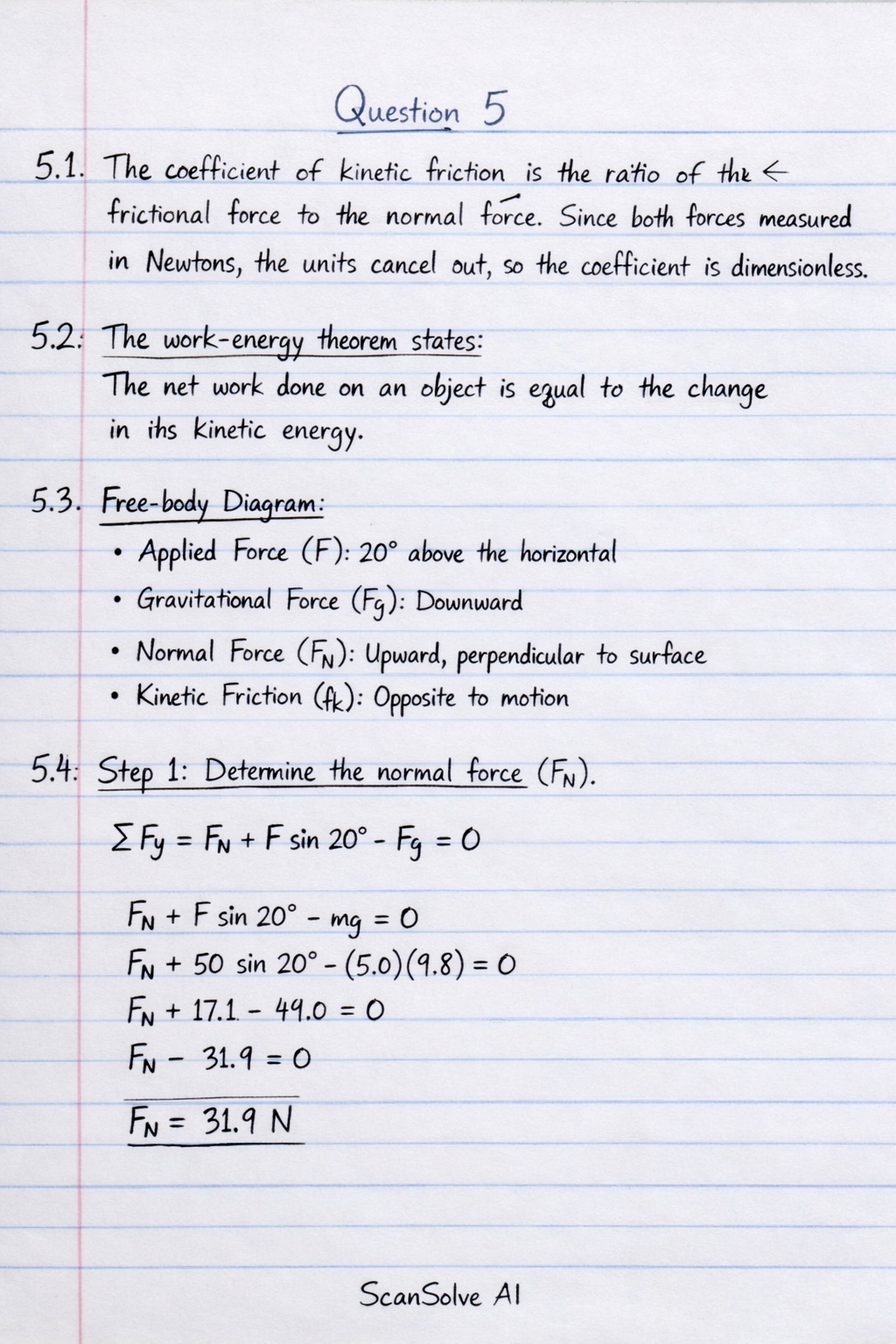
The coefficient of kinetic friction is a ratio of two forces: the kinetic frictional force and the normal force. Since it is a ratio of quantities with the same units (Newtons), the units cancel out, making the coefficient dimensionless.
5.2:
The work-energy theorem states that the net work done on an object is equal to the change in its kinetic energy.
5.3:
Free-body diagram:
- Applied Force (): At an angle of above the horizontal.
- Gravitational Force (): Vertically downwards.
- Normal Force (): Vertically upwards, perpendicular to the surface.
- Kinetic Frictional Force (): Horizontally opposite to the direction of motion.
5.4:
Step 1: Determine the normal force ().
The sum of forces in the vertical direction is zero because there is no vertical acceleration.
Still stuck on this one?
Ask a follow-up, and the answer starts from this question.
More Physics Questions
Handwritten Step-by-Step Solution
Get this as a handwritten image on WhatsApp — like a tutor wrote it for you.
Try on WhatsApp