
We read your photo as:
Convert 25°c to kelvin scale.
ScanSolve AI Answer
Answers
4 partsStep-by-step solution
7 stepsHere are the solutions to the questions.
Part 11· 3 steps
A solution is prepared by dissolving 50 gm of sugar in 450 gm of water. Express the concentration of the solution in mass/mass percentage.
Identify the mass of the solute and solvent.
Mass of solute (sugar) = 50 gm
Mass of solvent (water) = 450 gmCalculate the total mass of the solution.
Mass of solution = Mass of solute + Mass of solvent
Calculate the mass percentage concentration.
Mass percentage concentration =
The concentration of the solution is
\boxed{\text{10%}}.
Part 12
Convert 25°C to kelvin scale.
Use the conversion formula from Celsius to Kelvin.
The formula to convert temperature from Celsius to Kelvin is:
Substitute the given Celsius temperature into the formula.
The temperature in Kelvin is .
Part 13
A diver is able to cut through water in a swimming pool. Which property of matter does this observation show?
This observation shows that the particles of water have intermolecular spaces between them. It also demonstrates that the force of attraction between water particles is not very strong, allowing the diver to overcome these forces and move through the water.
Part 14
Name two organelles you have studied that contain genetic material?
Two organelles that contain genetic material are:
- Nucleus (contains DNA)
- Mitochondria (contains its own DNA)
- Chloroplasts (in plant cells, contain their own DNA)
Part 15
Area under a velocity time Graph represents a physical quantity. Write the S.I. unit of the physical quantity.
The area under a velocity-time graph represents displacement.
The S.I. unit of displacement is .
Part 16
A bus decreases its speed from 72 km/hr to 36 km/hr in 5 seconds. Find the acceleration of the bus.
Convert initial and final velocities from km/hr to m/s.
Initial velocity,
Final velocity,
Time,
Calculate the acceleration using the formula .
The acceleration of the bus is . (The negative sign indicates deceleration).
Part 17
How would you confirm that a colourless liquid given to you is pure water?
To confirm that a colourless liquid is pure water, you can measure its boiling point and freezing point. Pure water boils at (at standard atmospheric pressure) and freezes at . If the liquid exhibits these precise boiling and freezing points, it is pure water.
Part 18
Smoke and fog both are aerosols. In what way are they different?
Both smoke and fog are aerosols, meaning they are colloidal systems where solid or liquid particles are dispersed in a gas.
- Smoke is a dispersion of solid particles (like carbon) in a gas (usually air), typically formed by combustion.
- Fog is a dispersion of liquid droplets (water) in a gas (air), formed when water vapor condenses into tiny droplets near the ground.
Try one yourself
A new problem that tests the same skill.
Still stuck on this one?
Ask a follow-up, and the answer starts from this question.
More Physics Questions
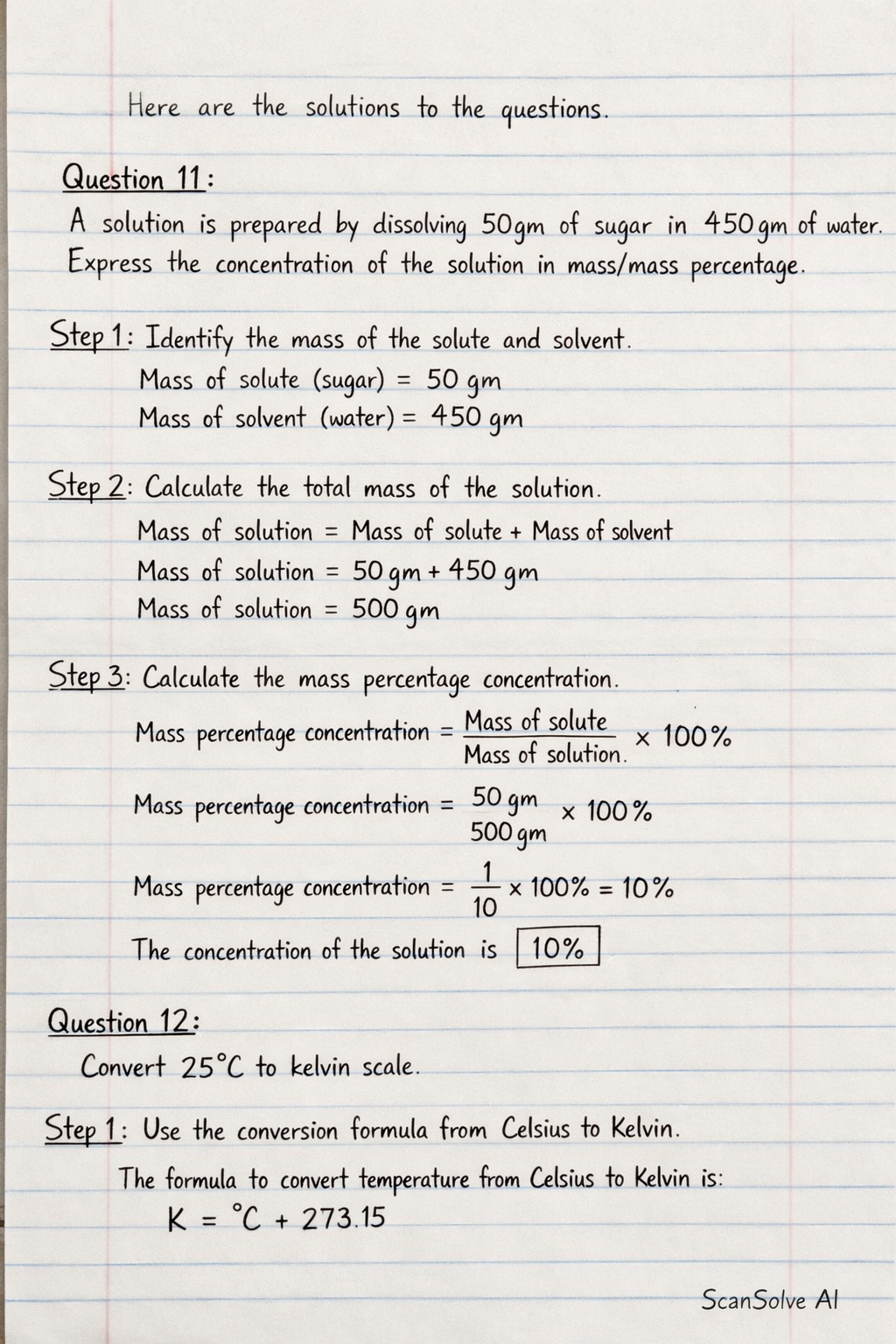
Handwritten Step-by-Step Solution
Get this as a handwritten image on WhatsApp — like a tutor wrote it for you.
Try on WhatsApp