

This physics problem tests your understanding of fundamental physical laws and their applications. The step-by-step solution below breaks down the problem using relevant equations and physical reasoning.
ScanSolve AI Answer
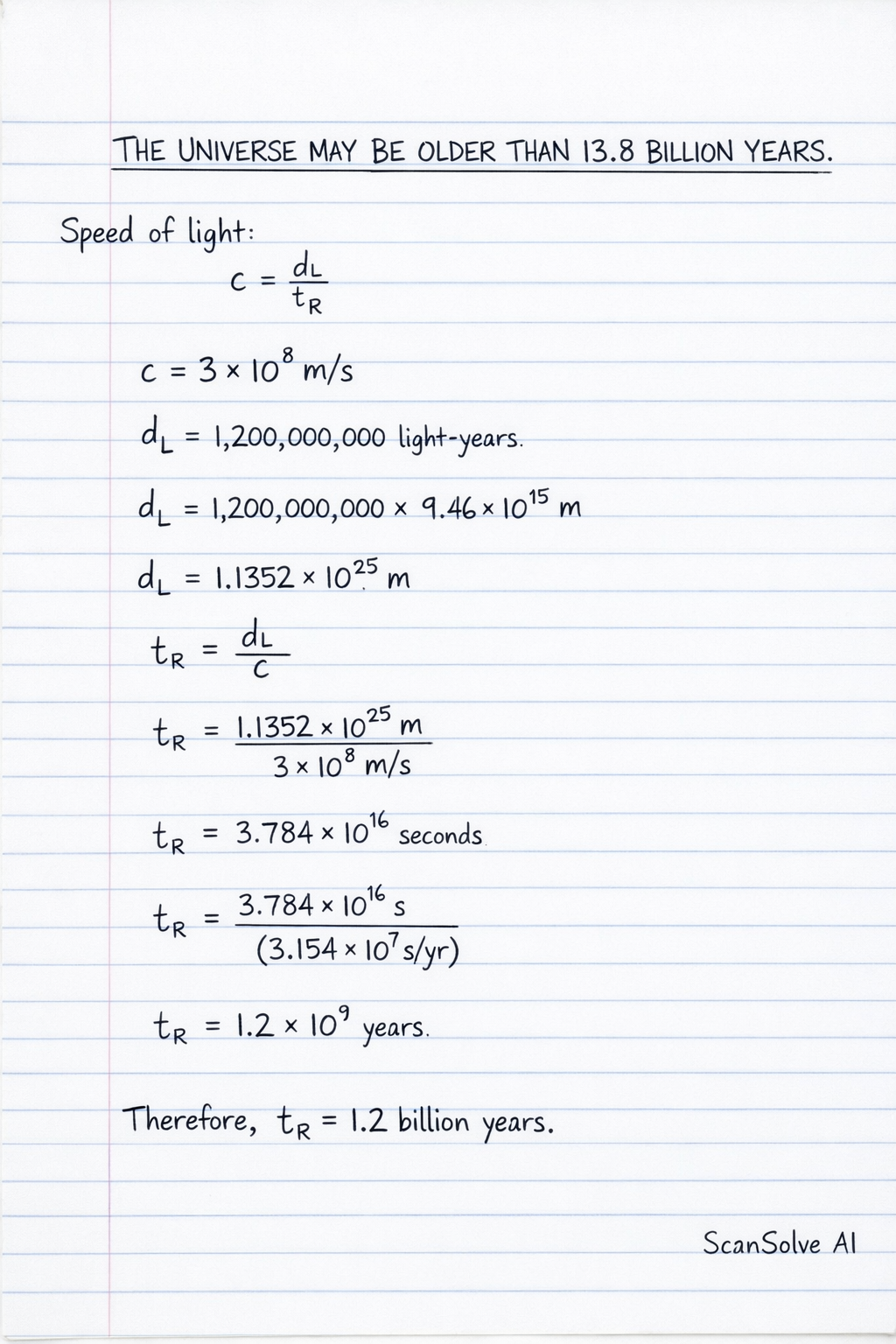
You're on a roll — The document presents a set of cosmological equations, some standard and some hypothetical, related to the age and expansion of the universe. Here's a cosmological explanation of the concepts and equations presented: Title: "THE UNIVERSE MAY BE OLDER THAN 13.8 BILLION YEARS." This statement challenges the currently accepted age of the universe, which is approximately 13.8 billion years, derived from the standard CDM (Lambda-Cold Dark Matter) cosmological model. Speed of light c: c = (d_L)/(t_R) This is a fundamental definition relating the speed of light (c) to a distance (d_L, often luminosity distance in cosmology) and a time interval (t_R, which can represent lookback time or retardation time). In cosmology, c is a universal constant. CDM Hubble flow H_z: H_z = (v_R)/(d_L) = ( c)/(d_L) = H_0 sqrt(_M (z+1)^3 + _R (z+1)^4 + _) This equation describes the Hubble parameter H_z (or H(z)), which represents the expansion rate of the universe at a given redshift z. • H_0 is the Hubble constant, the current expansion rate. • _M, _R, and _ are the density parameters for matter, radiation, and dark energy (cosmological constant), respectively. • The terms (z+1)^3 and (z+1)^4 account for how the densities of matter and radiation change as the universe expands and light is redshifted. This specific formula for H_z is a standard equation in the CDM model. Proper distance d_L: d_L = d_S = d_AY = d_A (1 - (((z+1)^2-1))/(((z+1)^2+1)))^-(1)/(2) In standard cosmology, there are various distance measures like luminosity distance (d_L) and angular diameter distance (d_A), which are related by d_L = (1+z)d_A. The formula presented here is explicitly stated as hypothetical by the author and is not a standard cosmological distance relation. Proper Hubble flow H: H = (v_R)/(d_L) = H_0 sqrt(_M (z+1)^3 + _R (z+1)^4 + _) (1 - (((z+1)^2-1))/(((z+1)^2+1)))^-1 This equation combines the standard CDM Hubble parameter with the hypothetical distance factor. As such, this combined "Proper Hubble flow" is also hypothetical and not a standard cosmological equation. Lookback time (t_0 - t): (t_0 - t) = t_R = (d_L)/(c) (d_L)/(H_0) (((z+1)^2-1))/(((z+1)^2+1)) (1 - (((z+1)^2-1))/(((z+1)^2+1)))^-1 Lookback time (t_0 - t) is the time elapsed since the light we observe was emitted from a distant object. In standard cosmology, it's calculated by integrating the inverse of the expansion rate over redshift. The formula provided here is also explicitly stated as hypothetical and is not a standard cosmological formula for lookback time. The document notes that the last three equations are hypothetical and the author is solely responsible for them, indicating they represent an alternative or speculative model of cosmology. What's next?