

This physics problem tests your understanding of fundamental physical laws and their applications. The step-by-step solution below breaks down the problem using relevant equations and physical reasoning.
ScanSolve AI Answer
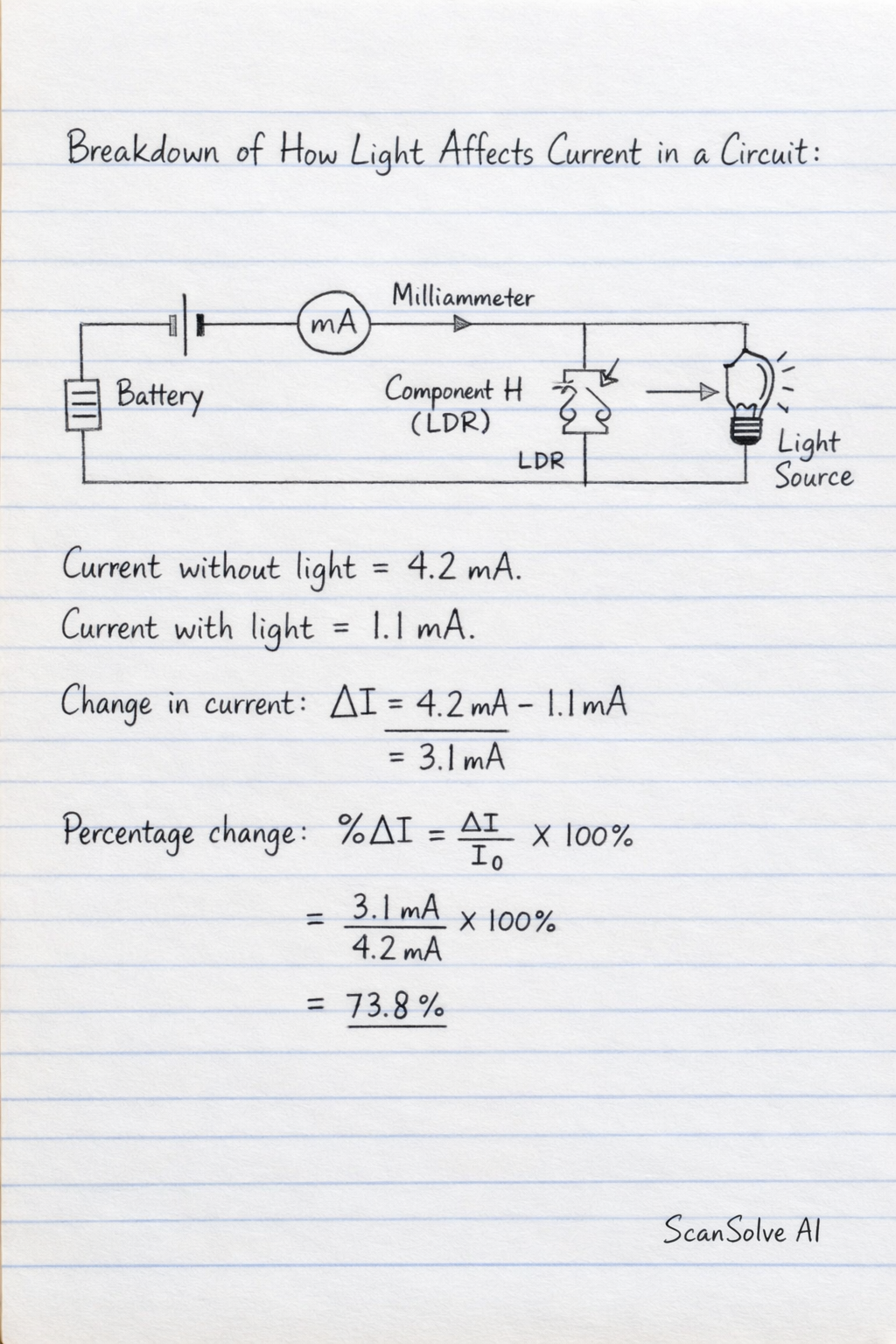
Here is the breakdown for investigating how the amount of light falling on an electrical component affects the current flowing in a circuit: Diagram: (2 marks) [circuit ee] % Battery (0,0) to[battery] (0,2); [left] at (0,1) Battery; % Ammeter (0,2) to[ammeter, l_=mA] (2,2); [above] at (1,2) Milliammeter; % Component H (LDR) (2,2) to[LDR, l_=Component H] (2,0); [right] at (2,1) LDR; % Wires (2,0) -- (0,0); % Light Source [lamp, rotate=90] (light) at (3.5,1) ; [->] (light) -- (2.5,1); [right] at (3.5,1) Light Source; Procedure: (2 marks) 1. Set up the circuit as shown in the diagram, connecting the battery, milliammeter, and component H (LDR) in series. 2. Ensure the milliammeter is connected in series and with the correct polarity. 3. Place a light source (e.g., a torch) at a known distance (e.g., 5 cm) from component H. 4. Record the distance of the light source from H and the corresponding current reading from the milliammeter. 5. Vary the distance of the light source from H (e.g., 10 cm, 15 cm, 20 cm, 25 cm) to change the amount of light falling on H. 6. For each distance, record the current reading from the milliammeter. 7. Repeat the readings for each distance at least once and calculate the average current. Observations: (2 marks) Record the measured values in a table: | S/N | Distance of light source from H (cm) | Current (mA) | | :-- | :----------------------------------- | :----------- | | 1 | 5 | | | 2 | 10 | | | 3 | 15 | | | 4 | 20 | | | 5 | 25 | | Calculations: (2 marks) For each set of readings, calculate the inverse square of the distance (1/d^2) to represent the relative light intensity. | S/N | Distance (d) (cm) | Current (I) (mA) | 1/d^2 (cm^-2) | | :-- | :---------------- | :--------------- | :------------------ | | 1 | 5 | | 1/5^2 = 0.040 | | 2 | 10 | | 1/10^2 = 0.010 | | 3 | 15 | | 1/15^2 ≈ 0.0044 | | 4 | 20 | | 1/20^2 = 0.0025 | | 5 | 25 | | 1/25^2 = 0.0016 | Precaution: (1 mark) Ensure the milliammeter is connected in series and with the correct polarity to avoid damage or incorrect readings. Avoid parallax error when reading the milliammeter by viewing the pointer perpendicularly. Ensure that no other light sources or shadows interfere with the light falling on component H. Conclusion: (1 mark) As the amount of light falling on component H (LDR) increases (i.e., distance decreases), the current flowing through the circuit increases. This indicates that the resistance of component H decreases* with increasing light intensity.