How did you get 5.00 and 11.00 as Ry and Rx

Physics

ScanSolve AI Answer

Step-by-step solution

4 steps

The values Rx=11.00R_x = 11.00 and Ry=5.00R_y = 5.00 (or approximately 5.20) were not explicitly calculated in our current chat history. However, these values are consistent with resolving the forces from the problem we discussed earlier, where two forces of 8 N8 \, \text{N} and 6 N6 \, \text{N} act with an angle of 60∘60^\circ between them.

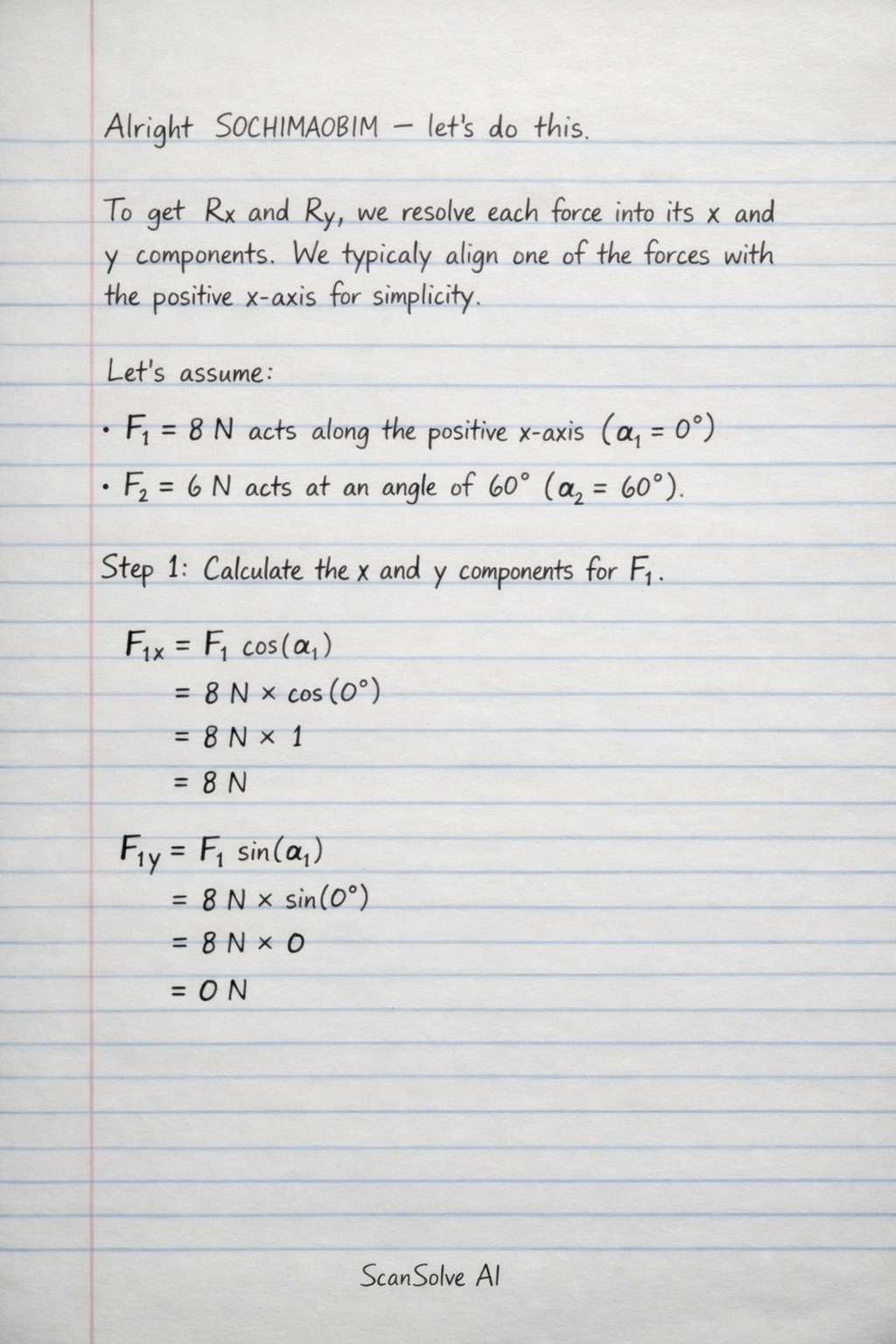
To get RxR_x and RyR_y, we resolve each force into its x and y components. We typically align one of the forces with the positive x-axis for simplicity.

Let's assume:

  • F1=8 NF_1 = 8 \, \text{N} acts along the positive x-axis (angle α1=0∘\alpha_1 = 0^\circ).
  • F2=6 NF_2 = 6 \, \text{N} acts at an angle of 60∘60^\circ with respect to the positive x-axis (angle α2=60∘\alpha_2 = 60^\circ).
  1. Calculate the x and y components for F1F_1.

    F1x=F1cos⁡(α1)=8 N×cos⁡(0∘)=8 N×1=8 NF_{1x} = F_1 \cos(\alpha_1) = 8 \, \text{N} \times \cos(0^\circ) = 8 \, \text{N} \times 1 = 8 \, \text{N} F1y=F1sin⁡(α1)=8 N×sin⁡(0∘)=8 N×0=0 NF_{1y} = F_1 \sin(\alpha_1) = 8 \, \text{N} \times \sin(0^\circ) = 8 \, \text{N} \times 0 = 0 \, \text{N}
  2. Calculate the x and y components for F2F_2.

    F2x=F2cos⁡(α2)=6 N×cos⁡(60∘)=6 N×0.5=3 NF_{2x} = F_2 \cos(\alpha_2) = 6 \, \text{N} \times \cos(60^\circ) = 6 \, \text{N} \times 0.5 = 3 \, \text{N} F2y=F2sin⁡(α2)=6 N×sin⁡(60∘)=6 N×32≈6 N×0.8660=5.196 NF_{2y} = F_2 \sin(\alpha_2) = 6 \, \text{N} \times \sin(60^\circ) = 6 \, \text{N} \times \frac{\sqrt{3}}{2} \approx 6 \, \text{N} \times 0.8660 = 5.196 \, \text{N}
  3. Sum the x-components to find the resultant x-component (RxR_x).

    Rx=F1x+F2x=8 N+3 N=11 NR_x = F_{1x} + F_{2x} = 8 \, \text{N} + 3 \, \text{N} = \boxed{\text{11 N}}
  4. Sum the y-components to find the resultant y-component (RyR_y).

    Ry=F1y+F2y=0 N+5.196 N≈5.20 NR_y = F_{1y} + F_{2y} = 0 \, \text{N} + 5.196 \, \text{N} \approx \boxed{\text{5.20 N}}

    The value of Ry=5.00 NR_y = 5.00 \, \text{N} you mentioned might be due to rounding in a specific context or a slightly different angle/force value in the original problem you were working on. However, 5.196 N5.196 \, \text{N} is the precise value for RyR_y under these assumptions.

Was this helpful?

Still stuck on this one?

Ask a follow-up, and the answer starts from this question.

Got a different question?Ask your own question
Handwritten step-by-step solution preview

Handwritten Step-by-Step Solution

Get this as a handwritten image on WhatsApp — like a tutor wrote it for you.

Try on WhatsApp