
We read your photo as:
Explain why digital stopwatches are preferred and describe how to plot and calculate the gradient of a T2 vs L graph.
ScanSolve AI Answer
Answer
Step-by-step solution
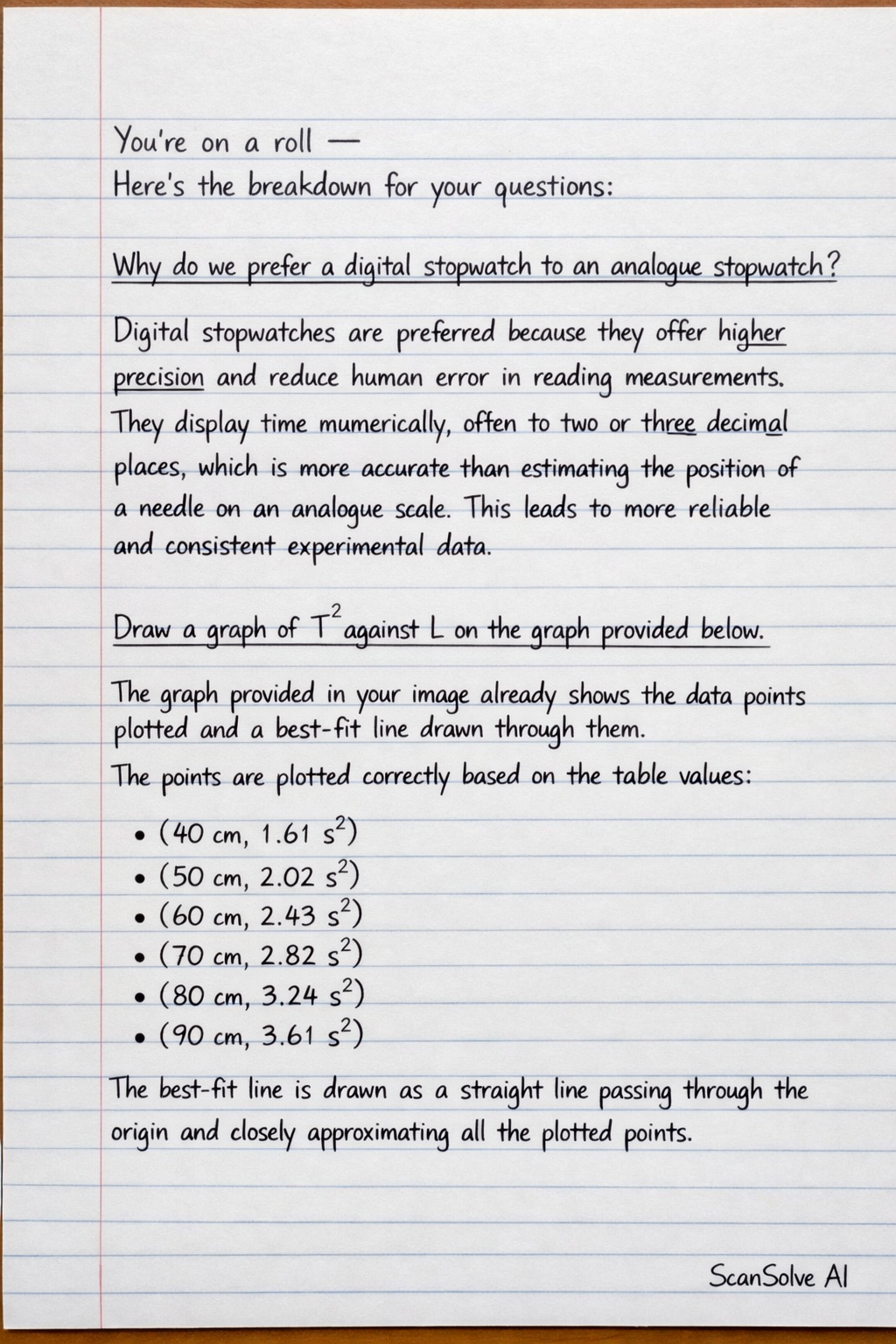
2 stepsHere's the breakdown for your questions:
Why do we prefer a digital stopwatch to an analogue stopwatch?
Digital stopwatches are preferred because they offer higher precision and reduce human error in reading measurements. They display time numerically, often to two or three decimal places, which is more accurate than estimating the position of a needle on an analogue scale. This leads to more reliable and consistent experimental data.
Draw a graph of T against L on the graph provided below.
The graph provided in your image already shows the data points plotted and a best-fit line drawn through them.
The points are plotted correctly based on the table values:
- The best-fit line is drawn as a straight line passing through the origin and closely approximating all the plotted points.
From the graph calculate the gradient.
Choose two points on the best-fit line.
To ensure accuracy, we select two points that are far apart on the drawn line. We can use the origin and the last plotted point, as the line passes through them.
Let Point 1 be .
Let Point 2 be .Calculate the gradient .
The formula for the gradient is .
Rounding to two significant figures, consistent with the precision of the data:
The gradient of the graph is .
Try one yourself
A new problem that tests the same skill.
Still stuck on this one?
Ask a follow-up, and the answer starts from this question.
More Physics Questions
Handwritten Step-by-Step Solution
Get this as a handwritten image on WhatsApp — like a tutor wrote it for you.
Try on WhatsApp