This physics problem tests your understanding of fundamental physical laws and their applications. The step-by-step solution below breaks down the problem using relevant equations and physical reasoning.
ScanSolve AI Answer
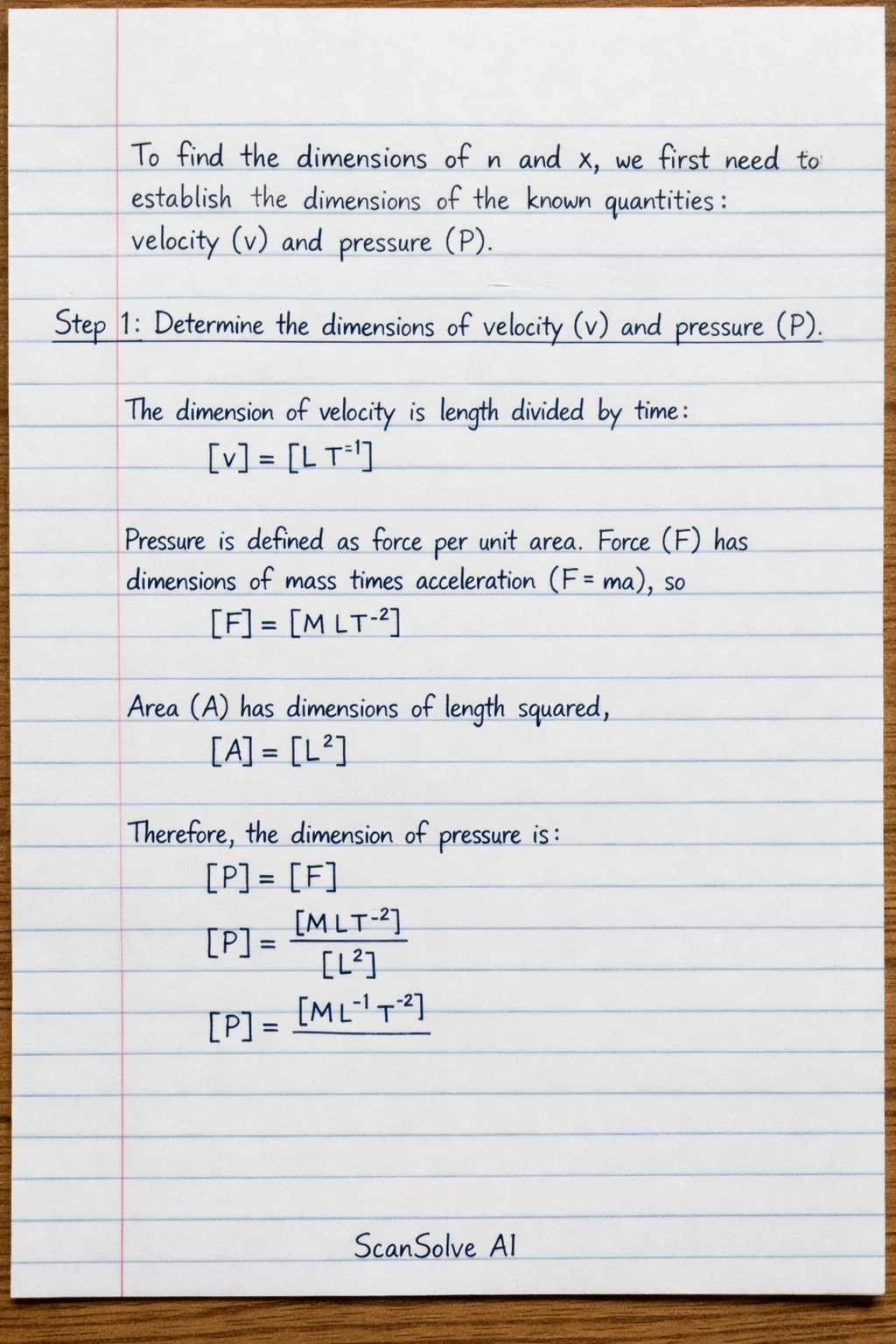
To find the dimensions of $n$ and $x$, we first need to establish the dimensions of the known quantities: velocity ($v$) and pressure ($P$).
Step 1: Determine the dimensions of velocity ($v$) and pressure ($P$).
The dimension of velocity is length divided by time:
$$[v] = [L T^{-1}]$$
Pressure is defined as force per unit area. Force ($F$) has dimensions of mass times acceleration ($F=ma$), so $[F] = [M L T^{-2}]$. Area ($A$) has dimensions of length squared, $[A] = [L^2]$.
Therefore, the dimension of pressure is:
$$[P] = \frac{[F]}{[A]} = \frac{[M L T^{-2}]}{[L^2]} = [M L^{-1} T^{-2}]$$
Step 2: Apply the principle of dimensional homogeneity to the terms inside the square root.
For terms to be added or subtracted, they must have the same dimensions. In the expression $\sqrt{P + \frac{1}{n}}$, the terms $P$ and $\frac{1}{n}$ must have the same dimensions.
So, the dimension of $\frac{1}{n}$ must be equal to the dimension of $P$:
$$\left[\frac{1}{n}\right] = [P]$$
$$[n]^{-1} = [M L^{-1} T^{-2}]$$
To find the dimension of $n$, we take the reciprocal:
$$[n] = [M^{-1} L T^2]$$
The dimension of $P + \frac{1}{n}$ is therefore also $[M L^{-1} T^{-2}]$.
Step 3: Determine the dimension of the numerator $\sqrt{P + \frac{1}{n}}$.
Since $[P + \frac{1}{n}] = [M L^{-1} T^{-2}]$, the dimension of the square root is:
$$\left[\sqrt{P + \frac{1}{n}}\right] = \sqrt{[M L^{-1} T^{-2}]} = [M^{1/2} L^{-1/2} T^{-1}]$$
Step 4: Use the full equation to find the dimension of $x$.
The given equation is $v = \frac{\sqrt{P + \frac{1}{n}}}{x}$.
We can write this in terms of dimensions:
$$[v] = \frac{\left[\sqrt{P + \frac{1}{n}}\right]}{[x]}$$
Rearranging to solve for $[x]$:
$$[x] = \frac{\left[\sqrt{P + \frac{1}{n}}\right]}{[v]}$$
Substitute the dimensions we found:
$$[x] = \frac{[M^{1/2} L^{-1/2} T^{-1}]}{[L T^{-1}]}$$
$$[x] = [M^{1/2} L^{-1/2 - 1} T^{-1 - (-1)}]$$
$$[x] = [M^{1/2} L^{-3/2} T^0]$$
$$[x] = [M^{1/2} L^{-3/2}]$$
The dimensions are:
Dimension of $n$: $\boxed{M^{-1} L T^2}$
Dimension of $x$: $\boxed{M^{1/2} L^{-3/2}}$
Determine the dimensions of velocity (v) and pressure (P).
|Physics
Determine the dimensions of velocity (v) and pressure (P).
ScanSolve AI Answer
To find the dimensions of n and x, we first need to establish the dimensions of the known quantities: velocity (v) and pressure (P).
Step 1: Determine the dimensions of velocity (v) and pressure (P).
The dimension of velocity is length divided by time:
[v]=[LT−1]
Pressure is defined as force per unit area. Force (F) has dimensions of mass times acceleration (F=ma), so [F]=[MLT−2]. Area (A) has dimensions of length squared, [A]=[L2].
Therefore, the dimension of pressure is:
[P]=[A][F]=[L2][MLT−2]=[ML−1T−2]
Step 2: Apply the principle of dimensional homogeneity to the terms inside the square root.
For terms to be added or subtracted, they must have the same dimensions. In the expression P+n1, the terms P and n1 must have the same dimensions.
So, the dimension of n1 must be equal to the dimension of P:
[n1]=[P][n]−1=[ML−1T−2]
To find the dimension of n, we take the reciprocal:
[n]=[M−1LT2]
The dimension of P+n1 is therefore also [ML−1T−2].
Step 3: Determine the dimension of the numerator P+n1.
Since [P+n1]=[ML−1T−2], the dimension of the square root is:
[P+n1]=[ML−1T−2]=[M1/2L−1/2T−1]
Step 4: Use the full equation to find the dimension of x.
The given equation is v=xP+n1.
We can write this in terms of dimensions:
[v]=[x][P+n1]
Rearranging to solve for [x]:
[x]=[v][P+n1]
Substitute the dimensions we found:
[x]=[LT−1][M1/2L−1/2T−1][x]=[M1/2L−1/2−1T−1−(−1)][x]=[M1/2L−3/2T0][x]=[M1/2L−3/2]
The dimensions are:
Dimension of n: M−1LT2
Dimension of x: M1/2L−3/2
Need help with your own homework?
Get instant step-by-step solutions to any question. Free to start.