

This physics problem tests your understanding of fundamental physical laws and their applications. The step-by-step solution below breaks down the problem using relevant equations and physical reasoning.
ScanSolve AI Answer
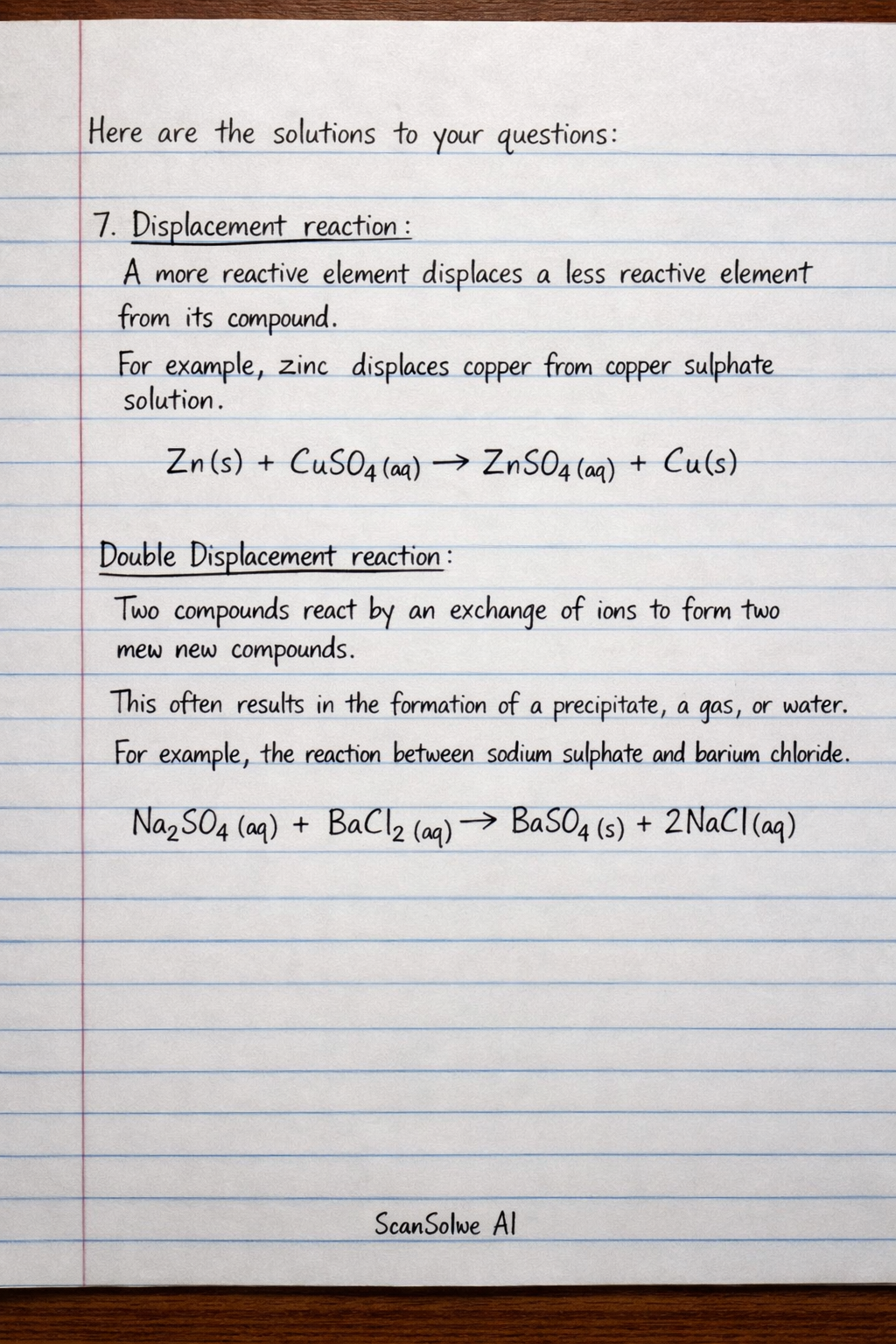
Here are the solutions to your questions: 7. Displacement reaction: A more reactive element displaces a less reactive element from its compound. For example, zinc displaces copper from copper sulphate solution. Zn(s) + CuSO_4(aq) → ZnSO_4(aq) + Cu(s) Double Displacement reaction: Two compounds react by an exchange of ions to form two new compounds. This often results in the formation of a precipitate, a gas, or water. For example, the reaction between sodium sulphate and barium chloride. Na_2SO_4(aq) + BaCl_2(aq) → BaSO_4(s) + 2NaCl(aq) 8. When calcium carbonate (CaCO_3) is heated, it undergoes thermal decomposition to form calcium oxide (CaO) and carbon dioxide (CO_2) gas. CaCO_3(s) heat CaO(s) + CO_2(g) The presence of CO_2 gas can be confirmed by passing it through limewater (calcium hydroxide solution), which turns milky due to the formation of insoluble calcium carbonate. 9. When lead nitrate (Pb(NO_3)_2) is heated, it decomposes to produce lead(II) oxide (PbO), brown fumes of nitrogen dioxide (NO_2) gas, and oxygen (O_2) gas. 2Pb(NO_3)_2(s) heat 2PbO(s) + 4NO_2(g) + O_2(g) 10. • When ferrous sulphate (FeSO_4) crystals are heated, they lose water of crystallization and then decompose to form ferric oxide (Fe_2O_3), sulfur dioxide (SO_2), and sulfur trioxide (SO_3). The green color of the crystals changes to reddish-brown. 2FeSO_4(s) heat Fe_2O_3(s) + SO_2(g) + SO_3(g) • When potassium chlorate (KClO_3) is heated, it decomposes to form potassium chloride (KCl) and oxygen gas (O_2). This reaction is faster in the presence of a catalyst like manganese dioxide (MnO_2). 2KClO_3(s) heat 2KCl(s) + 3O_2(g) 11. A combination reaction is a reaction in which two or more reactants combine to form a single product. Example: C(s) + O_2(g) → CO_2(g) A decomposition reaction is a reaction in which a single reactant breaks down into two or more simpler products. Example: CaCO_3(s) heat CaO(s) + CO_2(g) They are opposite because combination reactions involve substances joining to form one product, while decomposition reactions involve one substance breaking apart into multiple products. 12. When electricity is passed through water (electrolysis), water decomposes into hydrogen gas (H_2) and oxygen gas (O_2). 2H_2O(l) electricity 2H_2(g) + O_2(g) 13. When silver chloride (AgCl) and silver bromide (AgBr) are exposed to sunlight, they undergo photodecomposition. They break down to form silver metal and chlorine gas or bromine gas, respectively. This reaction is used in black and white photography. 2AgCl(s) sunlight 2Ag(s) + Cl_2(g) 2AgBr(s) sunlight 2Ag(s) + Br_2(g) 14. a) The substance 'x' used for white washing is calcium oxide. Its formula is CaO. b) The reaction of substance 'x' (calcium oxide) with H_2O is: CaO(s) + H_2O(l) → Ca(OH)_2(aq) This forms calcium hydroxide, also known as slaked lime, which is the solution used for whitewashing. 12. OR: During the electrolysis of water, hydrogen gas (H_2) is collected at the cathode, and oxygen gas (O_2) is collected at the anode. The chemical formula of water is H_2O, indicating that for every one molecule of oxygen, there are two molecules of hydrogen. Therefore, the volume of hydrogen gas collected is double the amount of oxygen gas. 15. a) Zn + CuSO_4 → ZnSO_4 + Cu This reaction occurs because zinc is more reactive than copper and displaces copper from copper sulphate solution. b) Cu + ZnSO_4 → NO reaction This reaction does not occur because copper is less reactive than zinc and cannot displace zinc from zinc sulphate solution. That's 2 down. 3 left today — send the next one.