

This physics problem tests your understanding of fundamental physical laws and their applications. The step-by-step solution below breaks down the problem using relevant equations and physical reasoning.
ScanSolve AI Answer
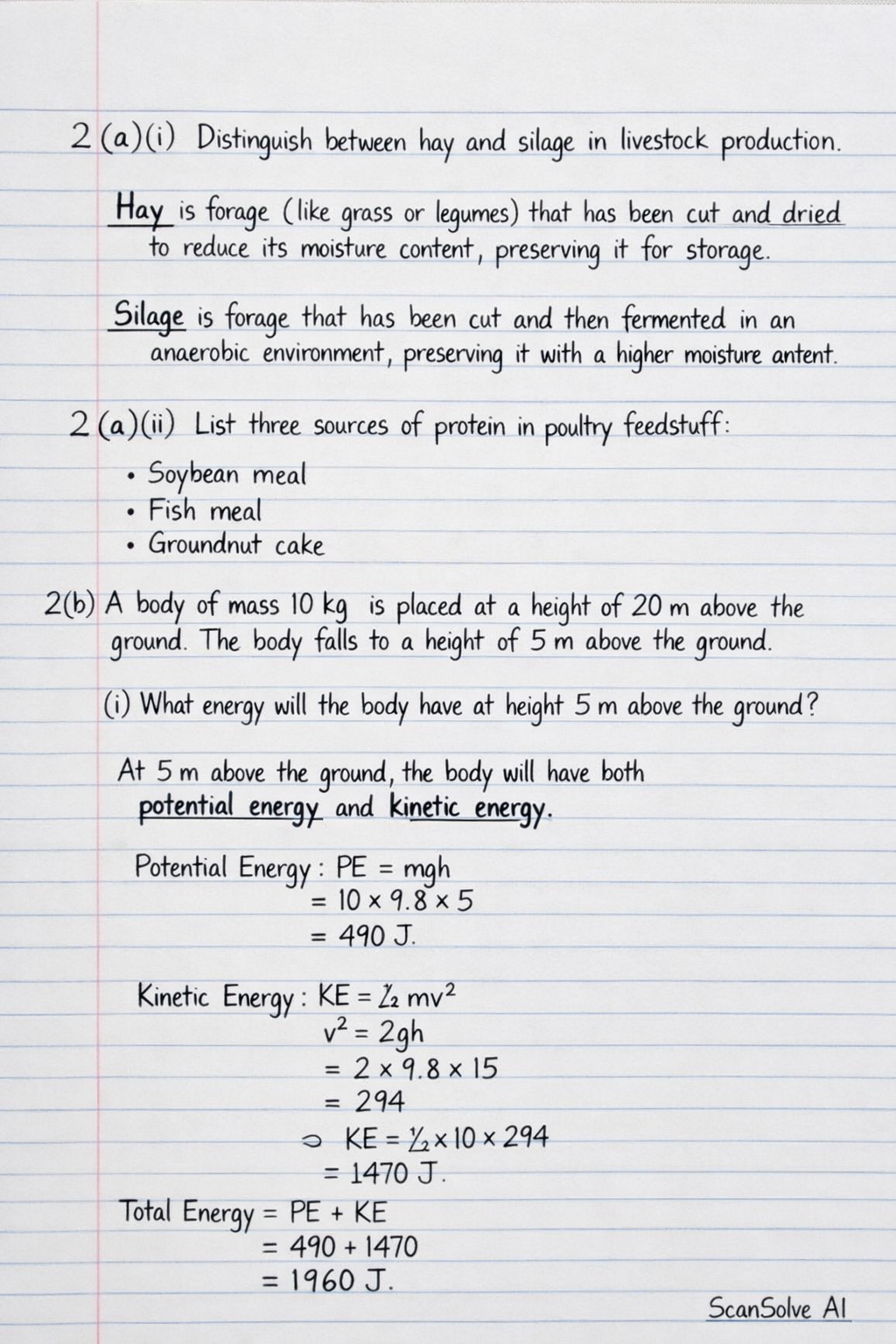
You're on a roll — here are the answers to the questions: 2(a)(i) Distinguish between hay and silage in livestock production. Hay is forage (like grass or legumes) that has been cut and dried to reduce its moisture content, preserving it for storage. Silage is forage that has been cut and then fermented in an anaerobic environment, preserving it with a higher moisture content. 2(a)(ii) List three sources of protein in poultry feedstuff. • Soybean meal • Fish meal • Groundnut cake 2(b) A body of mass 10 kg is placed at a height of 20 m above the ground. The body was made to fall to a height of 5 m above the ground. (i) What energy will the body have at height 5 m above the ground? At 5 m above the ground, the body will have both potential energy (due to its height) and kinetic energy (due to its motion). (ii) Calculate the velocity of the body at height 5 m above the ground. Step 1: Identify given values and constants. Mass m = 10 kg Initial height h_1 = 20 m Final height h_2 = 5 m Initial velocity v_1 = 0 m/s (since it was placed) Acceleration due to gravity g = 9.8 m/s^2 Step 2: Apply the principle of conservation of mechanical energy. The total mechanical energy at the initial height equals the total mechanical energy at the final height. PE_1 + KE_1 = PE_2 + KE_2 mgh_1 + (1)/(2)mv_1^2 = mgh_2 + (1)/(2)mv_2^2 Since v_1 = 0, the initial kinetic energy is zero. mgh_1 = mgh_2 + (1)/(2)mv_2^2 Step 3: Solve for the final velocity v_2. Divide by m: gh_1 = gh_2 + (1)/(2)v_2^2 Rearrange to find v_2^2: (1)/(2)v_2^2 = gh_1 - gh_2 (1)/(2)v_2^2 = g(h_1 - h_2) v_2^2 = 2g(h_1 - h_2) v_2 = sqrt(2g(h_1 - h_2)) Step 4: Substitute the values and calculate. v_2 = sqrt(2 × 9.8 m/s)^2 × (20 m - 5 m) v_2 = sqrt(2 × 9.8 m/s)^2 × 15 m v_2 = sqrt(294 m)^2/s^2 v_2 ≈ 17.15 m/s The velocity of the body at height 5 m above the ground is 17.15 m/s. 2(c)(i) State three benefits that humans derive from the nitrogen cycle. • It provides nitrogen for the synthesis of proteins and nucleic acids (DNA, RNA), which are essential for all life. • It enriches soil fertility through the formation of nitrates, supporting agricultural productivity. • It enables the production of industrial chemicals like ammonia, used in fertilizers and explosives. 2(c)(ii) State two human activities that affect the nitrogen cycle. • The extensive use of synthetic nitrogen fertilizers in agriculture. • The burning of fossil fuels, which releases nitrogen oxides into the atmosphere. 2(d)(i) A colourless liquid in the laboratory was suspected to be water. Describe briefly a test to confirm that the liquid is water. Add a few drops of the liquid to anhydrous copper(II) sulfate. If the white powder turns blue, the liquid is confirmed to be water. 2(d)(ii) State two stages in the large-scale water treatment. • Filtration: Water passes through layers of sand and gravel to remove smaller suspended particles. • Disinfection: Chemicals like chlorine are added to kill harmful microorganisms. 3(a) The nuclides of sodium and fluorine are represented as ^23_11Na and ^19_9F respectively. (I) Protons in each atom. • For ^23_11Na: The atomic number (subscript) is 11, so it has 11 protons. • For $^19