
We read your photo as:
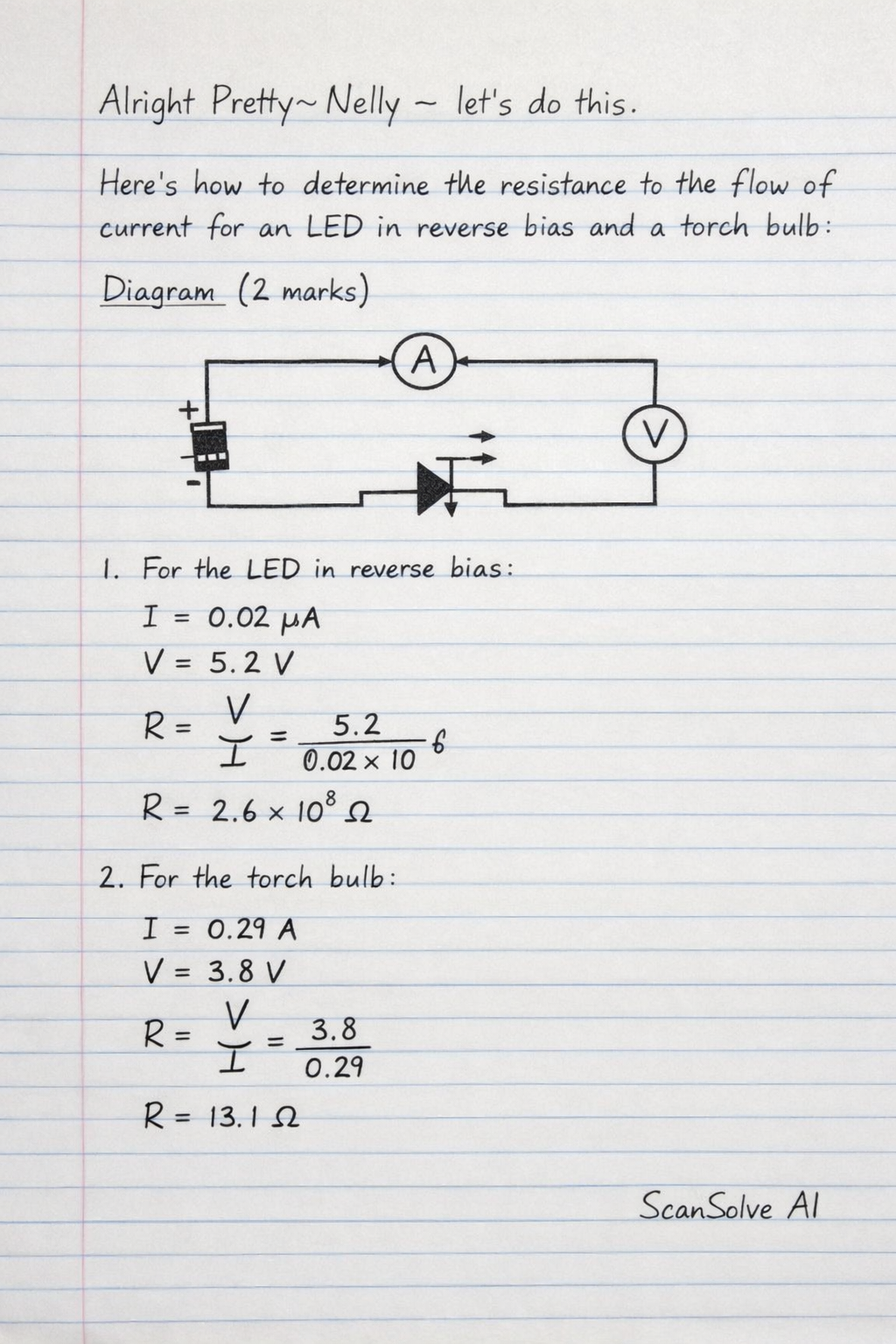
Draw a circuit diagram to measure the reverse bias resistance of an LED and a torch bulb.
ScanSolve AI Answer
Step-by-step solution
4 stepsHere's how to determine the resistance to the flow of current for an LED in reverse bias and a torch bulb:
Diagram (2 marks)
\text{
    \begin{tikzpicture}[
        thick,
        battery/.pic={
            \draw (0,0) -- (0,0.5);
            \draw (0.2,0) -- (0.2,0.5);
            \draw (0.1,0.5) -- (0.1,0.7);
            \draw (0.1,0) -- (0.1,-0.2);
            \node at (0.1,0.8) {$+$};
            \node at (0.1,-0.3) {$-$};
        },
        ammeter/.pic={
            \draw (0,0) circle (0.3);
            \node at (0,0) {A};
        },
        voltmeter/.pic={
            \draw (0,0) circle (0.3);
            \node at (0,0) {V};
        },
        led/.pic={
            \draw (0,0) -- (0.2,0);
            \draw (0.2,0) -- (0.2,0.5);
            \draw (0.2,0.5) -- (0.4,0.5);
            \draw (0.4,0.5) -- (0.4,0);
            \draw (0.4,0) -- (0.6,0);
            \draw[->] (0.3,0.6) -- (0.4,0.7);
            \draw[->] (0.2,0.7) -- (0.3,0.8);
            \node at (0.3,0.25) {$\blacktriangleright$};
            \node at (0.3,0.25) {$\vert$};
            \node at (0.1, -0.2) {Anode};
            \node at (0.5, -0.2) {Cathode};
        },
        bulb/.pic={
            \draw (0,0) circle (0.3);
            \draw (0.1,0.1) -- (-0.1,-0.1);
            \draw (0.1,-0.1) -- (-0.1,0.1);
        }
    ]
        % Main circuit
        \coordinate (P1) at (0,0);
        \coordinate (P2) at (3,0);
        \coordinate (P3) at (3,2);
        \coordinate (P4) at (0,2);

        \draw (P1) -- (P2) -- (P3) -- (P4) -- cycle;

        % DC Power Source
        \pic at (0.5,0) {battery};
        \node at (0.5, -0.5) {DC Power Source};

        % Ammeter
        \pic at (2,0) {ammeter};
        \node at (2, -0.5) {Ammeter};

        % Component (LED or Bulb)
        \draw (3,1) -- (2.5,1); % Connection to component
        \draw (0,1) -- (0.5,1); % Connection from component
        \node at (1.5,1) {Component}; % Placeholder for LED/Bulb

        % Voltmeter
        \pic at (1.5,2) {voltmeter};
        \draw (0.5,1) -- (1.5,2); % Connect to one side of component
        \draw (2.5,1) -- (1.5,2); % Connect to other side of component
        \node at (1.5, 2.5) {Voltmeter};
    \end{tikzpicture}
}
Procedure (4 marks)
Circuit Setup
Connect the DC power source, an ammeter (multimeter set to 10A DC range), and the component (either the LED or the torch bulb) in series using connecting cables and crocodile clips. Connect a voltmeter (multimeter set to 20V DC range) in parallel across the component.
LED (Reverse Bias)
- Place the LED into the circuit, ensuring it is connected in reverse bias (positive terminal of the power source connected to the cathode, and the negative terminal to the anode).
- Switch on the DC power source.
- Record the voltage reading () from the voltmeter and the current reading () from the ammeter.
- Calculate the reverse bias resistance of the LED using Ohm's Law: .
Torch Bulb
- Carefully replace the LED with the torch bulb in the same circuit.
- Switch on the DC power source.
- Record the voltage reading () from the voltmeter and the current reading () from the ammeter.
- Calculate the resistance of the torch bulb: .
Comparison
Compare the calculated values of and .
- Precaution:
- Ensure the LED is connected with the correct polarity for reverse bias to avoid damage and measure the intended resistance.
- Select the appropriate ranges on the multimeters (20V DC for voltmeter, 10A DC for ammeter) to prevent damage to the meters and ensure accurate readings.
- Make sure all connections are tight to minimize contact resistance, which could lead to inaccurate readings.
Observations (2 marks)
- When the LED is connected in reverse bias, the voltmeter will show a voltage reading, but the ammeter will show a very small, almost negligible current reading. The LED will not light up.
- When the torch bulb is connected, both the voltmeter and ammeter will show significant readings, and the torch bulb will light up.
Conclusion (2 marks)
The calculated reverse bias resistance of the LED will be extremely high, often approaching infinity, due to its diode properties preventing current flow in this direction. The calculated resistance of the torch bulb will be a finite, measurable value. Therefore, the reverse bias resistance of the LED is significantly higher than the resistance of the torch bulb.
- Precaution:
Still stuck on this one?
Ask a follow-up, and the answer starts from this question.
More Physics Questions
Handwritten Step-by-Step Solution
Get this as a handwritten image on WhatsApp — like a tutor wrote it for you.
Try on WhatsApp