

This physics problem tests your understanding of fundamental physical laws and their applications. The step-by-step solution below breaks down the problem using relevant equations and physical reasoning.
ScanSolve AI Answer
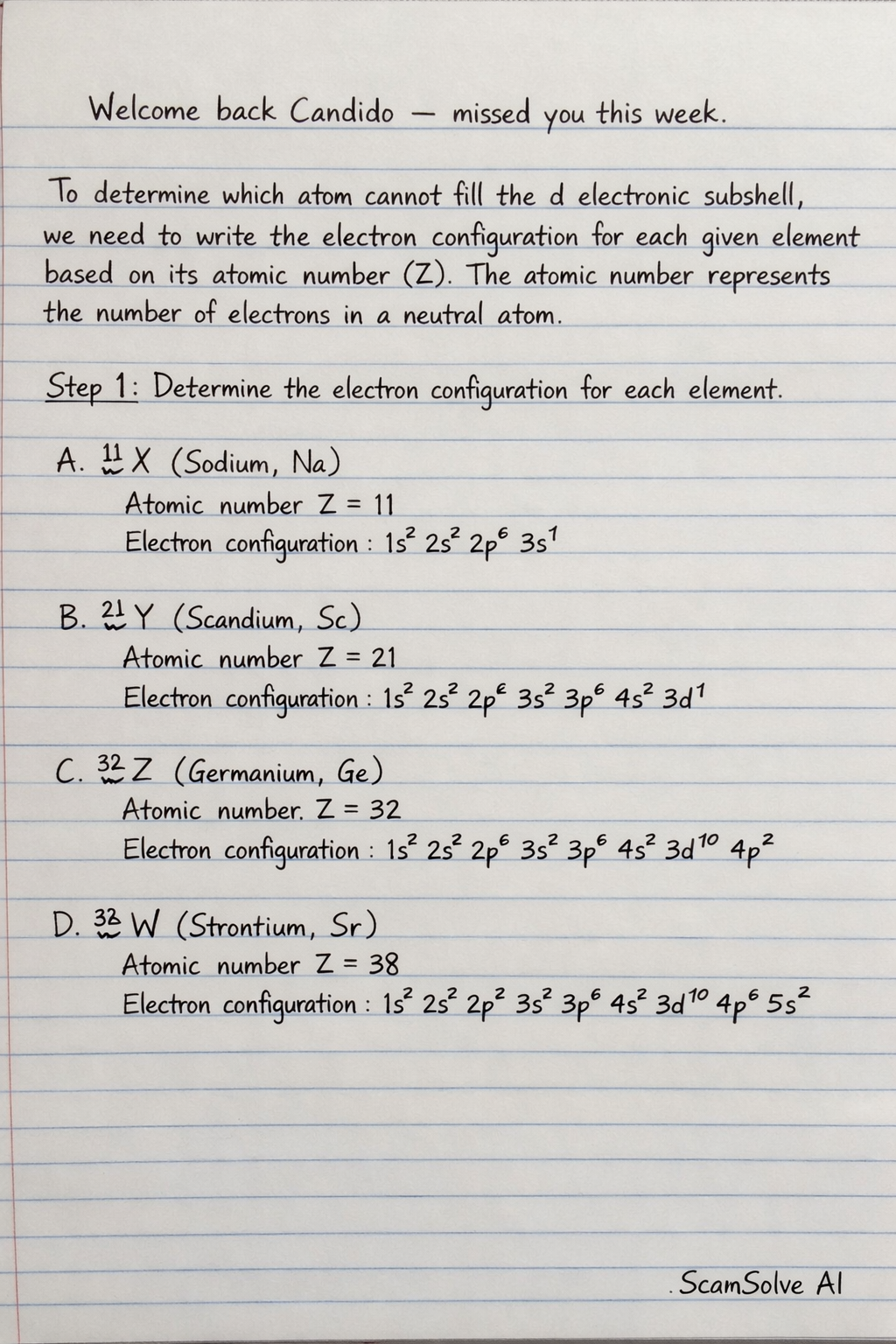
To determine which atom cannot fill the d electronic subshell, we need to write the electron configuration for each given element based on its atomic number (Z). The atomic number represents the number of electrons in a neutral atom. Step 1: Determine the electron configuration for each element. A. _11X (Sodium, Na) Atomic number Z = 11 Electron configuration: 1s^2 2s^2 2p^6 3s^1 B. _21Y (Scandium, Sc) Atomic number Z = 21 Electron configuration: 1s^2 2s^2 2p^6 3s^2 3p^6 4s^2 3d^1 C. _32Z (Germanium, Ge) Atomic number Z = 32 Electron configuration: 1s^2 2s^2 2p^6 3s^2 3p^6 4s^2 3d^10 4p^2 D. _38W (Strontium, Sr) Atomic number Z = 38 Electron configuration: 1s^2 2s^2 2p^6 3s^2 3p^6 4s^2 3d^10 4p^6 5s^2 Step 2: Analyze the presence and filling of the 'd' subshell for each element. A. _11X (Sodium): The highest occupied subshell is 3s^1. The 3d subshell is empty and significantly higher in energy, meaning it is not typically filled in the ground state or common chemical reactions of sodium. B. _21Y (Scandium): This atom has a partially filled 3d subshell (3d^1). It can* fill this subshell with more electrons (up to 3d^10). C. _32Z (Germanium): This atom has a completely filled 3d subshell (3d^10). It has* filled this subshell. D. _38W (Strontium): This atom has a completely filled 3d subshell (3d^10). It has* filled this subshell. While the 4d subshell is empty, the 3d subshell is filled. Step 3: Identify the atom that cannot fill the 'd' electronic subshell. The question asks which atom cannot fill the 'd' subshell. Among the given options, Sodium (_11X) is the only element that does not typically involve 'd' subshells in its electron configuration or chemical behavior. The 'd' subshells are not energetically accessible for filling in the same way they are for transition metals or elements in periods 4 and above. The final answer is A.