This physics problem tests your understanding of fundamental physical laws and their applications. The step-by-step solution below breaks down the problem using relevant equations and physical reasoning.
Understand the rules for quantum numbers.
Physics
ScanSolve AI Answer
Step 1: Understand the rules for quantum numbers. For a set of quantum numbers to be valid:
- The principal quantum number must be a positive integer ().
- The azimuthal quantum number must be an integer from to .
- The magnetic quantum number must be an integer from to .
- The spin quantum number must be either or .
Step 2: Evaluate each option based on these rules.
-
A.
- is valid.
- is valid (since ).
- is invalid because for , must be . The value is not allowed.
-
B.
- is valid.
- is valid (since ).
- is invalid because for , must be . The value is not allowed.
-
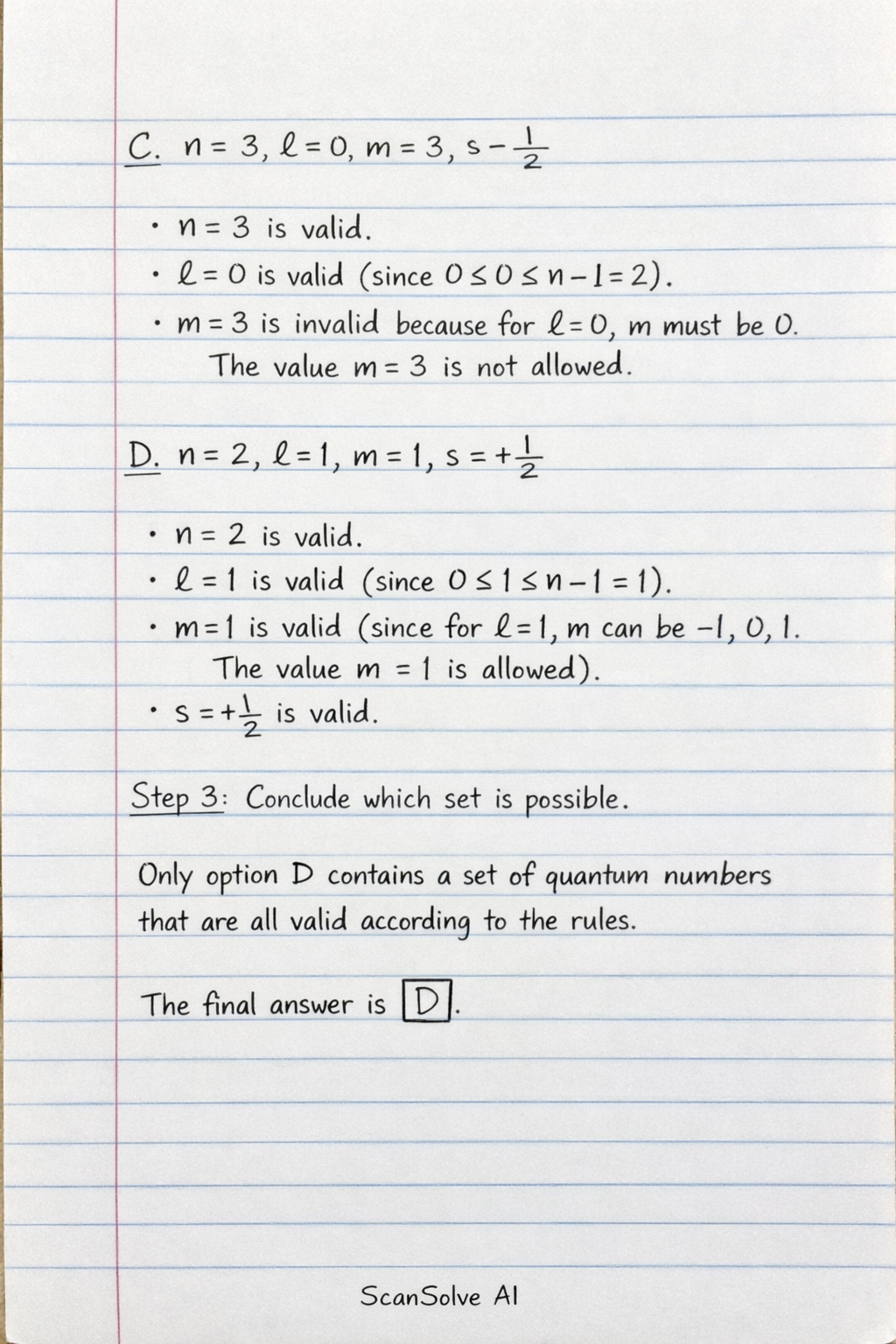
C.
- is valid.
- is valid (since ).
- is invalid because for , must be . The value is not allowed.
-
D.
- is valid.
- is valid (since ).
- is valid (since for , can be . The value is allowed).
- is valid.
Step 3: Conclude which set is possible. Only option D contains a set of quantum numbers that are all valid according to the rules.
The final answer is .
Was this helpful?
Still stuck on this one?
Ask a follow-up, and the answer starts from this question.
Got a different question?Ask your own question
More Physics Questions
QUnderstand the principal quantum number.QSignificance of quantum numbers to an electron in an atom:**QExplain Pauli's Exclusion Principle and describe the four quantum numbers and their significance.QThe quantum numbers of six electrons are given below. Arrange them in order of increasing energies.…QWhat does magnetic quantum number represents
Browse by topic:Quantum Physics

Handwritten Step-by-Step Solution
Get this as a handwritten image on WhatsApp — like a tutor wrote it for you.
Try on WhatsAppScanSolve AI Answer
Step 1: Understand the rules for quantum numbers. For a set of quantum numbers (n, l, m, s) to be valid: The principal quantum number n must be a positive integer (n 1). The azimuthal quantum number l must be an integer from 0 to n-1. The magnetic quantum number m must be an integer from -l to +l. The spin quantum number s must be either +(1)/(2) or -(1)/(2). Step 2: Evaluate each option based on these rules. A. n=2, l=0, m=2, s=-(1)/(2) n=2 is valid. l=0 is valid (since 0 0 n-1=1). m=2 is invalid* because for l=0, m must be 0. The value m=2 is not allowed. B. n=2, l=0, m=1, s=+(1)/(2) n=2 is valid. l=0 is valid (since 0 0 n-1=1). m=1 is invalid* because for l=0, m must be 0. The value m=1 is not allowed. C. n=3, l=0, m=3, s=-(1)/(2) n=3 is valid. l=0 is valid (since 0 0 n-1=2). m=3 is invalid* because for l=0, m must be 0. The value m=3 is not allowed. D. n=2, l=1, m=1, s=+(1)/(2) n=2 is valid. l=1 is valid (since 0 1 n-1=1). m=1 is valid (since for l=1, m can be -1, 0, 1. The value m=1 is allowed). s=+(1)/(2) is valid. Step 3: Conclude which set is possible. Only option D contains a set of quantum numbers that are all valid according to the rules. The final answer is D.