
Energy profile for catalysed and uncatalysed exothermic and endothermic reaction
ScanSolve AI Answer
Answer
A catalyst always lowers the activation energy for both exothermic and endothermic reactions, but it never changes the initial and final energy states, nor the overall enthalpy change.
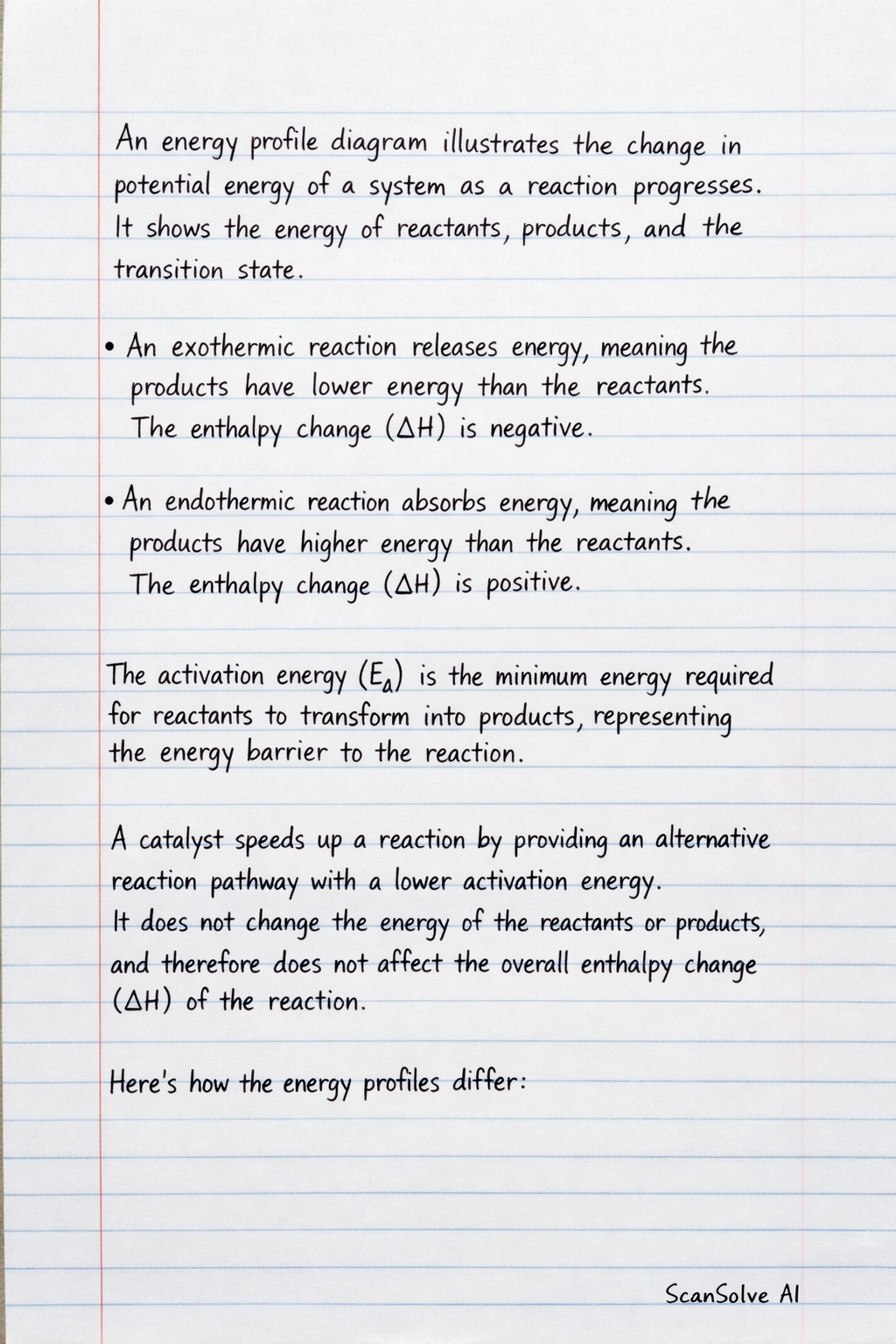
An energy profile diagram illustrates the change in potential energy of a system as a reaction progresses. It shows the energy of reactants, products, and the transition state.
- An exothermic reaction releases energy, meaning the products have lower energy than the reactants. The enthalpy change () is negative.
- An endothermic reaction absorbs energy, meaning the products have higher energy than the reactants. The enthalpy change () is positive.
The activation energy () is the minimum energy required for reactants to transform into products, representing the energy barrier to the reaction.
A catalyst speeds up a reaction by providing an alternative reaction pathway with a lower activation energy. It does not change the energy of the reactants or products, and therefore does not affect the overall enthalpy change () of the reaction.
Here's how the energy profiles differ:
-
Uncatalyzed Exothermic Reaction: The energy of the reactants is higher than the energy of the products. There is a high energy barrier (activation energy) that must be overcome for the reaction to proceed.
-
Catalyzed Exothermic Reaction: The energy of the reactants and products remains the same as the uncatalyzed reaction. However, the activation energy is significantly lowered, allowing the reaction to proceed faster. The overall energy released () is unchanged.
-
Uncatalyzed Endothermic Reaction: The energy of the reactants is lower than the energy of the products. There is a high energy barrier (activation energy) that must be overcome. Energy must be continuously supplied for the reaction to proceed.
-
Catalyzed Endothermic Reaction: The energy of the reactants and products remains the same as the uncatalyzed reaction. The activation energy is lowered, making it easier for the reaction to occur, but the overall energy absorbed () is unchanged.
Still stuck on this one?
Ask a follow-up, and the answer starts from this question.
More Physics Questions
Handwritten Step-by-Step Solution
Get this as a handwritten image on WhatsApp — like a tutor wrote it for you.
Try on WhatsApp