
Why do the gases at low temperature and high pressure show large deviations from ideal behaviour
ScanSolve AI Answer
Step-by-step solution
3 stepsRecall the assumptions of an ideal gas.
Ideal gas behavior is based on two main assumptions:
- Gas molecules themselves occupy negligible volume compared to the total volume of the container.
- There are no attractive or repulsive forces between gas molecules.
Explain deviation at high pressure.
At high pressure, gas molecules are forced much closer together. In this situation, the actual volume occupied by the gas molecules themselves becomes a significant fraction of the total container volume. Therefore, the assumption that molecules have negligible volume breaks down. Also, the close proximity of molecules allows intermolecular attractive forces to become more significant.
Explain deviation at low temperature.
At low temperature, the kinetic energy of the gas molecules is reduced. The molecules move slower, making it easier for the intermolecular attractive forces to pull them closer together. These forces are no longer negligible compared to the kinetic energy, causing the molecules to interact more strongly and deviate from ideal behavior.
The final answer is
Still stuck on this one?
Ask a follow-up, and the answer starts from this question.
More Physics Questions
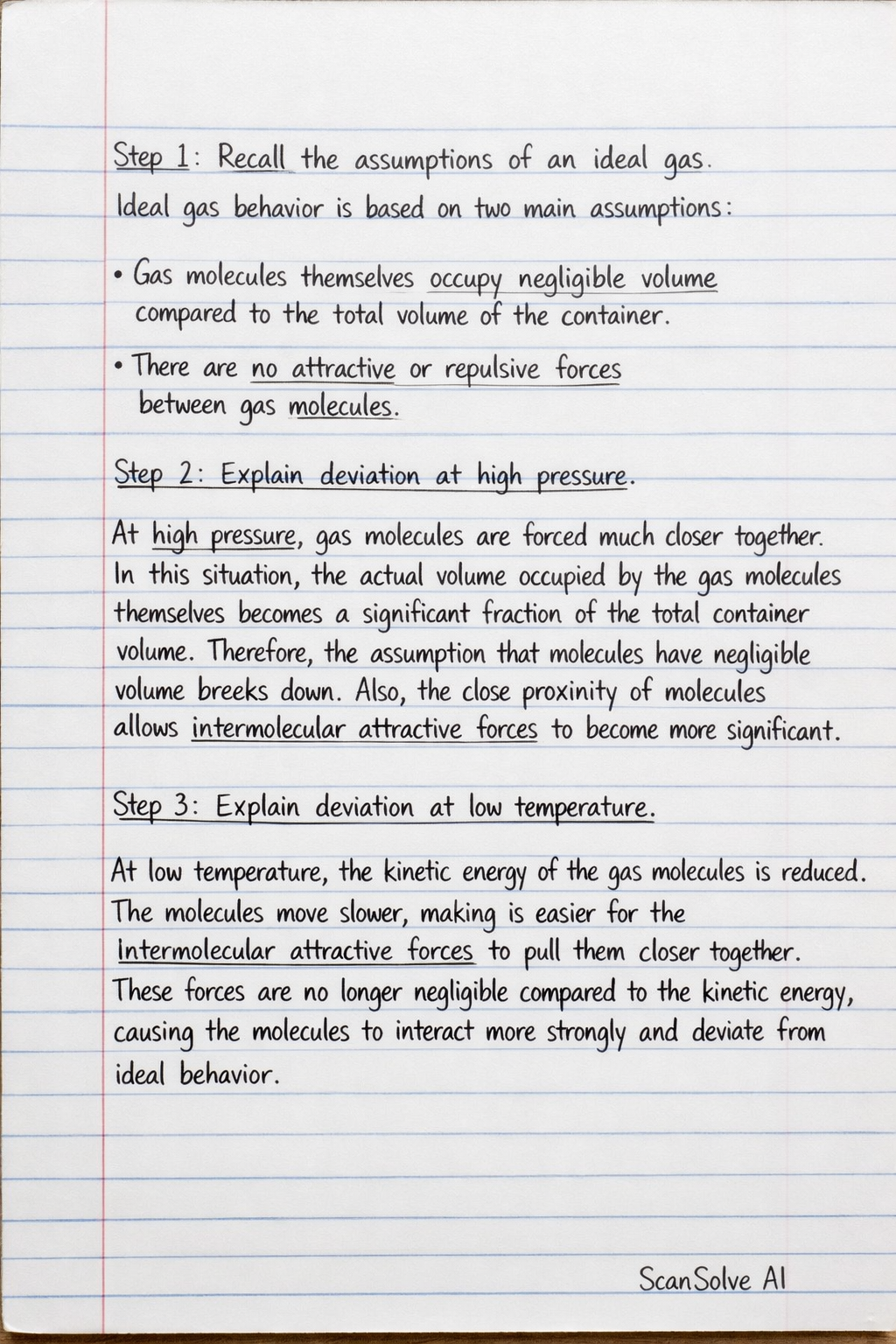
Handwritten Step-by-Step Solution
Get this as a handwritten image on WhatsApp — like a tutor wrote it for you.
Try on WhatsApp