
With the aid of diagram explain Energy profile for catalysed and uncatalysed exothermic and endothermic reaction
ScanSolve AI Answer
Answer
An energy profile diagram illustrates the change in potential energy during a chemical reaction. It plots potential energy (y-axis) against reaction progress (x-axis).
Diagram Description:
Imagine a graph with "Potential Energy" on the vertical axis and "Reaction Progress" on the horizontal axis.
- Reactants and Products: Points on the y-axis representing the initial and final energy states.
- Transition State: The highest energy point on the curve between reactants and products.
- Activation Energy (): The energy difference between the reactants and the transition state.
- Enthalpy Change (): The energy difference between the reactants and the products.
1. Exothermic Reaction (Uncatalyzed and Catalyzed):
- Uncatalyzed: The curve starts at a higher energy level (Reactants), rises to a high peak (Transition State), and then drops to a lower energy level (Products).
- The energy of the Reactants is higher than the Products.
- is the vertical distance from Reactants to Products, and it is negative (energy released).
- is the vertical distance from Reactants to the high Transition State peak.
- Catalyzed: A second curve starts at the same Reactant energy level and ends at the same Product energy level. This curve has a lower peak (Catalyzed Transition State) than the uncatalyzed one.
- is the vertical distance from Reactants to this lower peak.
- Crucially, .
- remains the same for both catalyzed and uncatalyzed reactions.
2. Endothermic Reaction (Uncatalyzed and Catalyzed):
- Uncatalyzed: The curve starts at a lower energy level (Reactants), rises to a high peak (Transition State), and then ends at a higher energy level (Products).
- The energy of the Reactants is lower than the Products.
- is the vertical distance from Reactants to Products, and it is positive (energy absorbed).
- is the vertical distance from Reactants to the high Transition State peak.
- Catalyzed: A second curve starts at the same Reactant energy level and ends at the same Product energy level. This curve has a lower peak (Catalyzed Transition State) than the uncatalyzed one.
- is the vertical distance from Reactants to this lower peak.
- Crucially, .
- remains the same for both catalyzed and uncatalyzed reactions.
In both cases, the catalyst provides an alternative reaction pathway with a lower activation energy, thus speeding up the reaction without changing the overall energy difference between reactants and products ().
Still stuck on this one?
Ask a follow-up, and the answer starts from this question.
More Physics Questions
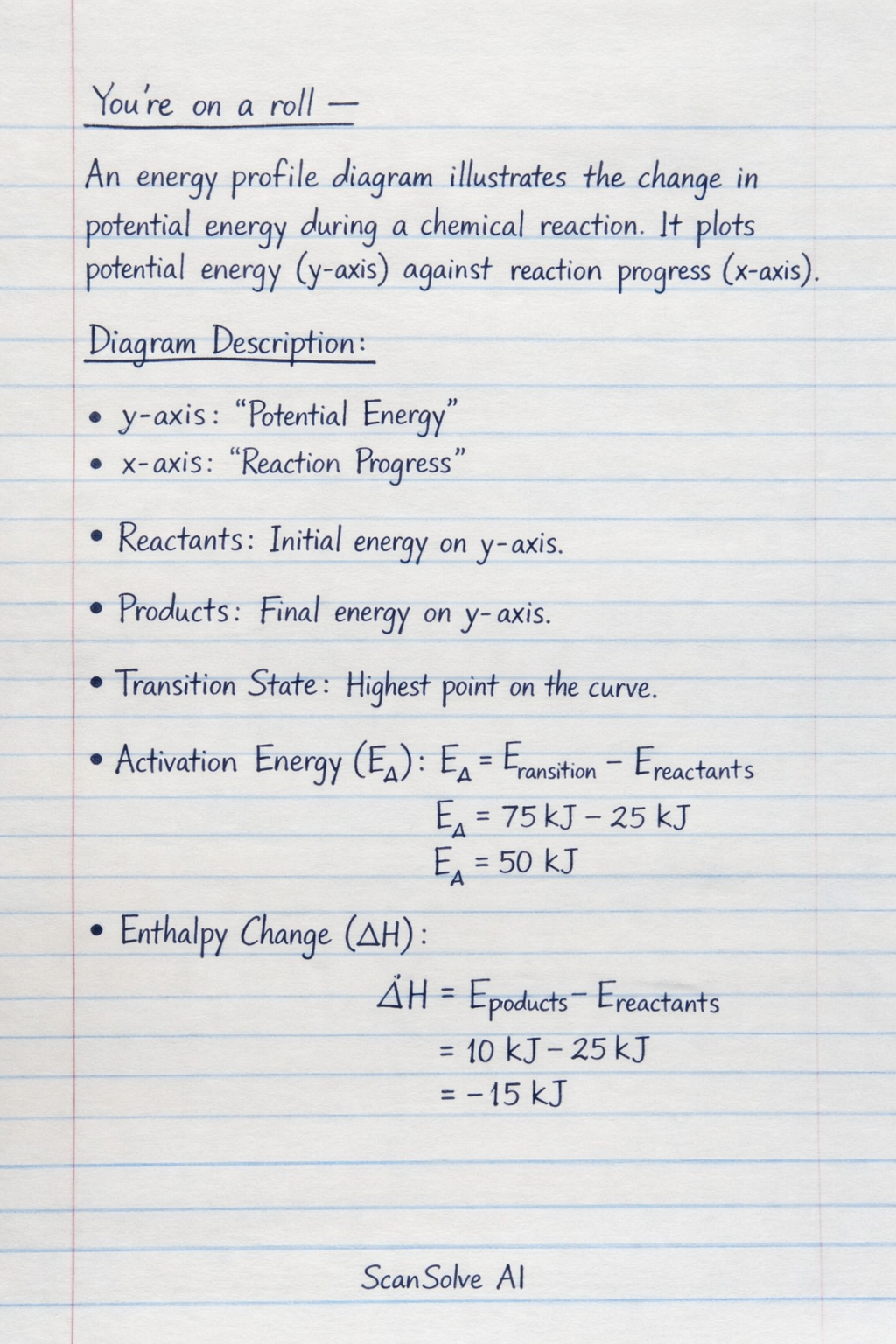
Handwritten Step-by-Step Solution
Get this as a handwritten image on WhatsApp — like a tutor wrote it for you.
Try on WhatsApp