ScanSolve logoScanSolve
Toggle sidebar
  • Homework
  • Tutor
  • Humanizer
  • AI Detector
  • Questions
  • Blog
  • History
  • Mobile App

  • Homework
  • Tutor
  • Humanizer
  • AI Detector

  • Questions
  • Math homework helpMath
    Physics homework helpPhysics
    Chemistry homework helpChemistry
    Biology homework helpBiology
    Computer Science homework helpComputer Science
    History homework helpHistory
    More homework helpMore
  • Blog
  • History

  • Mobile App
ScanSolvePLUS
  • Unlimited answers
  • ScanSolve AI Pro
Start Free Trial →
Try on WhatsApp
Physics: Determine the equivalent resistance for parallel resistors. — Step-by-Step Solution | ScanSolve
Home > Physics Homework Help > Solution

Determine the equivalent resistance for parallel resistors.

Asked on March 27, 2026|Physics

This physics problem tests your understanding of fundamental physical laws and their applications. The step-by-step solution below breaks down the problem using relevant equations and physical reasoning.

ScanSolve AI AnswerAnswered on March 27, 2026
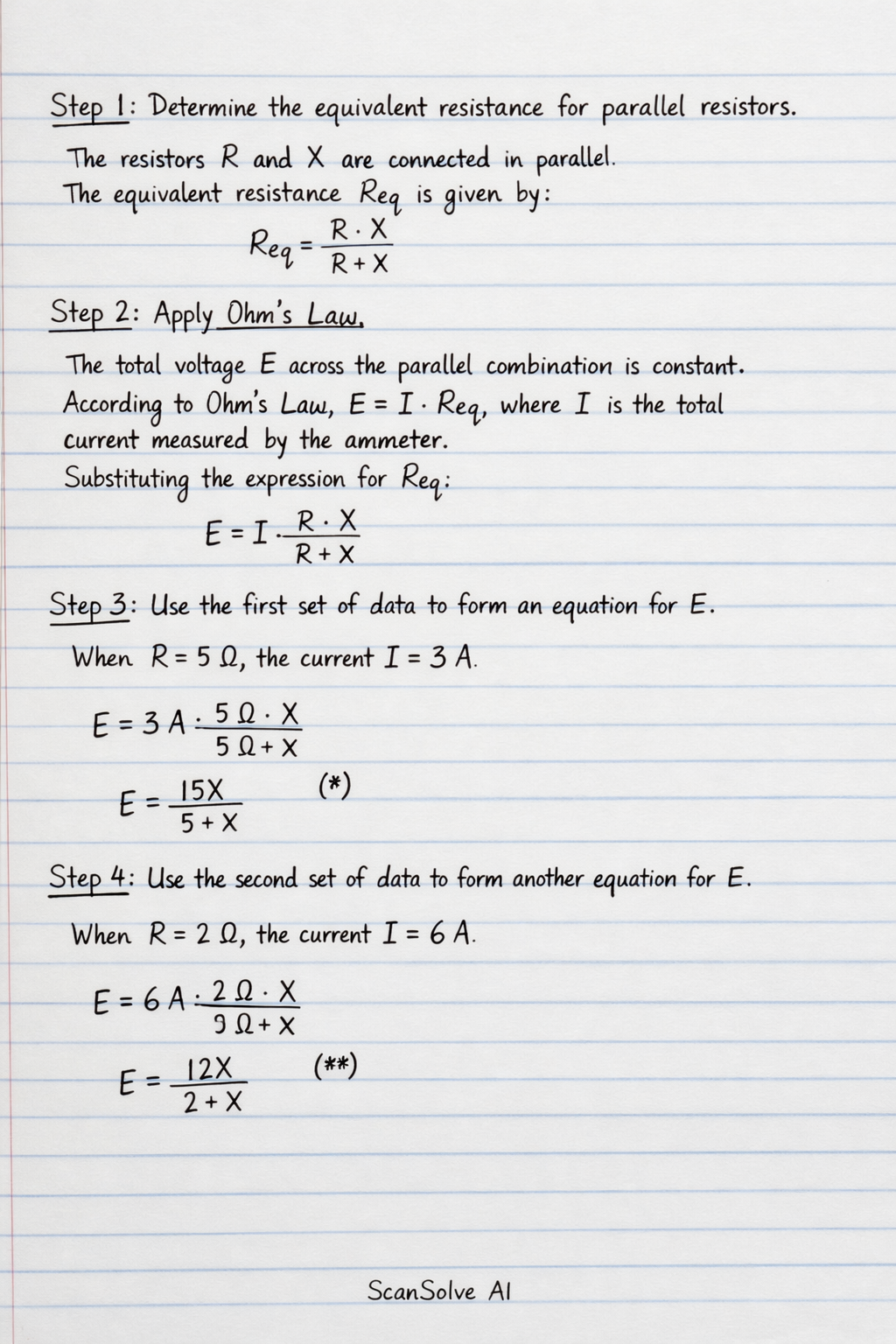
Step 1: Determine the equivalent resistance for parallel resistors. The resistors $R$ and $X$ are connected in parallel. The equivalent resistance $R_{eq}$ is given by: $$R_{eq} = \frac{R \cdot X}{R + X}$$ Step 2: Apply Ohm's Law. The total voltage $E$ across the parallel combination is constant. According to Ohm's Law, $E = I \cdot R_{eq}$, where $I$ is the total current measured by the ammeter. Substituting the expression for $R_{eq}$: $$E = I \cdot \frac{R \cdot X}{R + X}$$ Step 3: Use the first set of data to form an equation for $E$. When $R = 5 \, \Omega$, the current $I = 3 \, A$. $$E = 3 \, A \cdot \frac{5 \, \Omega \cdot X}{5 \, \Omega + X}$$ $$E = \frac{15X}{5 + X} \quad (*)$$ Step 4: Use the second set of data to form another equation for $E$. When $R = 2 \, \Omega$, the current $I = 6 \, A$. $$E = 6 \, A \cdot \frac{2 \, \Omega \cdot X}{2 \, \Omega + X}$$ $$E = \frac{12X}{2 + X} \quad (**)$$ Step 5: Equate the two expressions for $E$ and solve for $X$. Since $E$ is constant, we can set equation $()$ equal to equation $(*)$: $$\frac{15X}{5 + X} = \frac{12X}{2 + X}$$ Assuming $X \neq 0$ (as $X$ is a resistance), we can divide both sides by $X$: $$\frac{15}{5 + X} = \frac{12}{2 + X}$$ Cross-multiply: $$15(2 + X) = 12(5 + X)$$ $$30 + 15X = 60 + 12X$$ Subtract $12X$ from both sides: $$30 + 15X - 12X = 60$$ $$30 + 3X = 60$$ Subtract $30$ from both sides: $$3X = 60 - 30$$ $$3X = 30$$ Divide by $3$: $$X = \frac{30}{3}$$ $$X = 10 \, \Omega$$ The value of $X$ is $10 \, \Omega$. This corresponds to option C. The final answer is $\boxed{\text{C. 10 ohms}}$.

Related Physics Questions

  • Calculate the speed of the 1.5 kg trolley at point P using the principle of conservation of mechanical energy.
  • Identify the circuit configuration when K is closed.
  • If a device that draws 8A is used in a circuit with a 5A fuse, the current will exceed the fuse's rating. The fuse wire...
  • 151. All components of the electromagnetic spectrum in vacuum have the same
  • Define variables for their current ages.
  • What is 1+1?
See all Physics questions

This step-by-step solution was generated by ScanSolve AI. Need help with more physics problems? Browse Physics solutions or ask your own question.

Home›Physics Homework Help›Determine the equivalent resistance for parallel resistors.
Q

Determine the equivalent resistance for parallel resistors.

March 27, 2026|Physics
Determine the equivalent resistance for parallel resistors.

Determine the equivalent resistance for parallel resistors.

ScanSolve AI

ScanSolve AI Answer

Answered on March 27, 2026

Step 1: Determine the equivalent resistance for parallel resistors. The resistors RRR and XXX are connected in parallel. The equivalent resistance ReqR_{eq}Req​ is given by: Req=R⋅XR+XR_{eq} = \frac{R \cdot X}{R + X}Req​=R+XR⋅X​

Step 2: Apply Ohm's Law. The total voltage EEE across the parallel combination is constant. According to Ohm's Law, E=I⋅ReqE = I \cdot R_{eq}E=I⋅Req​, where III is the total current measured by the ammeter. Substituting the expression for ReqR_{eq}Req​: E=I⋅R⋅XR+XE = I \cdot \frac{R \cdot X}{R + X}E=I⋅R+XR⋅X​

Step 3: Use the first set of data to form an equation for EEE. When R=5 ΩR = 5 \, \OmegaR=5Ω, the current I=3 AI = 3 \, AI=3A. E=3 A⋅5 Ω⋅X5 Ω+XE = 3 \, A \cdot \frac{5 \, \Omega \cdot X}{5 \, \Omega + X}E=3A⋅5Ω+X5Ω⋅X​ E=15X5+X(∗)E = \frac{15X}{5 + X} \quad (*)E=5+X15X​(∗)

Step 4: Use the second set of data to form another equation for EEE. When R=2 ΩR = 2 \, \OmegaR=2Ω, the current I=6 AI = 6 \, AI=6A. E=6 A⋅2 Ω⋅X2 Ω+XE = 6 \, A \cdot \frac{2 \, \Omega \cdot X}{2 \, \Omega + X}E=6A⋅2Ω+X2Ω⋅X​ E=12X2+X(∗∗)E = \frac{12X}{2 + X} \quad (**)E=2+X12X​(∗∗)

Step 5: Equate the two expressions for EEE and solve for XXX. Since EEE is constant, we can set equation (∗)(*)(∗) equal to equation (∗∗)(**)(∗∗): 15X5+X=12X2+X\frac{15X}{5 + X} = \frac{12X}{2 + X}5+X15X​=2+X12X​ Assuming X≠0X \neq 0X=0 (as XXX is a resistance), we can divide both sides by XXX: 155+X=122+X\frac{15}{5 + X} = \frac{12}{2 + X}5+X15​=2+X12​ Cross-multiply: 15(2+X)=12(5+X)15(2 + X) = 12(5 + X)15(2+X)=12(5+X) 30+15X=60+12X30 + 15X = 60 + 12X30+15X=60+12X Subtract 12X12X12X from both sides: 30+15X−12X=6030 + 15X - 12X = 6030+15X−12X=60 30+3X=6030 + 3X = 6030+3X=60 Subtract 303030 from both sides: 3X=60−303X = 60 - 303X=60−30 3X=303X = 303X=30 Divide by 333: X=303X = \frac{30}{3}X=330​ X=10 ΩX = 10 \, \OmegaX=10Ω

The value of XXX is 10 Ω10 \, \Omega10Ω. This corresponds to option C.

The final answer is C.10ohms\boxed{C. 10 ohms}C.10ohms​.

Need help with your own homework?

Get instant step-by-step solutions to any question. Free to start.

Ask Your Question
Handwritten step-by-step solution

Handwritten Step-by-Step Solution

Get this solution as a handwritten image on WhatsApp — just like a tutor wrote it for you.

Try on WhatsApp

More Physics Questions

Calculate the speed of the 1.5 kg trolley at point P using the principle of conservation of mechanic…Identify the circuit configuration when K is closed.If a device that draws 8A is used in a circuit with a 5A fuse, the current will exceed the fuse's ra…151. All components of the electromagnetic spectrum in vacuum have the sameDefine variables for their current ages.What is 1+1?
See all Physicsquestions →