

This physics problem tests your understanding of fundamental physical laws and their applications. The step-by-step solution below breaks down the problem using relevant equations and physical reasoning.
ScanSolve AI Answer
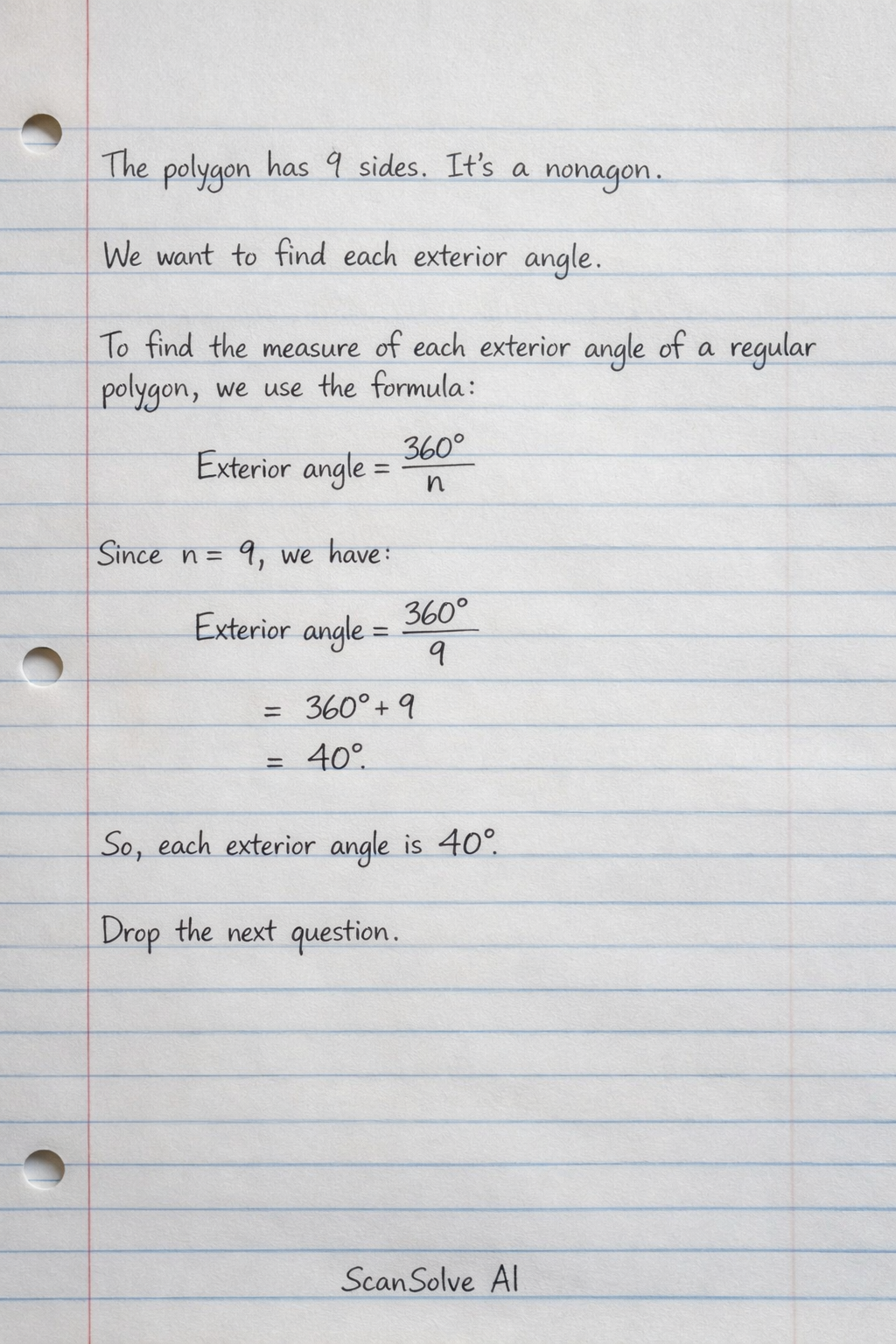
The convex polygon described in the problem has 9 sides, which means it is a nonagon. Picture-wise, a convex nonagon is a closed shape with 9 straight line segments as its sides. All its interior angles are less than 180^, meaning it doesn't have any "dents" or inward-pointing vertices. If it's a regular convex nonagon (as implied by the question asking for "each exterior angle"), all 9 sides are of equal length, and all 9 interior angles are equal (each measuring 140^), and all 9 exterior angles are equal (each measuring 40^). It looks like a symmetrical 9-pointed star if you connect the vertices in a specific way, but as a polygon, it's just the outer boundary. Drop the next question.