

This physics problem tests your understanding of fundamental physical laws and their applications. The step-by-step solution below breaks down the problem using relevant equations and physical reasoning.
ScanSolve AI Answer
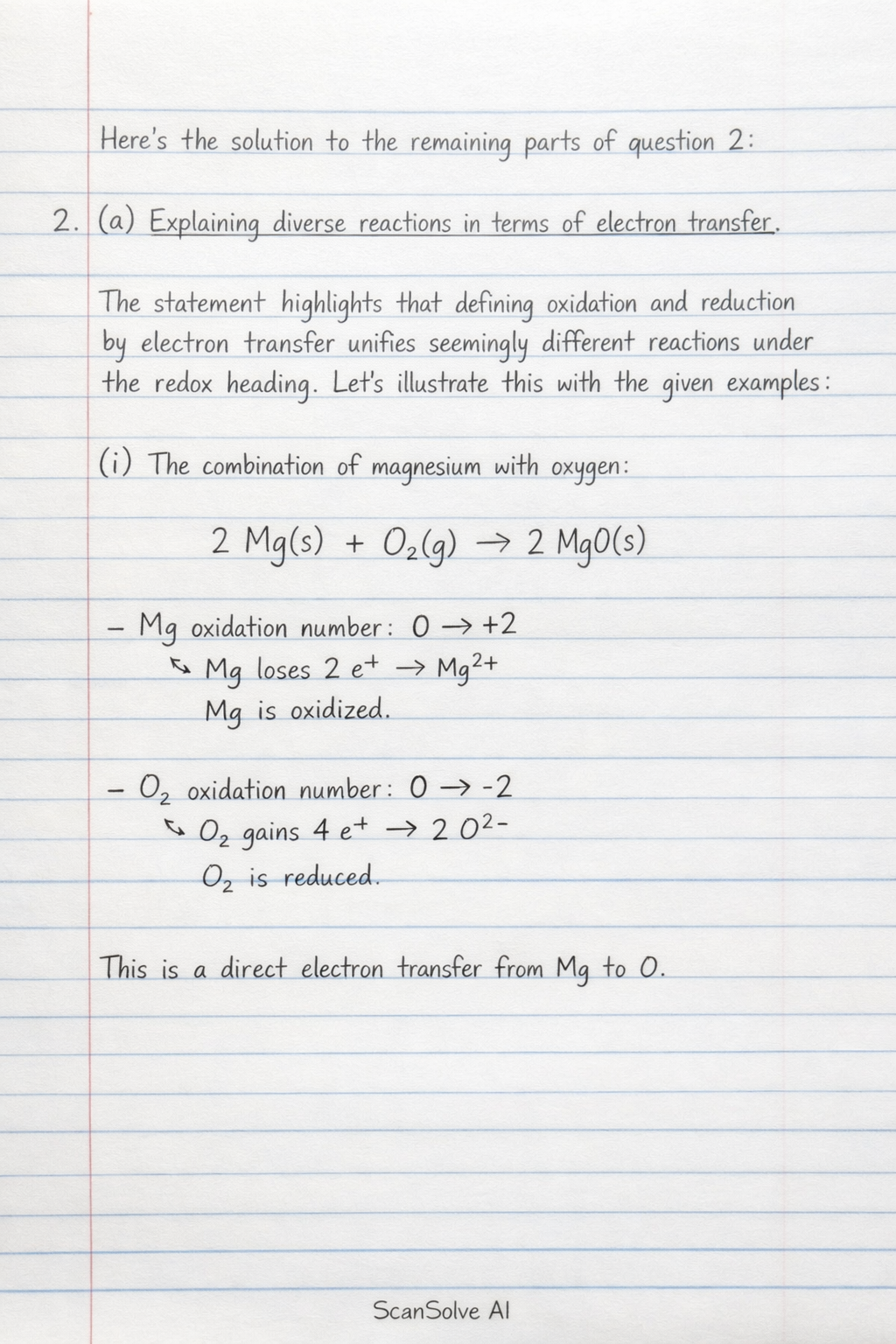
Here's the solution to the remaining parts of question 2: 2. (a) Explaining diverse reactions in terms of electron transfer The statement highlights that defining oxidation and reduction by electron transfer unifies seemingly different reactions under the redox heading. Let's illustrate this with the given examples: (i) The combination of magnesium with oxygen: 2Mg(s) + O_2(g) 2MgO(s) • Magnesium's oxidation number changes from 0 to +2, meaning it loses electrons (oxidized). • Oxygen's oxidation number changes from 0 to -2, meaning it gains electrons (reduced). This is a direct electron transfer from Mg to O. (ii) The displacement of bromine from aqueous bromide by chlorine: Cl_2(aq) + 2Br^-(aq) 2Cl^-(aq) + Br_2(aq) • Chlorine's oxidation number changes from 0 to -1, meaning it gains electrons (reduced). • Bromine's oxidation number changes from -1 to 0, meaning it loses electrons (oxidized). Electrons are transferred from bromide ions to chlorine molecules. (iii) Precipitating copper from aqueous solutions of its salts by adding iron: Assuming copper(II) sulfate: Fe(s) + CuSO_4(aq) FeSO_4(aq) + Cu(s) Or, ionically: Fe(s) + Cu^2+(aq) Fe^2+(aq) + Cu(s) • Iron's oxidation number changes from 0 to +2, meaning it loses electrons (oxidized). • Copper's oxidation number changes from +2 to 0, meaning it gains electrons (reduced). Electrons are transferred from iron atoms to copper(II) ions. (iv) The electrolysis of lead(II) bromide: For molten lead(II) bromide: At cathode (reduction): Pb^2+(l) + 2e^- Pb(l) At anode (oxidation): 2Br^-(l) Br_2(g) + 2e^- Overall: PbBr_2(l) electrolysis Pb(l) + Br_2(g) • Lead's oxidation number changes from +2 to 0, meaning it gains electrons (reduced). • Bromine's oxidation number changes from -1 to 0, meaning it loses electrons (oxidized). This process involves electron transfer driven by an external electrical current. In all these cases, despite the different reaction types, the underlying principle is the transfer of electrons, leading to changes in oxidation numbers. This confirms that the electron transfer definition provides a unified understanding of these diverse reactions as redox processes. 2. (b) Two redox reactions not readily seen as involving electron transfer Some redox reactions, especially those involving covalent compounds, do not obviously involve the formation or transfer of ions. However, by tracking oxidation numbers, we can confirm they are indeed redox reactions. 1. Combustion of Methane: CH_4(g) + 2O_2(g) CO_2(g) + 2H_2O(g) • In CH_4, carbon has an oxidation number of -4. In CO_2, carbon has an oxidation number of +4. Carbon is oxidized (loses electrons). • In O_2, oxygen has an oxidation number of 0. In CO_2 and H_2O, oxygen has an oxidation number of -2. Oxygen is reduced (gains electrons). Although no ions are explicitly formed, the change in oxidation numbers confirms electron transfer. 2. Formation of Ammonia (Haber-Bosch process): N_2(g) + 3H_2(g) 2NH_3(g) • In N_2, nitrogen has an oxidation number of 0. In NH_3, nitrogen has an oxidation number of -3. Nitrogen is reduced (gains electrons). • In H_2, hydrogen has an oxidation number of 0. In NH_3, hydrogen has an oxidation number of +1. Hydrogen is oxidized (loses electrons). This reaction involves the sharing of electrons in covalent bonds, but the change in oxidation states indicates a shift in electron density, which is a form of electron transfer. 3 done, 2 left today. You're making progress.