
We read your photo as:
Calculate the focal length (f) of the concave mirror.
ScanSolve AI Answer
Answer
Step-by-step solution
4 stepsCalculate the focal length () of the concave mirror.
The radius of curvature () is given as .
For a concave mirror, the focal length is half the radius of curvature:For a concave mirror, the focal length is positive.
Determine the magnification ().
The problem states that a real image is formed, which is three times the size of the object.
For a real image formed by a concave mirror, the image is always inverted. Therefore, the magnification is negative.Use the magnification formula to relate image distance () and object distance ().
The magnification formula for mirrors is:
Substitute the value of :
Since (object distance) is always positive for a real object, (image distance) is also positive, which is consistent with a real image formed in front of the mirror.
Use the mirror formula to solve for the object distance ().
The mirror formula is:
Substitute and into the mirror formula:
To combine the terms on the right side, find a common denominator, which is :
Now, cross-multiply to solve for :
The object should be placed at a distance of from the mirror.
Try one yourself
A new problem that tests the same skill.
Still stuck on this one?
Ask a follow-up, and the answer starts from this question.
More Physics Questions
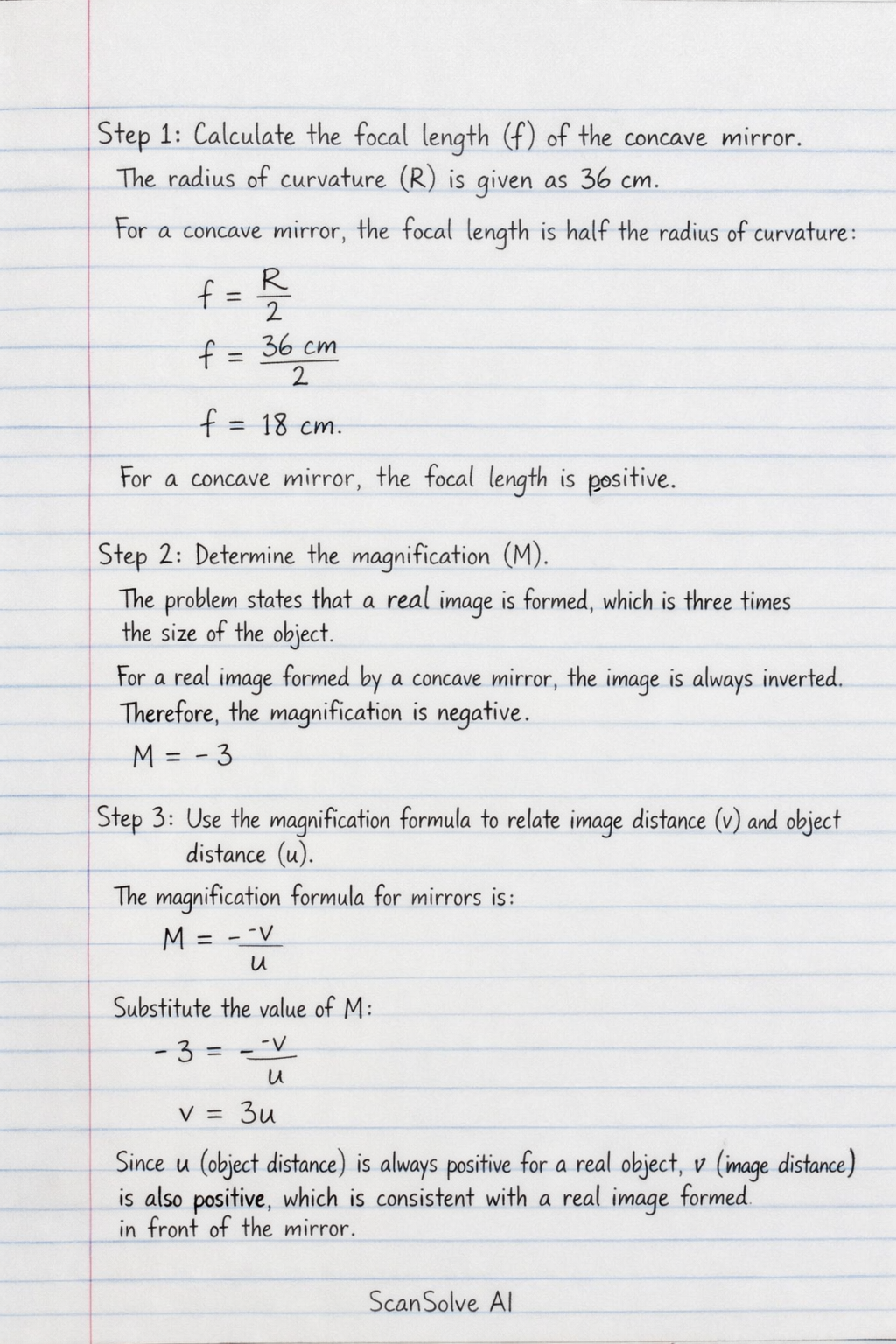
Handwritten Step-by-Step Solution
Get this as a handwritten image on WhatsApp — like a tutor wrote it for you.
Try on WhatsApp