
For an ideal solution made up of benzene and methylbenzene. given that the mole fraction of benzene at different concentration are 0, 0.25, 0.5, 0.75 and 1. find the respective mole fractions of methylbenzene at this concentration. Calculate the respective vapour pressure contribution of benzene at this concentration
ScanSolve AI Answer
Step-by-step solution
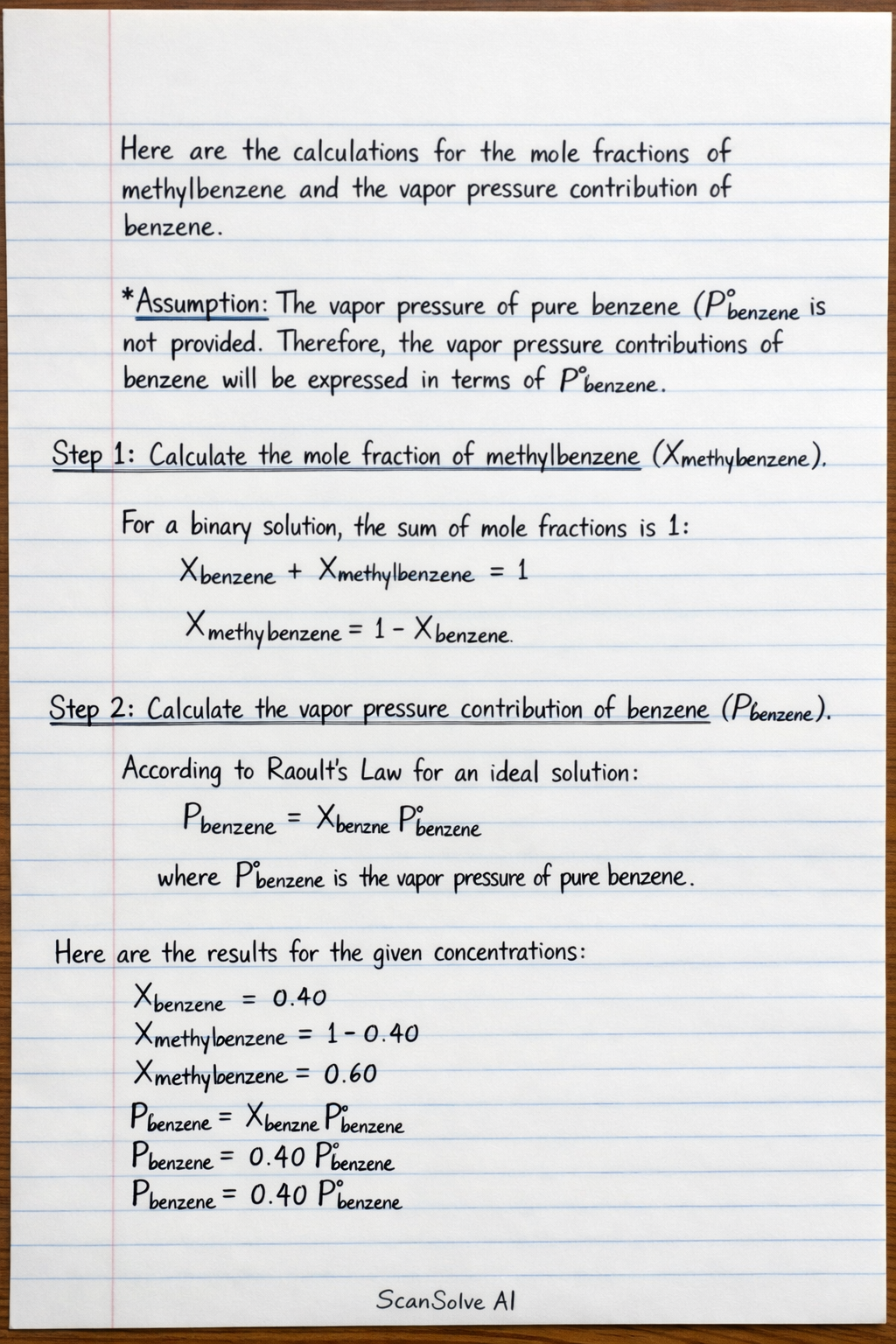
2 stepsHere are the calculations for the mole fractions of methylbenzene and the vapor pressure contribution of benzene.
Assumption: The vapor pressure of pure benzene () is not provided. Therefore, the vapor pressure contributions of benzene will be expressed in terms of .
Calculate the mole fraction of methylbenzene ().
For a binary solution, the sum of mole fractions is 1:
Therefore, .
Calculate the vapor pressure contribution of benzene ().
According to Raoult's Law for an ideal solution:
where is the vapor pressure of pure benzene.
Here are the results for the given concentrations:
(Vapor Pressure Contribution) 0 0.25 0.5 0.75 1 The respective mole fractions of methylbenzene are 1, 0.75, 0.5, 0.25, 0.
The respective vapor pressure contributions of benzene are 0, , , , .
Still stuck on this one?
Ask a follow-up, and the answer starts from this question.
More Physics Questions
Handwritten Step-by-Step Solution
Get this as a handwritten image on WhatsApp — like a tutor wrote it for you.
Try on WhatsApp